
If you are searching for self-improvement, personal development, or life-strategy books under the name “Chris Christensen,” you are almost certainly looking for the late Harvard Business School professor Clayton Christensen. While there are other individuals named Chris Christensen—such as the well-known travel podcaster or the founder of a popular dog grooming brand—it is Clayton Christensen’s groundbreaking work, particularly his seminal book How Will You Measure Your Life?, that serves as the definitive guide for personal development, resource allocation, and long-term fulfillment.
Finding the right starting point among his works depends entirely on your current personal and professional challenges. Rather than offering superficial life hacks, his books apply rigorous, battle-tested business models to the human experience. By understanding how these organizational frameworks translate to your personal life, you can make strategic decisions that align your daily actions with your deepest values.
Understanding the Core Philosophy Before You Choose
To appreciate why these books are so highly regarded in the self-improvement space, you must first understand the foundational philosophy that underpins them. Clayton Christensen did not set out to write conventional self-help books filled with generic motivational platitudes. Instead, he observed that many of his brilliant Harvard Business School classmates—who went on to achieve immense professional success, wealth, and power—were deeply unhappy, divorced, estranged from their children, or even embroiled in legal crises. This led him to realize that while these high-achievers knew how to apply strategic planning to multi-billion-dollar corporations, they failed to apply those same strategic principles to their own lives.
Products mentioned in this guide
![[eBook] Clayton M. Christensen - Disrupting Class (2010)](https://img.lazcdn.com/g/p/e67e8c34beea760f3496e6247782772f.jpg_400x400q80.jpg_.webp)
Prices are valid at publication and may change. Please refer to the product page for the latest price.
His core framework relies on the idea that your life is a complex organization that requires careful management of limited resources. Time, energy, talent, and capital are finite assets that you must allocate daily. If you do not manage these resources intentionally, your default behavior will be to channel them into areas that provide the fastest, most tangible feedback, such as career advancement or financial gain, while starving the long-term, high-value areas of your life, such as family, health, and personal ethics.
Another pillar of his philosophy is the concept of “marginal thinking.” In business, managers often make decisions based on marginal costs and marginal revenues, which can lead to long-term ruin when disruptive competitors emerge. In personal life, marginal thinking manifests as the belief that “just this once” is an acceptable compromise to your moral standards or personal relationships. Christensen argues that it is far easier to hold to your principles 100% of the time than it is to hold to them 98% of the time.
This philosophy is particularly relevant for ambitious professionals, students preparing to enter highly competitive industries, and anyone standing at a personal or professional crossroads. If you are trying to navigate a demanding career while maintaining your personal integrity and building deep, lasting relationships, this structured, analytical approach to self-improvement will resonate deeply with your mindset.
How to Match Your Current Life Stage to the Right Book
Choosing where to begin requires an honest assessment of your current life stage, your emotional readiness, and the specific pain points you are experiencing. Many professionals in fast-paced environments face intense pressure to perform, which often leads to career stagnation, chronic work-life imbalance, or a persistent sense of unfulfillment despite external success. Identifying which of these challenges is most pressing will guide you to the correct text.

First, evaluate your primary personal development goals. If you are experiencing a crisis of purpose—perhaps you have achieved your career milestones but still feel empty or disconnected from your family—you need a high-level philosophical framework to re-evaluate your life metrics. This requires a willingness to engage in deep introspection and ask hard questions about what truly matters to you.
Second, consider your capacity for implementing change. If you are overwhelmed by a chaotic schedule and struggle with daily execution, procrastination, or poor routines, you may benefit more from analytical frameworks that help you dissect why you engage in certain behaviors. Alternatively, if you are facing a major career transition, such as a promotion, a pivot to a new industry, or the launch of a new business venture, you require a strategic model that helps you manage risks, evaluate emergent opportunities, and allocate your professional resources wisely.
Finally, align your choice with your preferred reading format and time commitment. High-level strategic books require slow, reflective reading, often accompanied by journaling or note-taking. More tactical business-oriented texts can be consumed faster but demand active intellectual effort to translate corporate case studies into personal action plans. Consider whether you prefer a physical book for quiet evening study, an e-book for reading on your daily MRT commute, or an audiobook to listen to during active periods.
Recommended Chris Christensen Books by Self-Improvement Goal
To help you select the perfect starting point, the following recommendations analyze Clayton Christensen’s most influential works through the lens of personal development. Each book is matched to a specific self-improvement goal, detailing its core premise, why it fits that objective, the ideal reader profile, and its inherent limitations.
For Finding Purpose and Defining Life Metrics
How Will You Measure Your Life? is the primary recommendation for anyone seeking meaning, long-term vision, or a systematic way to evaluate their life choices. Co-authored with James Allworth and Karen Dillon, this book expands on a highly acclaimed speech Christensen delivered to the graduating class at Harvard Business School. It is the only book in his bibliography dedicated entirely to personal development and life strategy.
This book fits the goal of finding purpose because it directly addresses the conflict between short-term achievements and long-term fulfillment. Christensen uses Herzberg’s Motivation-Hygiene theory to explain that financial compensation, job security, and status are merely “hygiene factors”—they prevent dissatisfaction but do not create true happiness. True motivation comes from intrinsic factors like personal growth, meaningful work, and responsibility. The book details how the resource allocation process functions in our personal lives, warning that we naturally over-invest in our careers because they offer immediate, tangible rewards (like a closed deal or a promotion), while we under-invest in our relationships because the payoff takes years to materialize.
This book is best for individuals who feel unfulfilled despite achieving external milestones, mid-career professionals struggling with work-life balance, and young graduates planning their long-term life strategy. It is also an invaluable read for parents who want to understand how to build a supportive, values-driven family culture.
The primary limitation of this book is that it is highly philosophical and reflective. It does not provide a simplistic checklist or a step-by-step daily routine. Instead, it offers a set of rigorous questions and frameworks that require you to do the hard work of self-reflection to find your own answers.
For Building Better Habits and Daily Systems
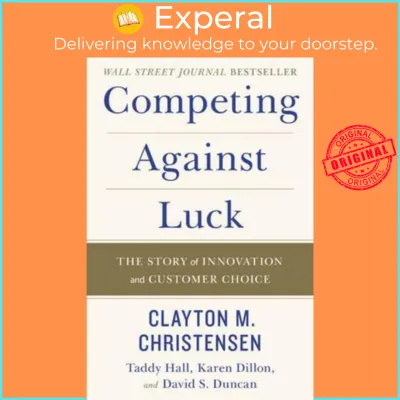
Competing Against Luck: The Story of Innovation and Customer Choice is the ideal starting point for readers focused on productivity, routine optimization, and understanding human behavior. Co-authored with Taddy Hall, Karen Dillon, and David S. Duncan, this book is primarily known as a business text that introduces the “Jobs to Be Done” (JTBD) framework, but its core principles are incredibly powerful when applied to personal habit-building.
The “Jobs to Be Done” theory posits that customers do not simply buy products; they “hire” them to do a specific job in their lives. When applied to self-improvement, this framework helps you understand why you “hire” certain habits, both positive and negative. For example, you do not just scroll through social media mindlessly; you “hire” that behavior to fulfill a specific emotional or social job, such as relieving stress or feeling connected during a break. By diagnosing the functional, emotional, and social dimensions of the jobs your habits are performing, you can design better daily systems and substitute unproductive habits with constructive ones that fulfill those same underlying needs.
This book is best for readers who struggle with consistency, procrastination, or time management, and who prefer an analytical, systems-based approach to behavioral change rather than relying solely on willpower.
Its main limitation is that because the book is written from a business perspective—using corporate case studies like how a fast-food chain optimized its milkshake sales—you must actively do the intellectual translation to apply these organizational concepts to your personal daily routines and habit-building strategies.
For Navigating Career Transitions and Professional Growth
The Innovator’s Dilemma: When New Technologies Cause Great Firms to Fail is the definitive recommendation for readers looking to apply strategic business principles to their career trajectory and professional growth. This classic text introduced the concept of disruptive innovation, explaining how outstanding companies can do everything “right” yet still lose their market leadership when disruptive technologies emerge.
This book fits the goal of career transition because the dynamics that cause massive corporations to fail are identical to the dynamics that cause individual careers to stagnate. Just as established firms focus entirely on their current high-margin customers and ignore small, low-margin disruptive opportunities, professionals often focus exclusively on their current high-paying career track while ignoring emerging skills or disruptive industry shifts. Reading this book helps you understand how to manage your personal portfolio of skills, when to pivot, and how to balance “deliberate strategy” (maximizing your current career path) with “emergent strategy” (allocating a portion of your personal resources to unexpected, high-potential opportunities).
This book is best for mid-career professionals, tech sector workers, entrepreneurs, and anyone facing a career pivot or industry disruption who needs a strategic framework to evaluate risks and future-proof their career.
The limitation of this book is its academic and technical density. It is filled with highly detailed, historical industry analyses—such as the evolution of disk drive manufacturers and mechanical excavator companies—which may feel dry or overly complex to casual readers seeking quick, conversational career advice.
What to Check Before Buying: Editions, Formats, and Local Availability
When you are ready to purchase these books, taking the time to verify the format, edition, and local availability will ensure you get the most out of your reading experience. Because these titles are highly sought-after international publications, navigating your purchasing options carefully is essential.
First, select the format that best matches your lifestyle and reading habits:
- Physical Books: Hardcovers and paperbacks are highly recommended for Christensen's works. His books contain structured diagrams, business matrices, and conceptual charts that are much easier to study, highlight, and annotate in print. Having a physical copy on your desk or bookshelf also serves as a visual reminder to reflect on your life metrics.
- E-books: Digital versions (such as EPUB formats for e-readers) are incredibly convenient for those who utilize their daily commutes on the MRT or buses to read. They allow you to carry multiple dense texts without adding weight to your bag and make it easy to search for specific strategic terms or highlight key passages.
- Audiobooks: Audio versions are excellent for busy professionals who prefer to absorb these concepts while walking through local parks, exercising, or doing household chores. However, because these books rely on complex business models, you may need to pair the audiobook with a physical notebook to jot down your reflections.
Second, verify the edition details before buying. How Will You Measure Your Life? was published in 2012; ensure you are purchasing the complete, authorized edition from reputable publishers (such as HarperBusiness) rather than unauthorized summaries, study guides, or abridged versions that omit the crucial business case studies and personal anecdotes.
Third, check local availability. In Singapore, major brick-and-mortar bookstores like Books Kinokuniya (especially the flagship store at Ngee Ann City, which maintains an extensive selection of international business and self-improvement titles) or Popular Bookstore are excellent places to find these books. If you prefer online shopping, verify stock and shipping times on authorized online book retailers.
Finally, keep price variations in mind. Imported English paperbacks in Singapore typically range from S$18 to S$35, while hardcovers can cost upwards of S$40 to S$50. Always check the bookstore’s local website to verify current stock levels and prices in SGD before making a physical trip, and be aware of potential international shipping fees or GST applications if ordering from overseas distributors.
Frequently Asked Questions (FAQ)
Do I need to read these books in chronological order?
No, you do not need to read these books in any specific chronological order. Each of Clayton Christensen’s books is entirely standalone and built around a distinct strategic framework. If your primary goal is to find personal purpose and evaluate your life decisions, you should start directly with How Will You Measure Your Life?. If you are focused on optimizing your daily habits and routines, you can jump straight into Competing Against Luck. Choose the book that addresses the specific challenges you are currently facing in your life.
Are audiobooks as effective as the physical books for these concepts?
Audiobooks are highly effective for capturing the narrative flow, personal anecdotes, and high-level concepts of Christensen’s work during your daily commute or exercise. However, because his books rely heavily on structured business models, visual diagrams, and deep self-reflection exercises, many readers find that physical books or e-books are superior for active study. To get the maximum benefit, you might consider listening to the audiobook first for inspiration, and then purchasing a physical copy to highlight, annotate, and systematically apply the frameworks to your life.
Community discussion
Share your experience or ask a question. Comments are reviewed before publication.