
Choosing the right Ghostfire cable for your beginner guitar setup depends on matching the cable’s physical connectors, length, and shielding to your specific instrument, amplifier, and playing environment. As a beginner, you do not need the most expensive professional-grade touring cable, but you must avoid low-quality cords that introduce unwanted hum, signal dropouts, or physical strain on your guitar’s internal electronics. By understanding how plug shapes, cable materials, and shielding types interact with your gear, you can select a reliable cable that preserves your tone and withstands daily practice.
Your guitar setup is only as strong as its weakest link, and the cable is the vital bridge between your instrument’s pickups and your amplifier. A mismatched or poorly constructed cable can result in a muddy tone, annoying background buzz, or intermittent crackling that disrupts your practice sessions. Selecting the correct Ghostfire cable involves evaluating your physical space, your guitar’s input jack design, and your future playing goals to ensure a seamless, noise-free connection.
Identify Your Guitar and Amp Connection Needs
Before looking at specific cable models, you must examine the physical layout of your guitar and amplifier. The most immediate decision is choosing between straight and right-angle plugs. Guitar input jacks generally fall into two categories: side-mounted and top-mounted. If your guitar has a side-mounted jack, such as on a Les Paul style or many acoustic-electric models, a right-angle plug is highly beneficial. It allows the cable to profile closely against the guitar body, reducing the leverage of any accidental tugs and preventing the connector from bending or breaking if you sit down while playing.
Products mentioned in this guide
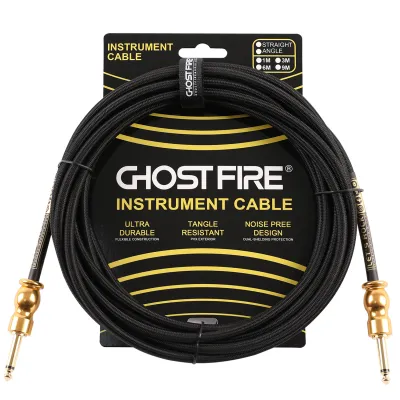
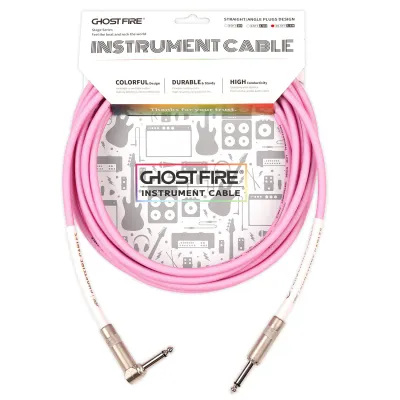
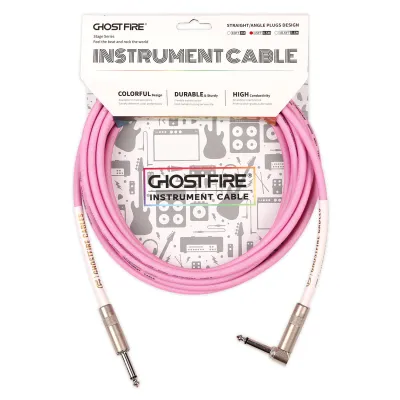
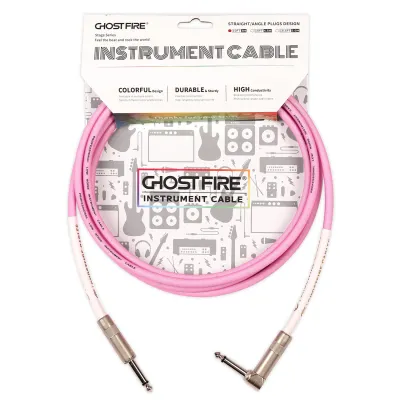
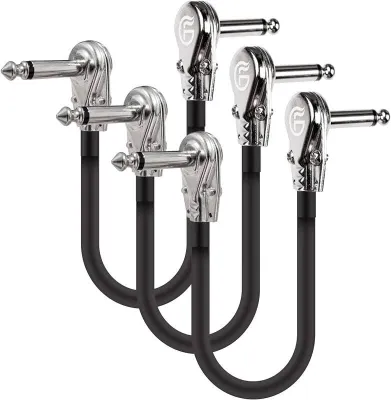
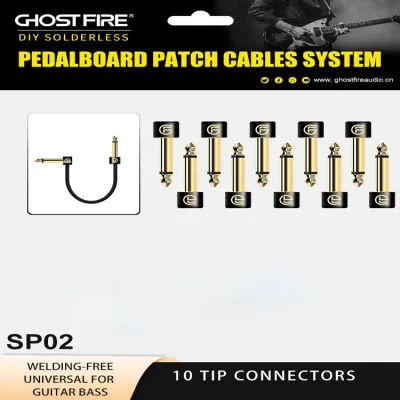
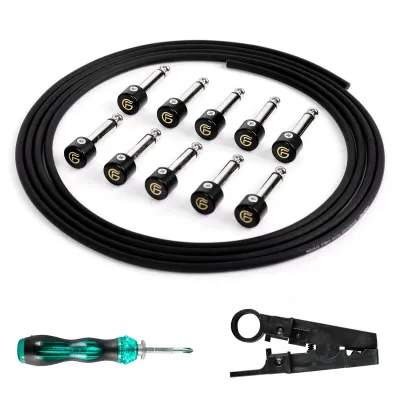
Prices are valid at publication and may change. Please refer to the product page for the latest price.
Conversely, if your guitar features a top-mounted or recessed jack, such as the angled input on a Stratocaster style body, a straight plug is usually necessary. A right-angle plug may not insert fully into a recessed jack, preventing a secure electrical connection or scratching the surrounding finish. For your amplifier connection, a straight plug is typically preferred for front-panel inputs to keep the cable hanging naturally, while a right-angle plug can keep rear-panel connections tidy and prevent the amplifier from being pushed against a wall and damaging the cable.
You must also distinguish between standard TS (Tip-Sleeve) instrument cables and TRS (Tip-Ring-Sleeve) balanced cables. Electric guitars output an unbalanced, high-impedance mono signal, which requires a standard TS cable. Using a TRS cable for a standard guitar-to-amp connection is unnecessary and can sometimes cause signal routing issues or silent outputs in certain active pickup systems. Ensuring you select a TS instrument cable prevents impedance mismatches and guarantees that your guitar’s signal is routed correctly to the amplifier’s input stage.
Finally, check the physical clearance around your guitar’s input jack. Some recessed or deeply inset jacks have narrow openings that cannot accommodate oversized or heavily molded connector housings. If the metal barrel or rubber strain relief of the cable is too thick, it will prevent the plug from seating fully, leading to a weak connection, signal loss, or physical damage to the jack assembly. Checking this clearance ensures that your chosen cable fits snugly without putting mechanical strain on your guitar’s internal wiring.
Core Specifications to Evaluate in Ghostfire Cables
Understanding the technical specifications of Ghostfire cables helps you interpret product labels and choose a cable that preserves your guitar’s natural tone. The first critical specification is cable length and its relationship with capacitance. All instrument cables act as natural capacitors, storing a small amount of electrical charge. The longer the cable, the higher the total capacitance, which acts as a low-pass filter that rolls off high-frequency treble frequencies. For a beginner, keeping your cable under six meters (approximately twenty feet) is ideal to prevent noticeable high-end signal loss and maintain a bright, clear tone.

Shielding is another essential factor that determines how quiet your setup will be. Instrument cables are susceptible to electromagnetic interference (EMI) and radio frequency interference (RFI) from household appliances, mobile phones, and fluorescent lighting. Look for cables that specify high-coverage shielding, such as braided or spiral copper shields. Braided shielding offers excellent coverage and physical strength, making it highly resistant to noise, though it is slightly stiffer. Spiral shielding is more flexible and cost-effective, which is excellent for light home use but can separate slightly over time with heavy bending.
The outer jacket material dictates how the cable behaves when handled and stored. Common materials include traditional polyvinyl chloride (PVC) and woven tweed or fabric jackets. PVC jackets are highly durable, easy to wipe clean, and resistant to moisture, which is particularly useful in humid climates where mold and dampness can affect stored gear. Woven fabric jackets offer a classic aesthetic and are highly resistant to tangling, but they can collect dust and are harder to clean if they drag across dirty floors.
Flexibility and memory are also key handling characteristics. A cable with “high memory” tends to retain the loops and kinks from how it was packaged, making it difficult to lay flat on the floor and increasing the risk of tripping. A highly flexible, low-memory cable coils easily using the over-under method and lies flat during use. Checking the manufacturer’s specifications for jacket flexibility and core construction will save you from the frustration of fighting with a stiff, tangled cord during every practice session.
Match Cable Features to Your Playing Scenarios
Your primary playing environment should dictate the specific features you prioritize when selecting a cable. A bedroom player has vastly different physical and electrical requirements than someone performing on a stage or tracking clean signals in a home studio.
Bedroom Practice and Casual Jamming
For home practice in confined spaces, such as a typical bedroom or study, a shorter cable is almost always the superior choice. A cable length of three meters (about ten feet) is usually more than enough to connect your guitar to a small practice amplifier or audio interface. Using a shorter cable minimizes the physical clutter on your floor, reducing tripping hazards and preventing your amplifier from being accidentally pulled off a desk or shelf. It also ensures that your signal remains strong and free from high-frequency degradation.
In a home environment, you will likely coil and uncoil your cable frequently to keep your space tidy. Therefore, prioritize cables with highly flexible jackets and low-memory designs. A cable that easily relaxes and lies flat will prevent loops from catching on chair legs or desk corners. Look for robust, molded strain reliefs at the connector joints, as home cables are frequently subjected to tight bends when playing while seated on a bed or sofa.
Rehearsals and First Live Gigs
When you transition from the bedroom to a shared rehearsal studio or your first live performance, your cable requirements change. You will need a longer cable, typically five to six meters (fifteen to twenty feet), to allow you to move around the stage or stand comfortably away from your amplifier. This extra length gives you the freedom to perform without feeling anchored to a single spot, but it must be balanced with high-quality construction to prevent signal loss over the longer distance.
Stage environments are filled with electromagnetic noise from lighting rigs, PA systems, and other musicians’ gear. To combat this, you must choose a cable with high-coverage braided shielding to ensure a low noise floor, especially if you use high-gain distortion pedals or amplifiers. Additionally, stage cables must be incredibly rugged. Look for connectors with heavy-duty metal housings and reinforced spring or rubber strain reliefs that can withstand being stepped on, run over by gear cases, and repeatedly plugged and unplugged.
Basic Home Recording
If you are setting up a basic home studio to record your guitar directly into an audio interface, signal purity is your absolute priority. When recording a dry direct-injection (DI) signal for software amp simulators, any noise or high-frequency loss introduced by the cable will be amplified by the software. For this scenario, look for low-capacitance specifications to preserve the sharp transient response and high-end clarity of your guitar’s pickups.
The quality of the connector plating also plays a significant role in a studio environment. Gold-plated connectors offer excellent resistance to corrosion and oxidation, which is highly beneficial for maintaining a clean, crackle-free connection over years of use, especially in humid climates. Ensure the cable has a high-density shield to block out computer monitor hum and power supply interference, allowing you to capture the cleanest possible take without relying heavily on digital noise gates.
Verify Authenticity and Warranty Coverage
As a beginner, it is easy to fall victim to counterfeit or substandard cables sold on unregulated online marketplaces. To ensure you are getting a genuine Ghostfire cable that meets the manufacturer’s safety and performance standards, you must verify the product’s authenticity before purchasing. Inspect the packaging carefully upon arrival; genuine products typically feature high-quality printing, clear branding, holographic security seals, or unique serial numbers that can be verified on the manufacturer’s website.
Before completing your purchase, cross-reference the seller against the authorized dealer list on the official Ghostfire website. Buying from unauthorized third-party sellers on generic ecommerce platforms increases the risk of receiving a counterfeit product made with inferior copper, poor shielding, and weak solder joints. Purchasing from an authorized source guarantees that you receive a genuine product and protects your investment.
Finally, take the time to understand the warranty terms offered with your cable. Many reputable cable manufacturers offer extended or lifetime warranties against manufacturing defects, such as a failed solder joint or a broken internal connection. However, these warranties almost always exclude physical wear and tear, accidental damage, or modifications made by the user. Knowing what is covered—and keeping your purchase receipt in a safe place—ensures that you can easily obtain a replacement if your cable fails due to a factory defect.
Frequently Asked Questions (FAQ)
Do I need a special Ghostfire cable for an acoustic-electric guitar?
No, you do not need a specialized cable for an acoustic-electric guitar. Most acoustic-electric guitars feature active pickup systems with built-in preamps powered by a battery, which output a low-impedance signal that is highly compatible with standard TS instrument cables. A standard Ghostfire TS cable will work perfectly to connect your acoustic-electric guitar to an acoustic amplifier, PA system, or direct box.
However, you must be cautious about cable length if your acoustic guitar uses a passive pickup system, such as a passive piezo transducer without an onboard preamp. Passive pickups output a very high-impedance signal that is highly sensitive to cable capacitance. Using an unnecessarily long cable run (over six meters) with a passive pickup will quickly load down the signal, resulting in a dull, muddy tone lacking in high-end sparkle. Keep your cable runs as short as possible to preserve the natural acoustic tone.
Can I use a Ghostfire instrument cable as a speaker cable?
No, you must never use an instrument cable as a speaker cable. Doing so can cause severe and expensive damage to your amplifier and speaker cabinet. Although instrument cables and speaker cables often look identical from the outside and both use 1/4-inch plugs, their internal construction and electrical properties are completely different and designed for entirely different tasks.
An instrument cable is designed to carry low-voltage, high-impedance signals from your guitar’s pickups to an amplifier. It uses a very thin inner conductor wire surrounded by a shield to block noise. A speaker cable, on the other hand, must carry high-voltage, high-current signals from an amplifier’s power stage to a speaker. It uses two thick, unshielded wires to handle the heavy electrical load. If you use a thin instrument cable for this purpose, the wire can overheat, melt, short-circuit, and destroy your amplifier’s output transformer.
How often should a beginner replace their guitar cables?
There is no fixed time-based schedule for replacing a guitar cable; instead, you should replace or repair your cable based on observable physical and auditory warning signs. A high-quality cable can last for many years if handled properly, while a cable subjected to rough treatment can fail within months. You should inspect your cable regularly for signs of degradation.
Auditory warning signs include loud crackling or popping sounds when you move, intermittent signal loss when the cable is wiggled near the connectors, or a sudden increase in background hum. Physical warning signs include visible tears or kinks in the outer jacket, loose connector barrels, or a bent metal plug. Before discarding a suspected faulty cable, you can use a digital multimeter or a dedicated cable tester to check for continuity and short circuits, which can help you determine if the issue is a simple loose connection that can be resoldered or if the cable requires complete replacement.
Community discussion
Share your experience or ask a question. Comments are reviewed before publication.