
Selecting the ideal Korg tuner requires matching the device’s physical design to your instrument’s output signal, your performance environment, and your specific tuning accuracy requirements. Whether you are performing on a brightly lit stage, tracking in a quiet recording studio, or practicing in a crowded rehearsal room, Korg offers distinct form factors optimized for these scenarios. Choosing the wrong type can lead to slow pitch tracking, signal degradation, or physical damage to your instrument’s finish.
To make the right choice, you must evaluate how the tuner receives the pitch signal—whether through a direct cable connection, physical surface vibrations, or an acoustic microphone. Pedal tuners offer seamless signal chain integration and hands-free muting for electric musicians. Clip-on tuners provide lightweight, cable-free convenience by sensing physical vibrations directly from the instrument’s body. Handheld and desktop tuners serve as versatile studio workhorses, combining high-sensitivity microphones with dedicated input and output jacks for multi-instrumentalists.
Quick Match: Korg Tuner Types by Instrument and Scenario
To simplify your decision, the following matrix matches the three primary Korg tuner form factors with their optimal instruments, environments, and core technical drivers.
Products mentioned in this guide
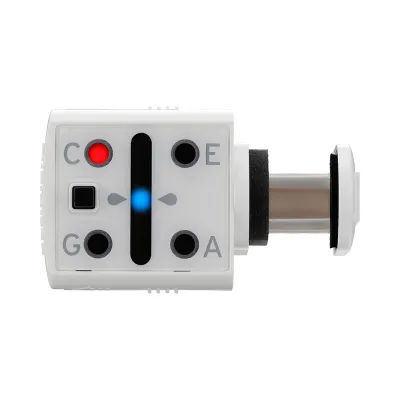

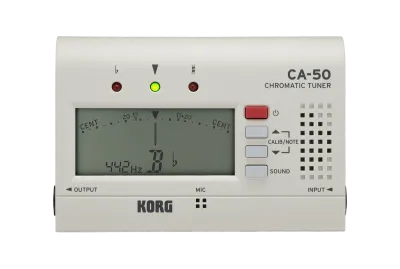
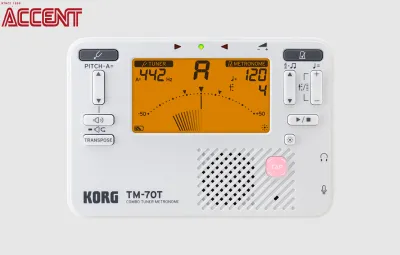


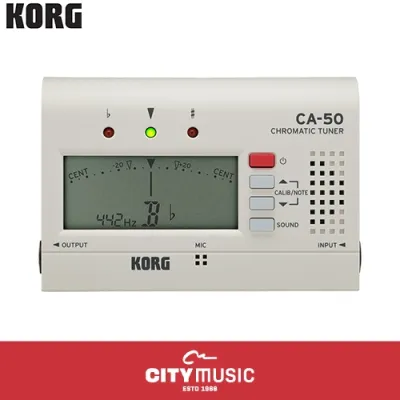

Prices are valid at publication and may change. Please refer to the product page for the latest price.
| Tuner Type | Primary Instruments | Ideal Environment | Core Decision Driver | Primary Connection |
|---|---|---|---|---|
| Pedal Tuner | Electric Guitar, Bass, Electro-Acoustic | Live Stages, Concert Halls, Pedalboards | Signal chain integration, silent muting, high visibility | 1/4" TS Instrument Cable |
| Clip-On Tuner | Acoustic Guitar, Ukulele, Violin, Brass | Rehearsal Rooms, Orchestra Pits, Home Practice | Physical vibration sensing, compact discretion | Piezoelectric Clamp (No Cable) |
| Handheld / Desktop | Synthesizers, Keyboards, Brass, Woodwinds | Recording Studios, Music Classrooms, Quiet Rooms | Acoustic microphone precision, multi-routing | Built-in Microphone or 1/4" / 3.5mm Jack |
Your primary decision driver should dictate which category you explore first. If your instrument uses a magnetic or active pickup and you perform live, a pedal tuner is the industry standard for maintaining an uninterrupted, clean signal path. If you play an acoustic or orchestral instrument, a clip-on tuner bypasses ambient room noise by measuring structural resonance. For complex synthesizer rigs, keyboard setups, or acoustic instruments in controlled environments, a handheld or desktop unit provides the necessary routing flexibility and built-in microphone precision.
Pedal Tuners: The Standard for Electric Instruments and Live Stages
For electric guitarists and bassists, the tuner is almost always the very first device in the signal chain. Korg’s pedal tuners, such as the long-running Pitchblack series, are engineered specifically to handle low-impedance and high-impedance instrument signals while offering robust road-ready chassis designs. The primary benefit of a pedal tuner is its ability to mute your signal completely when engaged, allowing for silent tuning between songs without projecting unpleasant pitch corrections to your audience.

When choosing a pedal tuner, the choice between true bypass and buffered bypass is critical for preserving your instrument’s natural tone. True bypass routing completely disconnects the tuner’s internal circuitry from the signal path when the pedal is disengaged, ensuring zero tonal coloration. However, if you use long cable runs (exceeding 6 meters) or have a complex pedalboard, high-frequency signal loss—often called “tone suck”—can occur due to cable capacitance. To combat this, many modern Korg pedal tuners feature advanced buffer designs, such as Ultra Buffer technology, which converts the high-impedance signal to a low-impedance signal, preserving your high-end sparkle and signal strength across long cable runs.
Stage visibility is another critical factor addressed by pedal tuners. Live music venues, theater stages, and outdoor night festivals present challenging lighting conditions that render standard LCD screens unreadable. Korg pedal tuners utilize high-brightness, high-contrast LED arrays or virtual strobe displays that remain highly visible under direct sunlight or in pitch-black wings. Many models offer customizable display modes, including standard needle meters, horizontal scroll modes, and high-precision strobe modes that visually amplify even the smallest pitch deviations.
Power management and pedalboard integration are also major considerations. Most Korg pedal tuners operate on standard 9V DC power supplies with a center-negative polarity, making them compatible with almost all multi-output power bricks. Many full-sized Korg pedals also include a 9V DC output jack, allowing you to daisy-chain power to adjacent low-draw pedals if your primary power supply lacks open ports. Additionally, you must weigh pedalboard real estate; mini-format pedal tuners save valuable space but often sacrifice the ability to run on an internal 9V battery, requiring constant external power.
Despite their advantages, pedal tuners have clear operational limitations. Because they rely entirely on a physical 1/4″ TS input cable to receive the instrument’s electrical signal, they are completely unusable for purely acoustic instruments, such as classical nylon-string guitars, violins, or saxophones, unless those instruments have been retrofitted with a pickup system. Attempting to tune an acoustic instrument by placing a pedal tuner nearby is impossible, as these units do not feature built-in microphones.
Clip-On Tuners: Versatility for Acoustic, Orchestral, and Rehearsal Settings
Clip-on tuners have revolutionized how acoustic and orchestral musicians maintain pitch accuracy. Instead of relying on air-transmitted sound waves, which are easily disrupted by ambient noise, clip-on tuners utilize highly sensitive piezoelectric sensors built into the mounting clamp. When clipped directly onto an instrument’s headstock, bridge, or bell, the sensor detects the structural physical vibrations of the instrument’s material, converting those mechanical oscillations directly into pitch data.
This vibration-sensing technology is highly advantageous in noisy environments. In a crowded rehearsal studio, a warm-up room, or a busy orchestra pit, tuning with a traditional microphone-based tuner is nearly impossible due to sound bleed from neighboring musicians. A Korg clip-on tuner isolates your instrument’s physical resonance, allowing you to tune accurately even while other band members are playing nearby. This makes them indispensable tools for school band students, orchestral players, and gigging acoustic guitarists.
Form factors among clip-on tuners vary widely to accommodate different aesthetic and physical requirements. For orchestral brass and woodwind players, Korg designs ultra-compact, highly discreet models that clip onto the bell of a trumpet or trombone, remaining virtually invisible to the audience. Conversely, acoustic guitarists often prefer larger, high-visibility models featuring multi-angle double-ball joints. These adjustable mounts allow you to position the display screen at the perfect viewing angle, regardless of how the tuner is clipped to the headstock.
Before purchasing a clip-on tuner, you must verify physical compatibility and instrument safety. The clamping mechanism must provide enough grip to transfer vibrations efficiently without applying excessive pressure that could mar delicate wood or metal finishes. If you own a vintage instrument or one finished with nitrocellulose lacquer, check the manufacturer’s care instructions; some rubber or plastic compounds used on tuner clamps can chemically react with nitrocellulose, causing permanent clouding or softening of the finish. It is highly recommended to remove clip-on tuners from your instrument when they are not in use rather than leaving them clamped on permanently inside a high-humidity environment like Singapore.
Clip-on tuners do have technical limitations when dealing with extreme frequencies and high stage volumes. Because they rely on physical vibrations, they can struggle to track very low frequencies, such as the low B string on a five-string bass or the lowest register of a double bass. The physical vibrations at these frequencies are slower and have less physical energy at the headstock, which can cause the tuner to lag or fail to register the note. Furthermore, on extremely loud stages with high-powered subwoofers, the low-end rumble from the PA system can vibrate the entire instrument, interfering with the clip-on sensor and causing erratic pitch readings.
Handheld and Desktop Tuners: Precision for Studios, Keyboards, and Brass
Handheld and desktop tuners represent the classic form factor that remains a staple of recording studios, academic music departments, and multi-instrumentalists. Unlike specialized pedals or clip-on units, handheld tuners are designed for maximum versatility, offering multiple input methods to accommodate almost any musical instrument. They are particularly favored by keyboardists, synthesists, and acoustic wind players who require dedicated tabletop positioning during practice or production.
At the core of a handheld tuner’s appeal is its built-in, high-sensitivity condenser microphone. This microphone is engineered to capture acoustic sound waves with exceptional linear accuracy in quiet environments. For acoustic piano tuning, historical keyboard maintenance, or brass and woodwind practice in a dedicated studio room, the open-air microphone provides a highly accurate reading of the projected sound, capturing the natural harmonics and fundamental pitches without requiring physical contact with the instrument.
For electronic musicians, handheld and desktop tuners provide essential physical input and output routing options. Synthesizers, drum machines, and vintage electric pianos do not project acoustic sound and often sit on multi-tiered keyboard stands where a pedal tuner is physically inconvenient to operate. Handheld units feature standard 1/4″ TS input jacks, allowing you to patch your synthesizer’s line-level output directly into the tuner. Many models also include 1/4″ bypass output jacks, enabling you to route the signal onward to your mixer, audio interface, or keyboard amplifier without needing to unplug the tuner during performance or recording sessions.
Many Korg handheld models are designed as multi-functional combo units, integrating a professional digital metronome alongside the chromatic tuner. These tuner-metronome combos (such as the Korg TM series) are highly valued for structured practice regimens. They allow students and professional classical musicians to practice scales, long tones, and rhythmic exercises while receiving real-time visual feedback on their pitch stability. This dual functionality helps develop muscle memory, embouchure control, and precise finger placement simultaneously.
However, the primary trade-off of handheld and desktop tuners is their lack of physical integration for live, high-energy performances. Because they must sit on a flat music stand, tabletop, or keyboard chassis, they are highly susceptible to being knocked over on a dark stage. They do not offer hands-free footswitch operation, meaning you must manually press buttons to turn them on or change settings. Furthermore, using the built-in microphone for tuning on a live stage is completely impractical due to the high volume of drums, amplifiers, and crowd noise bleeding into the sensor.
Essential Specifications to Verify Before Purchase
To ensure your chosen Korg tuner integrates seamlessly with your gear and meets your performance standards, you must verify several technical specifications before making a purchase.
- Calibration Range: Standard Western concert pitch is calibrated to A4 = 440 Hz. However, many orchestral ensembles, classical chamber groups, and historical performance organizations tune to alternative reference pitches, such as A4 = 442 Hz in modern European orchestras, or A4 = 415 Hz for baroque music. Ensure your Korg tuner features an adjustable calibration range (typically spanning 410 Hz to 480 Hz) so you can match the reference frequency of your specific ensemble.
- Detection Range and Accuracy: Verify that the tuner's physical detection range covers the complete frequency spectrum of your instrument. For example, a standard 4-string bass guitar requires detection down to E1 (~41 Hz), while a 5-string bass requires detection down to B0 (~31 Hz). Additionally, consider the required tuning accuracy: standard amateur tuning is usually sufficient at ±1 cent (one-hundredth of a semitone), but professional setups, guitar intonation adjustments, and studio tracking demand high-precision strobe tuning accurate to ±0.1 cents.
- Power and Battery Life: Different form factors utilize distinct power delivery systems. Clip-on tuners typically run on lightweight CR2032 lithium coin batteries; while highly portable, these batteries have limited capacity and can drain quickly if the auto-power-off feature is disabled. Handheld units generally use standard AAA or AA alkaline batteries, which offer significantly longer runtimes and are cheap to replace. Pedal tuners should be checked for their maximum current draw (measured in milliamperes, mA) to ensure they do not overload your pedalboard's isolated power supply ports.
- Interface and Connector Compatibility: Always physically verify the input and output jack sizes on both the tuner and your existing audio gear. While standard electric guitars and synthesizers utilize 1/4" (6.3mm) TS mono jacks, some compact handheld tuners or orchestral contact microphones utilize 1/8" (3.5mm) mini-jacks. Ensure you have the correct adapter cables to connect your instrument without signal loss or physical strain on the jacks.
Frequently Asked Questions (FAQ)
Can I use a Korg clip-on tuner on an electric guitar?
Yes, you can physically clip a Korg clip-on tuner onto the headstock of an electric guitar, and it will function. However, because solid-body electric guitars are highly dense and designed to minimize acoustic resonance, the physical vibrations traveling to the headstock are significantly weaker than those on an acoustic guitar. This can result in slower note tracking, erratic display readings, or difficulty registering the high E string. For electric guitars, a pedal tuner connected via an instrument cable is highly recommended for optimal speed and accuracy.
Do Korg pedal tuners drain my pedalboard power supply?
Modern Korg pedal tuners are highly energy-efficient, but their current draw varies depending on the display mode and brightness settings. Standard LED needle displays typically draw very little current (often under 30 mA), which is easily handled by any standard isolated power supply port. However, if you run the pedal in high-brightness strobe mode or utilize the DC power distribution output to power other pedals, the total current draw will increase. Always check the specific milliamp (mA) rating in your tuner’s manual and ensure your power supply port can deliver adequate current to prevent digital noise or pedal malfunction.
What is the difference between chromatic and guitar/bass tuning modes?
Chromatic tuning mode detects and displays all twelve semitones within the chromatic scale. This mode is highly versatile and essential for players using alternate tunings (such as Drop D, DADGAD, or open G) or non-standard instruments. Guitar and bass tuning modes restrict the tuner’s detection to only the specific pitches of standard guitar strings (E, A, D, G, B, E) or bass strings (G, D, A, E). By filtering out all other notes, these dedicated modes speed up pitch tracking and prevent you from accidentally tuning a string to the wrong semitone during quick on-stage adjustments.
Community discussion
Share your experience or ask a question. Comments are reviewed before publication.