
Preparing for the Singapore-Cambridge GCE O-Level examinations requires a strategic approach to practice papers. With various study materials filling the shelves of local bookstores, deciding where to allocate your revision time and budget can be overwhelming. The ideal choice depends entirely on your current academic timeline, your familiarity with the subject matter, and your specific learning goals.
To optimize your preparation, consider this quick selection framework:
- Ten-Year Series (TYS): Choose this format if you need to understand long-term question trends, master standard exam phrasing, and align your answers with official grading expectations.
- Assessment Books: Select these when you require targeted, topical practice with step-by-step worked examples to build foundational concepts and address specific knowledge gaps.
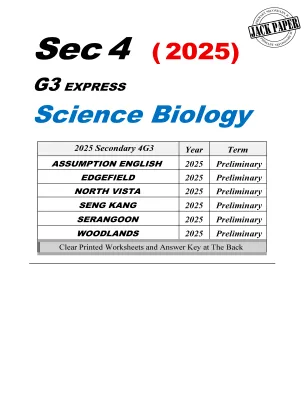
- Top School Prelim Papers: Opt for these in the final months of preparation when you need high-difficulty, full-paper simulations to test your mental endurance and time management under pressure.
Before making any purchase, always verify that the publication year and edition of the material explicitly match the current syllabus updates.
Products mentioned in this guide
Prices are valid at publication and may change. Please refer to the product page for the latest price.
Core Differences: Ten-Year Series, Assessment Books, and Prelim Papers
Understanding the structural and functional differences of each format clarifies what you are actually purchasing and how the content is generated.
Ten-Year Series These books compile actual past national examination papers chronologically or topically. They are published by authorized publishers under license from the Singapore Examinations and Assessment Board (SEAB) and Cambridge Assessment International Education. Because they contain real exam questions, they offer the most accurate representation of the language, structure, and scope of the actual papers you will face.
Assessment Books Created by educational publishers and experienced tutors, these books are typically organized by topic or chapter. They focus on reinforcing specific concepts through custom-designed questions. Many assessment books include comprehensive study notes, worked examples, and progressive difficulty tiers to help you build confidence systematically.
Top School Prelim Papers These are compilations of preliminary examination papers set by various secondary schools in Singapore. Unlike the standardized national exams, prelim papers are designed by individual school departments to test their own students before the final O-Levels. They are widely sought after because they often feature complex, non-routine questions that push students beyond basic syllabus requirements.
Evaluating Syllabus Alignment and Difficulty Progression
Assessing how closely each format mirrors the actual O-Level grading standards and expected difficulty helps you set realistic practice expectations.

The SEAB syllabus undergoes periodic reviews, which can result in the removal of certain topics or changes in question formats. When purchasing assessment books or prelim papers, you must actively check if they align with the latest syllabus code. Outdated books may contain topics that are no longer examinable, leading to wasted revision time, or they might omit newly introduced components.
It is common for top school prelim papers to be significantly more challenging than the actual O-Level examinations. Schools often design these papers to prepare students for worst-case scenarios and to ensure they do not become complacent. While practicing with these papers builds advanced problem-solving skills, you should not let lower scores on prelim papers discourage you; the TYS remains the true baseline for actual exam difficulty.
A critical difference lies in the reliability of the answer keys. Official TYS publishers provide detailed, step-by-step solutions that closely mirror the official SEAB marking rubrics, helping you understand exactly where marks are awarded. In contrast, secondhand or unofficial prelim paper compilations may feature answer keys drafted by third-party tutors, which can occasionally contain errors or lack the detailed marking criteria needed for precise self-grading.
Mapping Exam Papers to Your Academic Timeline
Guiding your revision sequence throughout the academic year maximizes the effectiveness of each practice paper type.
During the early to mid-year period, focus on topical assessment books. At this stage, you are still learning new content in school. Attempting full-length exam papers can be counterproductive and demoralizing. Instead, use topical books to master individual chapters immediately after they are taught in class. This reinforces classroom learning, highlights immediate knowledge gaps, and prevents weak areas from compounding.
As you transition into the mid to late-year period, begin working through the Ten-Year Series. Once you have covered the majority of the syllabus, start working through the TYS. Beginning with the topical TYS allows you to see how specific chapters are tested in the actual national exams. As the preliminary exams approach, switch to the yearly TYS format to practice managing your time across a complete paper and to adapt to the official phrasing of questions.
During the final countdown, utilize Top School Prelim Papers. In the final weeks leading up to the O-Levels, your primary goal is to build exam stamina and refine your exam-taking strategy. Treat these prelim papers as full-length, timed mock exams. Sit in a quiet room, set a timer, and complete the papers without referring to your notes. This high-pressure simulation trains you to handle unfamiliar, difficult questions under strict time constraints.
Avoiding Redundancy: Building a Smart Purchasing Strategy
Maximizing your revision budget and avoiding academic burnout requires a careful selection of materials to prevent unnecessary overlap.
Many students make the mistake of buying both a topical TYS and multiple topical assessment books for the same subject. This often leads to redundant practice and unnecessary expense. If your topical TYS already provides sufficient practice for each chapter, you can skip general assessment books and instead invest in targeted books that focus specifically on your weakest areas, such as structured questions or practical exam guides.
Different subjects benefit from different practice materials. For instance, in Mathematics and Sciences, practicing a wide variety of challenging questions from top school prelim papers can sharpen your analytical skills. For Humanities subjects like Social Studies or Geography, the TYS is often the most valuable resource, as it helps you master the specific source-based question formats and essay structures favored by examiners.
Whether you are purchasing from physical retail bookstores, online marketplaces, or secondhand platforms, always inspect the material carefully. Ensure that the answer keys are fully intact, as practicing without a reliable marking scheme severely limits the value of the paper. For secondhand purchases, verify that the pages are clean and free of previous pencil or pen markings, which can distract you and ruin the active recall process.
Frequently Asked Questions (FAQ)
Do I need to buy all three types of exam papers for every subject?
No, purchasing all three formats for every single subject is rarely necessary and often leads to academic burnout. Trying to complete dozens of papers across seven or eight subjects leaves little time for deep review and error analysis.
Instead, tailor your purchases to your current proficiency in each subject. For your strongest subjects, a yearly TYS and a few select prelim papers for timed practice may be entirely sufficient. For subjects where you struggle with foundational concepts, prioritize topical assessment books first to rebuild your understanding before moving on to exam-style papers.
How can I verify if an assessment book follows the latest O-Level syllabus?
To ensure your study materials are fully aligned with the current requirements, start by checking the publication or reprint year on the copyright page. Look for explicit syllabus compliance labels on the front cover, which often state the specific syllabus code set by the SEAB.
To be absolutely certain, download the official syllabus document for your subject directly from the SEAB website. Cross-reference the list of examinable topics and learning outcomes in the official document with the table of contents in the assessment book to confirm that no outdated topics are included and no new requirements are missing.
Community discussion
Share your experience or ask a question. Comments are reviewed before publication.