
Finding the right instrument to start your musical journey can feel overwhelming, but selecting a UMA ukulele simplifies the process considerably. For a complete beginner, the most suitable choice is generally a Concert-sized UMA ukulele with a laminate mahogany or acacia body. This configuration offers the ideal balance of physical comfort, ease of playability, structural durability against environmental shifts, and warm, pleasant acoustic projection. While smaller soprano models are highly portable, the slightly larger concert size provides a wider fretboard that prevents finger crowding, making the initial learning phase far less frustrating.
Quick Guide: Choosing Your First UMA Ukulele
When shopping for your first instrument, it is important to realize that there is no single “best” model that fits every individual. The ideal UMA ukulele for you depends on your physical hand size, personal comfort, aesthetic preferences, and budget. For most adult beginners, a Concert-sized UMA model with a low-action setup represents the most forgiving and versatile starting point.
As you evaluate different options, prioritize playability—how easily your fingers can press down on the strings to produce a clear note—and structural stability over premium tonewoods or elaborate decorative binding. A well-built, stable entry-level instrument that stays in tune will keep you motivated to practice daily, whereas an expensive but poorly set-up model can quickly lead to physical discomfort and early abandonment of the instrument.
Products mentioned in this guide
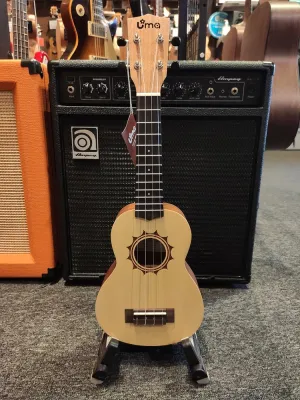

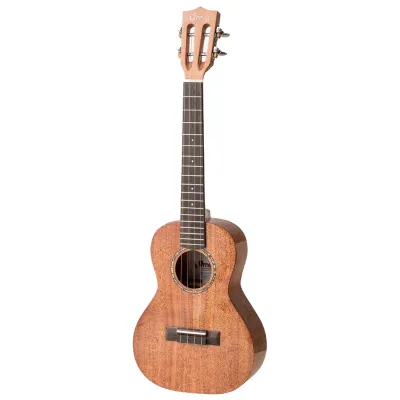
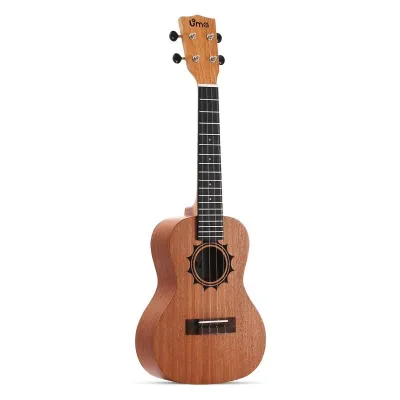

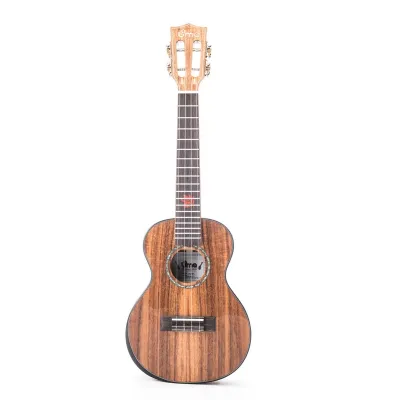
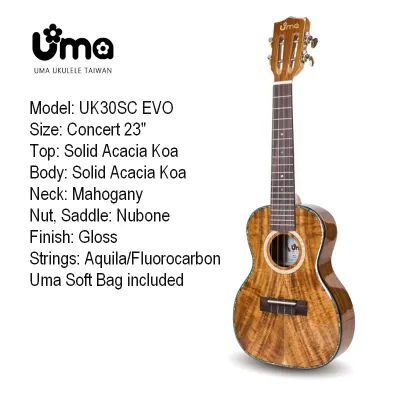

Prices are valid at publication and may change. Please refer to the product page for the latest price.
Soprano vs. Concert: Picking the Right UMA Size for Your Hands
Understanding the physical differences between ukulele sizes is the first step in narrowing down your options. UMA produces high-quality instruments across various sizes, but beginners are most successful when choosing between the classic soprano and the slightly larger concert scale. Each size influences both the physical handling of the instrument and the overall tonal character it projects.

Soprano UMA Ukuleles: Compact and Classic
The soprano is the traditional size most people associate with the ukulele. UMA’s soprano models typically measure around 21 inches in total length, featuring a compact body that produces a bright, cheerful, and distinctly “plucky” acoustic tone. This classic sound is highly percussive and cuts through easily, making it excellent for traditional Hawaiian strumming styles. Because of their small frame, soprano ukuleles are incredibly lightweight and highly portable, fitting effortlessly into small backpacks or carry-on luggage for travel.
However, the compact dimensions of a soprano ukulele come with physical trade-offs. The scale length—the distance between the nut and the saddle—is short, which means the frets are spaced very closely together. For adults or older teenagers with larger hands or thicker fingers, this tight spacing can make it difficult to press clean chords without accidentally muting adjacent strings. Transitioning quickly between chords like G major or E minor can feel cramped. Consequently, while a soprano UMA is an excellent, cost-effective choice for young children, travelers, or individuals with smaller hands, it requires a higher degree of initial finger precision.
Concert UMA Ukuleles: Roomier and Warmer
Stepping up to a concert size, which measures approximately 23 inches, provides a noticeably different playing experience. The slightly larger body cavity of a concert UMA ukulele allows the wood to resonate more deeply, resulting in a warmer, fuller, and more balanced tone with a stronger mid-range presence. It retains the classic ukulele sweetness but offers a bit more volume and sustain, which can be highly encouraging for beginners who want their notes to ring out clearly.
The primary advantage of the concert size for beginners lies in its physical dimensions. The longer scale length translates directly to wider spacing between the frets. This extra room gives your fingers more space to form complex chord shapes comfortably, minimizing the physical frustration of crowded fretboards. Additionally, the slightly longer neck and wider body are easier to hold securely against your torso while strumming, even without a strap. For most adult learners, those transitioning from the acoustic guitar, or anyone concerned about finger cramping, a concert UMA ukulele offers the smoothest and most forgiving learning curve.
Build and Materials: Balancing Tone and Durability in Singapore's Climate
When choosing a UMA ukulele, you will encounter two primary types of body construction: laminate (often labeled as plywood or layered wood) and solid wood (such as solid-top or all-solid models). Understanding how these materials interact with the local environment is crucial, especially in Singapore’s unique tropical climate.
Laminate wood instruments are constructed by gluing thin layers of wood together with the grain running in alternating directions, topped with a decorative veneer. This cross-grain construction makes laminate UMA ukuleles incredibly stable and highly resistant to changes in temperature and humidity. In Singapore, where relative humidity levels regularly exceed 80% outdoors, and homes often alternate between humid tropical air and dry, air-conditioned environments, wood expansion and contraction are major concerns. A laminate ukulele is highly resilient; it is far less likely to warp, swell, crack, or suffer from lifting bridges when subjected to these rapid climate shifts. Furthermore, laminate models are highly budget-friendly, typically costing between S$80 and S$150, making them an accessible entry point for beginners.
On the other hand, solid-top UMA ukuleles feature a soundboard made from a single piece of solid wood, such as spruce, mahogany, or acacia, paired with laminate back and sides. Solid wood vibrates more freely than laminate, offering superior resonance, greater dynamic range, and a tone that matures and improves in warmth over years of playing. However, solid wood is highly sensitive to environmental conditions. In Singapore’s climate, a solid-top instrument requires careful monitoring. If left in a highly humid room, the wood can swell, raising the string action and making it difficult to play. Conversely, if kept constantly in an air-conditioned room without proper humidification, the wood can dry out and crack.
For absolute beginners who do not want the added responsibility of maintaining a strict humidity-controlled environment—such as storing the instrument in a dedicated dry cabinet or using specialized case humidifiers—a high-quality laminate UMA ukulele is the most practical choice. It delivers reliable performance and durability with minimal maintenance. When shopping, always verify the exact material specifications on the manufacturer’s tag or the retailer’s product description. Do not assume an instrument is solid wood based solely on its visual grain or color; look for explicit terms like “solid top” or “laminate” to make an informed decision.
Playability and Setup: Ensuring Your UMA Is Easy on the Fingers
The physical ease of playing an instrument—often referred to as playability—is the single most important factor in determining whether a beginner continues to practice or gives up in frustration. When evaluating a UMA ukulele, several technical setup elements dictate this experience.
First and foremost is the “string action,” which is the physical distance between the bottom of the strings and the top of the frets. If the action is too high, you must apply significant finger pressure to press the strings down to the fretboard. This leads to rapid finger fatigue, sore fingertips, and buzzing notes when chords are not pressed hard enough. A low, comfortable action allows the strings to be depressed with minimal effort, making chord transitions smooth and painless. UMA ukuleles are generally known for consistent quality control, but minor setup variations can occur during shipping or storage.
Another critical factor is the quality of the strings. UMA ukuleles typically come equipped with high-quality strings, such as Aquila Nylgut or proprietary fluorocarbon strings, straight from the factory. Nylon-style strings are softer on beginner fingers compared to the steel strings found on acoustic guitars, but they still require a breaking-in period. New strings are highly elastic and will stretch continuously for the first few days or weeks of play, requiring frequent retuning.
To manage this initial stretching period, stable tuning machines are essential. Ensure the UMA model you choose features geared tuners (metal pegs with visible gears on the back of the headstock) rather than friction pegs. Geared tuners provide a precise turning ratio, making it much easier to fine-tune each string and keep the instrument in pitch once the strings have settled.
Before finalizing your purchase, it is highly recommended to speak with the staff at your local Singapore music retailer. Ask them to perform a basic “setup check” on the specific UMA ukulele you plan to buy. A qualified technician can inspect the nut and saddle heights, filing them down slightly if the action is too high near the first fret. This minor adjustment can transform an average instrument into an incredibly comfortable, easy-to-play learning tool.
In-Store and Online Checklist: Inspecting Your UMA Before Purchase
Whether you are purchasing your UMA ukulele from a physical music store in Singapore or ordering from an authorized online retailer, conducting a systematic inspection ensures you receive a flawless, high-quality instrument. Use the following checklist to evaluate your potential purchase.
Visual and Structural Inspection
- Neck Straightness: Hold the ukulele at eye level and look down the edge of the fretboard from the headstock to the body. The neck should be straight or have a very slight upward curve (relief). Avoid any instrument with a noticeable backward bow or twisting.
- Fret Ends: Run your index finger gently along both sides of the neck. The metal fret ends should feel smooth and flush with the wood. In dry, air-conditioned retail spaces, the wood fretboard can shrink, causing the metal frets to stick out. This condition, known as "fret sprout," can cause uncomfortable scratches on your hand while playing.
- Joints and Seams: Inspect the areas where the neck meets the body, and where the bridge is glued to the soundboard. Look for any visible glue squeeze-out, hairline cracks, or tiny gaps that indicate poor bonding or wood separation.
Intonation and Tuning Test
- Open vs. Fretted Notes: Tune the ukulele precisely using a digital tuner. Play each string open, and then press down gently at the 12th fret (the octave marker). The note at the 12th fret should be perfectly in tune and exactly one octave higher than the open string. If the 12th fret note is significantly sharp or flat, the instrument has poor intonation, meaning it will sound out of tune as you play higher up the neck.
- Fret Buzz: Play every single note on every string, fret by fret, from the first fret to the body. Listen closely for any unwanted buzzing or rattling sounds, which could indicate uneven frets or an excessively low saddle setup.
Bundle Evaluation
- Many beginner UMA ukuleles are sold as starter bundles that include accessories like a gig bag, tuner, strap, and spare strings.
- Gig Bag Quality: Check the thickness of the padding on the included gig bag. A thin, unpadded nylon sleeve offers minimal protection against minor bumps or drops. Look for a bag with at least 5mm to 10mm of foam padding to protect your investment during commutes.
- Tuner Type: Ensure the included tuner is a chromatic clip-on model. Chromatic tuners detect any musical pitch, making them far more versatile and accurate than basic ukulele-only tuners, especially when tuning in noisy environments.
Warranty and Support
- Always verify the warranty terms offered by the local Singapore distributor or retailer. A standard manufacturer's warranty typically covers structural defects or glue failures for 6 to 12 months.
- If purchasing online, review the seller's return policy, specifically who covers return shipping costs if the instrument arrives damaged or defective. Confirm if the retailer offers after-sales support, such as free truss rod adjustments or action setups within the first few months of ownership.
Frequently Asked Questions (FAQ)
Do I need to buy a separate tuner for my UMA ukulele?
While many UMA starter bundles include a basic clip-on tuner, having a reliable tuning tool is essential for every practice session. If your bundle does not come with one, purchasing a dedicated chromatic clip-on tuner is highly recommended. These devices attach directly to the headstock of your ukulele and detect pitch through the physical vibrations of the wood, making them highly accurate even in noisy rooms. Alternatively, you can download a highly-rated, free chromatic tuning application on your smartphone. Smartphone apps are convenient for quiet home environments, but they can struggle to register the correct pitch in noisy spaces or group classes.
Should I upgrade the strings on a new beginner UMA ukulele?
There is no need to upgrade or replace the strings on your new UMA ukulele immediately. The factory-installed strings are selected to match the instrument’s build and provide a pleasant, balanced tone right out of the box. Beginners should play on these original strings for at least three to four weeks to allow them to stretch, settle, and hold their tune consistently. This period also allows your fingertips to adapt to the physical feel of the instrument. Once you have established a consistent practice routine and can play several chords cleanly, you might consider upgrading to fluorocarbon strings, which offer a brighter tone and a slightly thinner profile.
Is a tenor or baritone UMA ukulele suitable for a complete beginner?
Tenor and baritone ukuleles are generally less suitable for absolute beginners. Tenor models are larger and require more finger stretch, which can be challenging for those without prior fretted instrument experience. Baritone ukuleles are even larger and are traditionally tuned to D-G-B-E (matching the top four strings of a guitar) rather than the standard G-C-E-A tuning used by sopranos and concerts. Because almost all beginner ukulele instructional books, online tutorials, and chord charts are written for standard G-C-E-A tuning, learning on a baritone requires translating chords, which adds unnecessary complexity. Sticking to a soprano or concert UMA ukulele ensures you can easily follow standard beginner resources.
Community discussion
Share your experience or ask a question. Comments are reviewed before publication.