
Starting a musical journey requires an instrument that balances cost, playability, and sound quality. A poorly constructed guitar can frustrate a beginner, leading them to abandon the instrument before they can experience the joy of playing. The Yamaha FG800 has long stood as a benchmark for entry-level acoustic guitars. By offering a solid wood top at an accessible price point, it bridges the gap between fragile budget instruments and premium professional models. Understanding the specific design choices, material selections, and physical characteristics of this model helps prospective players make an informed decision about whether it fits their learning path.
Choosing a first guitar involves navigating a vast market filled with varying specifications, materials, and price points. For many beginners, the technical jargon surrounding tonewoods, bracing patterns, and neck profiles can feel overwhelming. The reputation of this specific model is built on a history of reliable manufacturing and consistent quality control, making it a safe starting point for those without prior musical experience. By examining how its construction translates to real-world playability and sound, new players can understand why this instrument remains a staple recommendation among guitar instructors worldwide.
Construction and Build Quality for Long-Term Use
The foundation of any acoustic guitar’s sound and durability lies in its construction materials. The most critical component of an acoustic guitar is its soundboard, or top, which vibrates to project the sound of the strings. This model features a solid Sitka spruce top, a design choice typically reserved for more expensive instruments. Unlike laminated tops, which consist of multiple thin layers of wood glued together, a solid piece of wood vibrates with greater freedom and efficiency. This results in a richer, more resonant tone with superior projection and dynamic range.
Products mentioned in this guide
![Yamaha FG800 FG800M Acoustic Guitar FG 800 M Full Size Solid Spruce Top Beginners Series [LIMITED STOCK]](https://img.lazcdn.com/g/p/ebccdae0f44bc8448a2d98fc192a14d6.jpg_400x400q80.jpg_.webp)
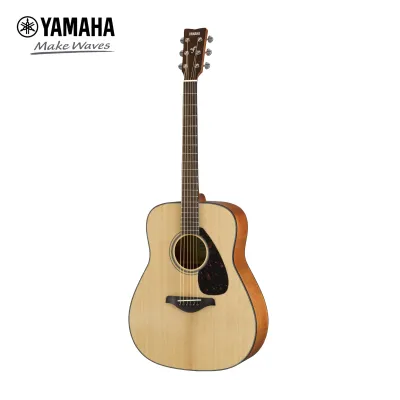
Prices are valid at publication and may change. Please refer to the product page for the latest price.
To balance cost and structural integrity, the back and sides of the instrument are constructed from laminated nato or okoume. This hybrid approach is highly practical for beginners. While a fully solid-wood guitar offers maximum resonance, it is also highly sensitive to environmental changes and requires meticulous humidity control. In tropical climates with high relative humidity, such as Singapore, wood constantly absorbs and releases moisture. Laminated back and sides provide excellent resistance to warping, cracking, and joint separation caused by these environmental shifts, making the guitar exceptionally durable for home storage without dedicated climate control.
Beneath the solid spruce top lies the internal bracing system, which supports the wood against the immense tension of the steel strings. This model utilizes a scalloped bracing pattern, a design refinement where portions of the wooden braces are carved out. This reduction in mass allows the top to vibrate more dynamically, particularly in the lower frequency spectrum, resulting in a warmer and more robust bass response. The bracing pattern ensures that the guitar remains structurally stable over years of tension while maximizing the acoustic energy transferred from the strings.
When unboxing a new instrument, beginners should perform a basic visual inspection to ensure the build quality meets expectations. Examine the gloss finish across the body, looking for any uneven pooling, bubbles, or rough patches. Inspect the binding—the protective strip where the top and back meet the sides—to ensure there are no visible gaps or glue squeeze-out. Finally, check the alignment of the bridge and the neck joint, ensuring that all components are flush and securely bonded, which indicates a well-assembled instrument ready for long-term use.
Playability and Neck Comfort for Developing Hands
For a beginner, physical comfort is often the deciding factor in whether they continue practicing. Developing finger strength and calluses takes time, and an instrument that is difficult to play can cause unnecessary hand fatigue. The neck profile of this model is designed with a slim taper, featuring a comfortable matte finish on the back. This satin texture prevents the player’s hand from sticking to the neck during chord transitions, allowing for smoother movement up and down the fretboard.

The nut width measures approximately 43 millimeters, which is standard for traditional steel-string acoustic guitars. This width provides sufficient spacing between the strings to prevent accidental muting of adjacent notes, which is a common frustration for beginners learning basic open chords. At the same time, the neck profile remains slim enough that players with average or smaller hands can comfortably wrap their fingers around the fretboard to execute clean chord shapes without excessive wrist strain.
Another critical aspect of playability is the string action, which refers to the height of the strings above the frets. Factory setups are generally designed to be conservative, meaning the action may be set slightly high to prevent fret buzzing during shipping across different climate zones. For a new player, high action requires significant finger pressure to fret notes cleanly, leading to rapid finger soreness. It is highly recommended to have a local guitar technician or luthier perform a professional setup. Adjusting the truss rod, filing the nut slots, and slightly lowering the saddle can transform the instrument, making it significantly easier to play and reducing the learning curve.
The traditional dreadnought body shape of this model also carries ergonomic considerations. As a large-bodied guitar with a deep cavity and a wide waist, it is designed to maximize volume and bass response. However, this physical size can feel bulky when playing in a seated position, particularly for younger learners or individuals with shorter arms. When practicing, players should pay attention to their posture, ensuring they can comfortably drape their strumming arm over the lower bout of the guitar without raising their shoulder or straining their back.
Tonal Profile and Acoustic Versatility
The combination of a solid spruce top and a dreadnought body shape produces a classic acoustic voice characterized by strong projection and a balanced frequency response. Spruce is highly regarded for its broad dynamic range and crisp articulation, allowing the guitar to respond clearly whether played softly or strummed with force. The dreadnought shape naturally emphasizes the lower frequencies, providing a warm, robust bass that supports the clear mid-range and bright treble notes.
This balanced tonal profile makes the instrument highly versatile across a wide range of musical genres. For players focused on strumming chords to accompany vocals, the guitar offers a cohesive, full-bodied sound that easily fills a room. Flatpickers will appreciate the clear note definition and projection during single-note runs. While fingerstyle players often prefer smaller-bodied guitars for their immediate mid-range response, this model remains a highly capable all-rounder, allowing beginners to explore various playing styles before committing to a specialized instrument.
A unique advantage of the solid spruce top is its ability to mature acoustically over time, a phenomenon often referred to as “opening up.” As the wood is played regularly, it undergoes continuous vibration, which helps dry out residual moisture and crystallize the natural resins within the wood fibers. This aging process gradually enhances the guitar’s resonance, sustain, and overall warmth. Unlike fully laminated budget guitars, which sound the same throughout their lifespan, this instrument will reward consistent practice by developing a deeper and more complex tonal character over the years.
Limitations and When to Consider Alternatives
Despite its many strengths, this model is not a universal solution for every aspiring guitarist. The dreadnought body shape, while excellent for sound projection, can be physically challenging for smaller players, teenagers, or those who prefer a more compact instrument. For these individuals, a concert-sized acoustic guitar is often a more suitable alternative. Concert bodies are thinner and feature a tighter waist, allowing the instrument to sit lower on the lap and bringing the fretboard closer to the player’s body for improved comfort.
Another limitation to consider is the lack of built-in electronics. The standard version of this guitar is a purely acoustic instrument, meaning it does not include an onboard pickup, preamp, or output jack. If your immediate goals include performing live on stage, playing in a church band, or recording directly into an audio interface, you will need to use an external microphone or invest in an aftermarket pickup. Alternatively, you may want to look at acoustic-electric models within the same product family, which feature built-in electronics but typically come at a higher price point.
Finally, beginners should evaluate whether a steel-string acoustic guitar aligns with their musical preferences and physical tolerance. Steel strings are under high tension and can be painful for uncalloused fingers during the first few weeks of learning. If your primary interest lies in classical music, flamenco, or traditional folk, a nylon-string classical guitar may be a better starting point. Nylon strings are softer, under lower tension, and produce a mellower tone, though the wider neck of a classical guitar presents its own set of physical challenges for small hands.
Pre-Purchase Checklist and Authenticity Verification
Purchasing a first guitar requires careful verification to ensure you receive a genuine, high-quality instrument. To avoid counterfeit products or gray-market items, always purchase from authorized music retailers rather than unverified third-party sellers on general online marketplaces. Authorized dealers ensure that the instrument has been stored in a climate-controlled environment and is backed by the manufacturer’s warranty, providing peace of mind for your investment.
Before finalizing your purchase, whether in-store or immediately upon unboxing a shipped instrument, conduct a thorough physical inspection. Run your fingers along the edges of the fretboard to check for “fret sprout”—sharp metal fret ends that protrude when the wood of the neck shrinks. While less common in humid climates, sudden temperature and humidity drops during international shipping can cause the wood to contract. Additionally, turn each tuning machine to ensure they rotate smoothly without catching, slipping, or feeling excessively loose, as reliable tuning stability is essential for a frustrating-free practice experience.
It is also important to understand what is included in the box so you can budget accurately for necessary accessories. The standard packaging typically includes only the guitar, an adjustment hex wrench for the truss rod, and a basic owner’s manual. To protect your instrument and facilitate learning, you should budget separately in S$ for several essential items. A padded gig bag (typically ranging from S$30 to S$60) is crucial for safe transport and dust protection. A reliable clip-on electronic tuner (S$15 to S$30) is indispensable, as new steel strings stretch frequently and require constant adjustment. Other recommended accessories include a pack of medium or light picks (S$5), a comfortable guitar strap (S$15 to S$30), and a sturdy floor stand (S$20 to S$40) to keep your guitar safe and easily accessible for daily practice.
Frequently Asked Questions (FAQ)
Is the Yamaha FG800 available in a left-handed version?
Yes, a dedicated left-handed version of this model is produced by the manufacturer, typically designated as the FG800L. It features the exact same construction, including the solid spruce top and scalloped bracing, but is mirrored for left-handed players. If local music stores do not have this specific version in stock, it can often be special-ordered through authorized dealers. It is highly recommended to purchase a dedicated left-handed model rather than attempting to restringe a standard right-handed guitar, as restringing would require replacing the nut and saddle to maintain proper intonation and string spacing.
Does the standard FG800 come with a built-in pickup for amplification?
The standard model is a purely acoustic instrument and does not include a built-in pickup or preamp. For players who require amplification for live performances or direct recording, Yamaha offers the FGX800C, which is an acoustic-electric variant featuring a cutaway body and onboard electronics. Alternatively, players can choose to have an aftermarket pickup installed by a professional technician. Options include temporary soundhole magnetic pickups or permanent under-saddle transducers, allowing you to amplify the guitar without altering its natural acoustic properties.
How does the FG800 compare to the FS800 for smaller players?
The primary difference between these two models lies in their body dimensions and physical comfort. The FG800 features a traditional dreadnought body, which is deeper and wider, prioritizing maximum volume, projection, and bass response. In contrast, the FS800 features a concert-sized body that is thinner and has a more pronounced waist. This smaller profile makes the FS800 significantly more comfortable to hold and play for younger students, individuals with smaller frames, or anyone who prefers a more intimate, manageable instrument when practicing in a seated position, though it offers slightly less low-end projection than its larger counterpart.

Community discussion
Share your experience or ask a question. Comments are reviewed before publication.