
Quick Answer: Evaluating World of Science for PSLE Preparation
The Primary School Leaving Examination (PSLE) Science paper in Singapore is renowned for testing more than just rote memorisation. It demands that primary school students apply abstract scientific concepts to complex, unfamiliar, and real-world scenarios. Among the vast array of preparation materials available, the World of Science series by World Scientific has emerged as a popular choice for parents and educators seeking to build this exact application skill.
To evaluate whether World of Science is the right fit for your child, it is essential to understand how it stacks up against traditional PSLE science assessment books. The series is highly effective for students who need to bridge the gap between foundational textbook knowledge and complex exam application. However, because of its unique narrative format, it may not be the sole resource needed for every learner, especially those who require intensive, timed exam practice.
Our comparison evaluates World of Science against general categories of popular PSLE science assessment books, such as foundation guides and intensive drill books. By analysing content coverage, question difficulty, and alignment with the current Singapore Ministry of Education (MOE) syllabus, this guide helps you make an informed decision for your child’s study plan.
Products mentioned in this guide
![[CLEARANCE] WS E - World of Science All Single Books - Age 6-12+ Children STEM Science Primary School Learning Comic Book](https://img.lazcdn.com/g/p/d28f5bc1b85a665e095bff548ee05e39.jpg_400x400q80.jpg_.webp)
![[SG STOCK] WS E - World of Science All Titles - Age 6-12+ Children STEM Science Primary School Learning Comic Book](https://img.lazcdn.com/g/p/5399acd8f1b9cf545f420fee291525e8.jpg_400x400q80.jpg_.webp)
![[SG STOCK] WS E - World of Science Set 1 to 8 (Bundle Set) - Age 6-12+ Children STEM Science Primary School Learning Comic Book](https://img.lazcdn.com/g/p/780365c5d5388e80ee188dab643a3d3c.png_400x400q80.png_.webp)
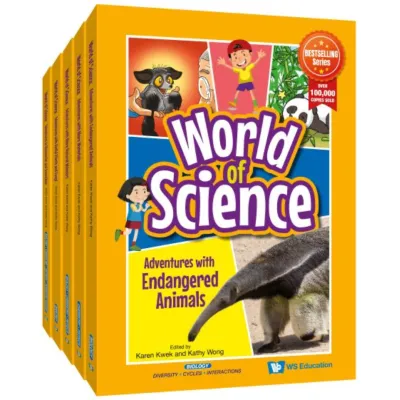
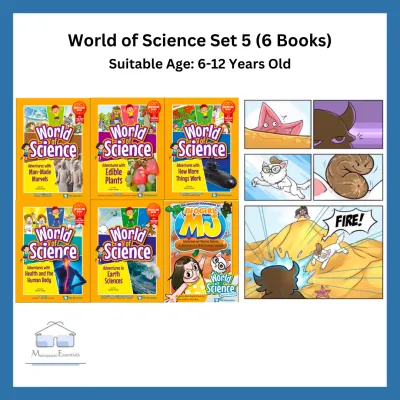
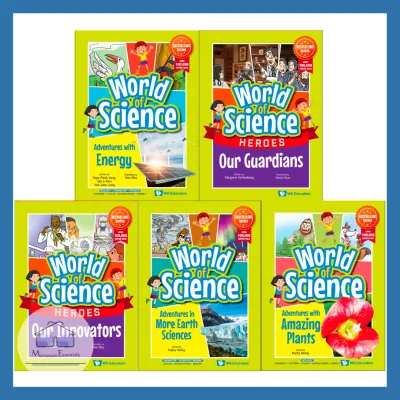
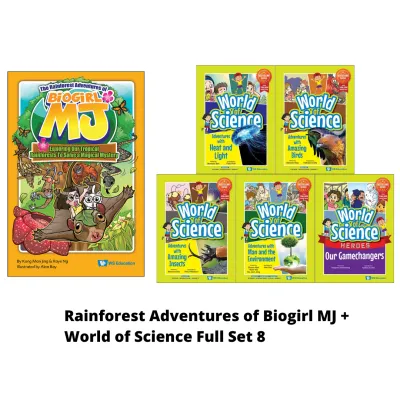
Prices are valid at publication and may change. Please refer to the product page for the latest price.
Core Comparison Dimensions: What Sets World of Science Apart?
To appreciate the value of any assessment book, parents must look beyond the cover and examine how the material is structured. The Singapore PSLE Science curriculum requires students to master five core themes: Diversity, Cycles, Systems, Interactions, and Energy. How an assessment resource organizes these themes directly impacts a student’s cognitive retention and ability to make cross-thematic connections.

Content Coverage and Thematic Organization
Unlike conventional assessment books that present information in dense, black-and-white text blocks, the World of Science series takes a highly visual and narrative-driven approach. It organizes scientific concepts through engaging comic strips and colorful illustrations that align directly with the five core themes of the MOE primary science syllabus. This thematic organization allows students to see the continuity of science in the natural world rather than viewing topics as isolated facts to be memorized.
The depth of content notes in these books is uniquely balanced between academic rigour and accessibility. Instead of standard summary bullet points, the series uses character-driven dialogues to explain complex phenomena, such as how the circulatory system interacts with the respiratory system. Mind maps and visual summaries are integrated into the narratives, helping visual learners consolidate key concepts before they transition to the practice questions at the end of each chapter.
When compared to standard textbook companions, World of Science provides significantly more real-world context and deeper scientific explanations. Standard companions often repeat the school textbook’s phrasing verbatim, which can lead to passive reading. In contrast, this series expands on the ‘why’ behind scientific occurrences, giving students the conceptual depth needed to tackle the novel scenarios frequently presented in the PSLE.
Question Difficulty and Open-Ended Application
The progression of difficulty in World of Science is designed to ease students from basic comprehension into higher-order thinking skills (HOTS). Each thematic section concludes with a curated set of practice questions that transition from basic recall Multiple Choice Questions (MCQs) to multi-part Open-Ended Questions (OEQs). This gradual increase in difficulty prevents students from feeling overwhelmed when introduced to complex problem-solving.
The primary strength of this series lies in its focus on real-world application. The PSLE Science paper is notorious for presenting students with unfamiliar experiments or real-life situations and asking them to identify the underlying scientific principles. Because the chapters themselves are framed around real-world scientific inquiries, students are naturally trained to analyze novel scenarios and apply their knowledge critically, rather than relying on memorized answers.
Furthermore, the series actively addresses common student misconceptions and ‘tricky’ questions. By highlighting why certain everyday assumptions are scientifically inaccurate, the books guide students to avoid common pitfalls in their exams. This proactive approach to addressing misconceptions is crucial for securing high marks in Paper 2, where minor conceptual errors can result in a complete loss of marks.
Exam Alignment and Answering Techniques
While World of Science is highly praised for its engaging content, parents must consider how closely it aligns with the structural demands of the actual PSLE paper. The PSLE Science exam consists of Paper 1 (28 MCQs) and Paper 2 (12 to 13 OEQs), requiring a balance of speed, precision, and structured writing. The practice sections in World of Science offer a solid selection of these question types, but they are organized topically rather than as full-length, timed exam papers.
The quality of the marking scheme and answer keys is another critical factor for PSLE preparation. In Singapore, examiners look for specific keywords and scientific terms (such as ‘surface area exposed to the air,’ ‘rate of heat transfer,’ or ‘presence of oxygen’) when grading open-ended questions. World of Science provides comprehensive answer keys that highlight these essential keywords and explain the logic behind the answers, helping students learn the exact phrasing required to secure full marks.
However, when compared to pure past-year paper compilations, there is a clear trade-off. Past-year papers provide raw, unedited exam exposure that helps students build exam stamina and master time management under pressure. World of Science, on the other hand, acts as a conceptual bridge, ensuring that when students finally sit down to do those past-year papers, they actually possess the deep understanding required to solve the questions instead of guessing.
How World of Science Compares to Other Book Categories
To help you navigate the crowded assessment book aisles in Singapore, it is useful to categorize the available resources. Most books fall into distinct functional categories, each serving a specific stage of a student’s learning journey. Understanding where World of Science fits in this landscape ensures you do not buy redundant materials.
Versus Foundation and Textbook Companion Guides
Foundation and textbook companion guides are designed primarily for basic revision and textbook reinforcement. These books closely mirror the school textbook’s structure, focusing on basic definitions, simple fill-in-the-blanks, and direct recall questions. They are highly structured, predictable, and aim to ensure that a student can secure the baseline passing marks by remembering core facts.
The learning outcomes of these two categories differ significantly. While foundation guides are excellent for struggling students who need to build confidence and memorize basic scientific vocabulary, they rarely push students toward analytical thinking. World of Science, by contrast, assumes a basic level of literacy and immediately pushes the student to synthesize information, compare variables, and explain phenomena in detail.
Therefore, a clear boundary exists for when to use each resource. If a student is currently struggling to pass school assessments or cannot define basic terms like ‘photosynthesis’ or ‘conductors of heat,’ they should start with a foundation guide. Once the student consistently secures the basic recall marks, they should transition to World of Science to develop the critical thinking skills required to break into the higher grade bands (AL1 to AL3).
Versus Intensive Drill and Exam-Simulation Books
Intensive drill books and exam-simulation papers (often sold as ‘topical examination papers’ or ‘mock PSLE papers’) focus on sheer volume and exam replication. These books contain minimal notes and instead offer hundreds of questions designed to test a student’s speed, accuracy, and endurance. They are designed to replicate the exact pressure and layout of the PSLE exam environment.
The cognitive outcomes of these books are complementary rather than competitive. Intensive drill books are highly effective for building exam stamina, eliminating careless mistakes, and mastering time management. However, if a student has conceptual gaps, simply drilling more papers will not help; it will only reinforce their mistakes. World of Science builds the underlying conceptual framework and deep scientific interest that prevents those mistakes from happening in the first place.
For a holistic study plan, these two categories should be used in tandem. During the earlier phases of revision (such as the end of Primary 5 and the first half of Primary 6), students can use World of Science to master concepts and learn how to apply them. In the final run-up to the PSLE (typically from July to September), parents can introduce intensive drill books to sharpen exam techniques and build the speed necessary to complete the paper within the allocated time.
Decision Framework: When to Choose World of Science
Choosing the right assessment book requires a careful match between the book’s design and your child’s current academic standing, learning style, and goals. To simplify your purchasing decision, consider the following condition-based guidelines:
- Choose World of Science if:
- The student has a decent grasp of basic textbook definitions but consistently struggles with Paper 2 open-ended questions that present unfamiliar, real-world scenarios.
- The student is a visual learner who becomes disengaged or overwhelmed by traditional, text-heavy assessment books.
- You want a resource that fosters a genuine interest in science while still aligning with the rigorous requirements of the MOE syllabus.
- The student needs to build a deeper conceptual understanding of how different scientific systems (like the human respiratory and circulatory systems) interact with one another.
- Choose a Foundation Guide if:
- The student is currently scoring below passing marks or struggling to recall basic scientific facts, definitions, and vocabulary.
- The student needs highly structured, simple, and repetitive exercises (like fill-in-the-blanks) to build basic confidence before tackling application questions.
- Choose an Intensive Drill Book if:
- The student already consistently scores well in topical tests but needs to improve their exam stamina, speed, and time management.
- The student needs to become familiar with the exact layout, font, and pressure of a full-length, 100-mark PSLE Science paper.
- Verify first if:
- Your child's reading comprehension level is suited for the character-driven dialogues in World of Science, as some students prefer direct, bulleted facts over narrative-style explanations.
Practical Steps to Verify the Best Fit for Your Child
Before making a purchase at a local bookstore or online marketplace, parents should take a few practical steps to ensure the book will be an effective tool rather than sitting unused on a shelf.
- Check the Publication Year: Always verify the publication or revision date of the book. The Singapore Ministry of Education occasionally updates the science syllabus, removing certain topics or shifting the focus of others. Ensuring you have the latest edition prevents your child from wasting time on outdated content.
- Verify Edition and Format: Before buying, check the physical edition, language, and format options. Ensure you are purchasing the authorized print edition rather than an incomplete digital scan or an unauthorized copy, as visual quality is crucial for reading the detailed comic panels and charts.
- Review a Sample Chapter: Sit down with your child and look through a sample chapter together. Observe how they respond to the visual layout and the level of vocabulary used in the explanations. If the language is too complex, it may cause frustration; if it is too simple, it may not provide enough academic stretch.
- Align with the School's Teaching Flow: Different primary schools in Singapore may teach the science syllabus themes in varying sequences. Check your child's school scheme of work to see if the thematic organization of the book matches or complements the sequence their school teacher is currently following.
- Consult Your Child's Science Teacher: Do not hesitate to show the book or its table of contents to your child's school science teacher during parent-teacher meetings. The teacher has the best insight into your child's specific academic weaknesses—whether they lie in conceptual understanding, keyword application, or time management—and can advise if this book addresses those specific needs.
Community discussion
Share your experience or ask a question. Comments are reviewed before publication.