
Selecting your very first keyboard is a milestone journey, but the sheer variety of options can feel overwhelming. Yamaha has long been a household name for music education in Singapore, offering instruments that cater to different learning paces, household spaces, and financial plans. Finding the right model requires balancing your immediate musical goals with the practical realities of your home environment.
The best Yamaha keyboard for a beginner in Singapore depends entirely on your primary learning objective. If you or your child want an engaging, multi-functional instrument to explore diverse musical genres, the Yamaha PSR series offers unmatched versatility. For those living in compact apartments who prioritize a minimalist, piano-focused experience, the lightweight Yamaha Piaggero series fits seamlessly into modern spaces. Meanwhile, serious students committed to classical training and formal graded examinations will find their match in the Yamaha P-Series digital pianos, which deliver the authentic weighted key action required to build proper piano technique.
Key Features to Consider for Your First Yamaha Keyboard
Understanding the technical specifications of a keyboard helps you make an informed investment that supports your learning journey for years to come. Before looking at specific models, you must evaluate several core features that directly impact playability, technique development, and overall usability.
Products mentioned in this guide
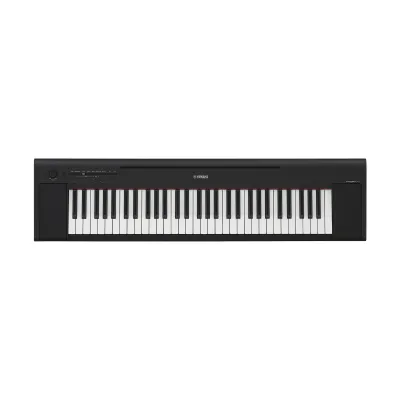
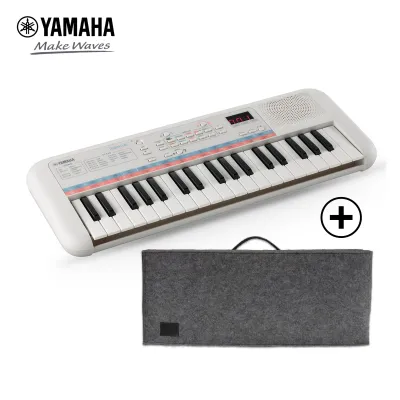
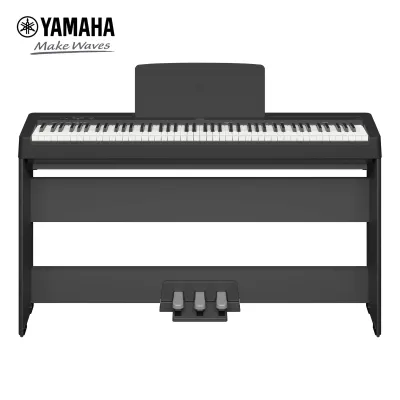
Prices are valid at publication and may change. Please refer to the product page for the latest price.
Touch Sensitivity
Touch sensitivity, also known as velocity sensitivity, is a fundamental feature for any beginner. A touch-sensitive keyboard responds to the force with which you press the keys; striking a key quickly produces a loud, bright sound, while a gentle press yields a soft, mellow tone. This feature is non-negotiable for developing musical expression and dynamics. Without touch sensitivity, every note sounds at a uniform volume, which prevents you from learning how to convey emotion or play classical and contemporary pieces with the intended nuance.
Key Action
Key action refers to the physical mechanism beneath the keys, which dictates how much resistance your fingers feel.
- Synth-action keys are spring-loaded and exceptionally light, offering minimal resistance. This action is easy on young fingers and ideal for playing fast synthesizer leads or organ sounds, but it does not prepare you for the physical demands of an acoustic piano.
- Weighted keys simulate the heavy wooden hammers of an acoustic piano. This resistance is crucial for building finger strength, hand endurance, and proper posture.
- Semi-weighted keys offer a middle ground, combining light spring tension with added weights to give a moderate level of resistance without the bulk of a fully weighted hammer mechanism.
Key Count
Keyboards generally come in three standard sizes: 61 keys (5 octaves), 76 keys (6 octaves), and 88 keys (7.2 octaves). A 61-key layout is highly portable and perfectly adequate for the first year of learning basic melodies, simple chords, and pop songs. However, as you progress to classical repertoire, complex jazz arrangements, or two-handed classical pieces, you will quickly run out of notes. An 88-key instrument is the standard size of an acoustic piano and is mandatory if you plan to take formal graded music examinations.
Educational Tools and Smart Connectivity
Modern Yamaha keyboards feature built-in learning aids designed to make self-study engaging. Many models include interactive lesson suites that break down songs into left- and right-hand parts, waiting for you to play the correct note before advancing. Furthermore, digital connectivity has revolutionized home practice. A USB-to-Host port allows you to connect your keyboard directly to an iPad, tablet, or laptop. This interface enables seamless integration with educational software, interactive sheet music apps like Flowkey, and digital audio workstations (DAWs) for basic recording and music production.
Recommended Yamaha Keyboard Series for First-Time Learners
Yamaha organizes its beginner-friendly instruments into distinct product lines, each tailored to specific lifestyles, budgets, and musical aspirations. Matching your personal goals to the strengths of these series will help you narrow down your choices.

Yamaha PSR Series: Best for Exploring Sounds and Versatility
The Yamaha PSR series consists of portable arranger keyboards designed to make learning interactive, creative, and fun. These instruments are packed with hundreds of realistic instrument voices—ranging from grand pianos and string ensembles to synthesizers and woodwinds—alongside built-in auto-accompaniment styles. The accompaniment feature acts as a virtual backing band that follows your chord changes in real-time, helping beginners understand rhythm, timing, and arrangement across various genres like pop, rock, and jazz.
- Ideal User: This series is perfect for children, casual adult hobbyists, and creative learners who want to explore songwriting, music production, and diverse musical styles rather than focusing solely on classical piano technique.
- Limitations to Consider: Most beginner models in the PSR series feature 61 synth-action keys. While highly expressive for electronic music, these light keys do not build the finger strength required for acoustic pianos. If a student transitions to formal classical training, they will likely need to upgrade to a weighted 88-key instrument within a year or two.
Yamaha Piaggero Series: Best for Portability and Piano Focus
Combining the words “piano” and “leggero” (the Italian word for light), the Piaggero series is designed for minimalist simplicity. These keyboards strip away the complex arrays of buttons, dials, and backing tracks found on arranger keyboards, focusing instead on delivering high-quality piano and electric piano samples. They are remarkably slim, lightweight, and designed to be set up or packed away in a matter of seconds.
- Ideal User: The Piaggero series is highly suited for teenagers and adults living in compact Singapore apartments, such as HDB flats or condominiums, where dedicated floor space is limited. It is also an excellent option for mobile musicians who need a basic, highly portable practice keyboard that can run on batteries.
- Limitations to Consider: To keep the instrument slim and lightweight, Yamaha equips the Piaggero series with semi-weighted or graded soft-touch keys. While these keys offer more resistance than a standard synth-action keyboard, they still lack the authentic physical weight and hammer action of a true digital piano, which may limit advanced classical development.
Yamaha P-Series Digital Pianos: Best for Serious Piano Practice
The “P” in P-Series stands for portable, but these instruments are true entry-level digital pianos. They feature a full set of 88 weighted keys utilizing Yamaha’s specialized hammer action mechanisms, which replicate the heavier touch in the lower registers and the lighter touch in the high notes. This series prioritizes authentic piano touch and tone, utilizing advanced stereo sampling to capture the rich resonance of world-class acoustic grand pianos.
- Ideal User: This series is the gold standard for students taking formal piano lessons, individuals preparing for classical exams (such as ABRSM or Trinity), and adult beginners committed to mastering traditional piano technique. It is an instrument designed to support a learner from their very first scale up to intermediate and advanced levels.
- Limitations to Consider: P-Series digital pianos represent a higher initial financial investment and are significantly heavier than portable keyboards. They require a sturdy, dedicated stand and bench, meaning they will occupy a permanent, fixed footprint in your home.
Comparing Playability, Space, and Budget
Choosing between these three series involves evaluating the practical trade-offs between your physical living space, your available budget, and your long-term musical goals.
Space Constraints in Singapore Homes
In high-density urban environments like Singapore, floor space is a premium commodity. A standard 61-key PSR or Piaggero keyboard measures roughly 94 cm in width and can easily be placed on a folding desk, dining table, or compact X-stand, then stored in a closet when not in use. Conversely, an 88-key P-Series digital piano requires a dedicated space of approximately 130 cm in width. If you choose a P-Series model with a wooden furniture stand and a triple-pedal unit, it becomes a permanent piece of furniture that cannot be easily tucked away, requiring careful planning of your room layout.
Budget Tiers and Financial Allocation
When planning your purchase, it helps to view the options within broad Singapore Dollar (SGD) price bands:
- Entry-Level Portable (S$200 to S$400): This tier includes basic PSR models. They offer great value and interactive features, making them low-risk options for testing a child's long-term interest.
- Mid-Range Portable & Slim Piano (S$350 to S$600): This band covers advanced PSR models and the Piaggero series. These instruments offer better sound engines, improved touch response, and enhanced connectivity.
- Entry-Level Digital Pianos (S$700 to S$1,200): This tier includes the P-Series models, often sold as bundles with stands, benches, and pedal units.
If your budget allows, it is always wiser to allocate funds toward touch sensitivity and weighted keys rather than an abundance of digital sound effects, as physical playability directly impacts how quickly you learn.
Long-Term Value and the Upgrade Cycle
While a lower-priced, non-weighted keyboard is gentle on your wallet today, it may cost you more in the long run. If a beginner is dedicated and practices regularly, they will likely outgrow a 61-key, non-weighted keyboard within 12 to 18 months as their repertoire expands. Investing in an 88-key weighted digital piano from the start eliminates the need for an intermediate upgrade, offering a much lower “cost per use” over a five-to-ten-year horizon.
Playability and Physical Technique
The physical difference between key actions is not just a matter of comfort; it dictates how your hand muscles develop. Playing on weighted keys builds the intrinsic strength of your fingers and wrist, teaching you how to control the speed of the key descent to vary your tone. Learning on a light, unweighted keyboard can lead to “lazy” finger habits and collapsed arches in your hands, making it highly frustrating when you attempt to play on an acoustic piano during a lesson or exam.
Buying Tips and Setup Considerations in Singapore
Once you have selected the right Yamaha model, taking the correct steps during purchase and setup ensures a safe, reliable, and durable ownership experience in Singapore.
Navigating Purchasing Channels
To protect your investment, always purchase your instrument through authorized local music retailers or official brand stores on major online marketplaces. Buying from authorized channels guarantees that you receive a genuine product backed by a local manufacturer’s warranty, which typically covers parts and labor for 12 months. Avoid purchasing parallel imports or gray-market models from unauthorized online sellers; these units often lack local warranty coverage, leaving you with high repair bills if the electronics or key contacts fail.
Power Supply and Electrical Safety
Singapore operates on a 230V, 50Hz electrical grid and utilizes Type G (UK-style) 3-pin plugs. Always verify that your keyboard package includes an original power adapter that is safety-certified for local use. Using uncertified third-party adapters or voltage converters imported from overseas can lead to power fluctuations, electrical hums in your headphones, or permanent damage to the keyboard’s internal circuit boards.
Climate Care for Tropical Environments
Singapore’s year-round high humidity (frequently exceeding 80%) and high temperatures present unique challenges for electronic instruments. High moisture levels can cause internal copper contacts to corrode, leading to dead keys or erratic electronic behavior.
To safeguard your instrument, keep these environmental tips in mind:
- Avoid Direct Sunlight: Position your keyboard away from windows where intense afternoon sun can warp the plastic casing and degrade internal components.
- Manage Air Conditioning: Avoid placing the instrument directly under or opposite air-conditioning vents, as rapid temperature shifts cause condensation to form inside the chassis.
- Use Dust Covers: Always place a fitted spandex, velvet, or nylon dust cover over the keys when the instrument is not in use to block out airborne dust and ambient moisture.
- Moisture Control: Consider running a dehumidifier in your practice room, or place silica gel packs inside your keyboard gig bag if you store the instrument in a case.
Essential Accessories for a Complete Setup
To get the most out of your new instrument, budget for a few essential accessories that are rarely bundled with the base keyboard unit:
- A Sturdy Stand: Avoid placing your keyboard on a standard writing desk, which is usually too high for proper playing posture. A double-braced X-stand offers excellent portability, while a heavy-duty Z-stand or a dedicated wooden furniture stand provides maximum stability and eliminates wobbling.
- An Adjustable Bench: Maintaining the correct height—where your elbows sit slightly above the keyboard level—is vital to prevent wrist fatigue and repetitive strain injuries. An adjustable padded bench allows you to customize your seating height perfectly.
- A Quality Sustain Pedal: While entry-level keyboards often include a flat, plastic foot switch, these tend to slide around on tiled or laminate floors. Investing in a heavy-duty, chrome-plated metal sustain pedal replicates the physical resistance and travel of an acoustic piano pedal, enhancing your pedaling technique.
- Closed-Back Headphones: For quiet practice in high-density HDB flats, a good pair of closed-back headphones is invaluable. They block out household distractions while ensuring you do not disturb your family or neighbors during late-night practice sessions.
Frequently Asked Questions (FAQ)
Do I need an 88-key keyboard to start learning?
No, you do not strictly need 88 keys to begin your musical journey. A 61-key keyboard is perfectly adequate for the first year of learning, as it covers the range required for basic scales, simple classical melodies, and standard pop chord progressions. However, as you progress to intermediate levels, prepare for graded classical exams, or learn pieces that require wide left-hand bass jumps and high-register melodies, upgrading to a full-size 88-key keyboard becomes necessary.
Can I connect my Yamaha keyboard to a computer or tablet?
Yes, almost all modern beginner keyboards from Yamaha feature a USB-to-Host port, which allows the instrument to transmit MIDI data to computers, tablets, and smartphones. This connection enables you to use the keyboard as a controller for educational apps like Flowkey, notation software, or digital audio workstations (DAWs) to record your performances. Some mid-to-high-tier models also offer built-in Bluetooth MIDI or audio, allowing for wireless connection to smart devices.
How do I maintain my keyboard in Singapore's humid weather?
To protect your keyboard from Singapore’s tropical humidity, wipe the keys down with a dry or slightly damp microfiber cloth after every practice session to remove finger oils and sweat. Always protect the keyboard with a fitted dust cover when it is not in use. Keep the room well-ventilated, place the instrument away from direct air-conditioning drafts, and consider using a small room dehumidifier or placing silica gel packets near the keybed to prevent moisture from causing sticky keys or electronic faults.

Community discussion
Share your experience or ask a question. Comments are reviewed before publication.