
To choose the best Manning piano for a beginner, you must focus on verifying key action, keyboard size, and essential digital features rather than relying on brand names alone. The ideal starting instrument should closely mimic the feel and response of a traditional acoustic piano to ensure you build correct finger strength and technique from day one. By systematically checking the specifications of Manning models, you can find an instrument that fits your budget, space, and learning goals.
What Makes a Piano Suitable for Beginners?
A beginner’s instrument must bridge the gap between accessibility and technical accuracy. The primary goal of early practice is to develop muscle memory, finger independence, and a sensitive touch. If an instrument is too basic, you risk developing poor habits that are difficult to correct later; if it is overly complex, you may pay for features you do not yet need.
Fully weighted keys use graded hammer action to replicate the physical resistance of an acoustic piano’s hammers. Semi-weighted keys offer some resistance using springs, which is lighter and less physically demanding but fails to build the necessary finger strength for classical playing. Synth-action keys have no resistance and spring back instantly, making them suitable for electronic music but highly detrimental to a student trying to learn traditional piano dynamics.
Products mentioned in this guide
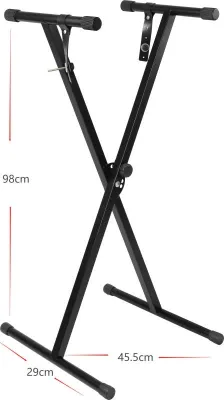
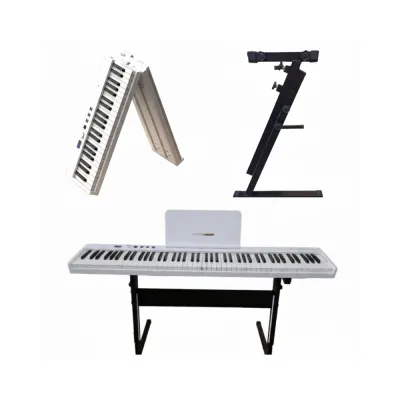
Prices are valid at publication and may change. Please refer to the product page for the latest price.
A standard piano has 88 keys, spanning over seven octaves. While 61-key and 76-key keyboards are lighter and more compact, they limit the repertoire you can play. Within the first year of study, many classical pieces and modern arrangements require notes outside the five-octave range of a 61-key board, making an 88-key instrument the most future-proof investment.
Polyphony refers to the number of individual notes or voices the piano can produce simultaneously. For a beginner, a minimum of 64-note polyphony is recommended, though 128-note or higher is ideal. When you use the sustain pedal, notes continue to sound even after you release the keys; low polyphony causes older notes to cut off abruptly, ruining the expressiveness of your practice.
Built-in tools can significantly enhance your practice sessions. A built-in metronome is essential for developing a steady sense of rhythm. Recording functions allow you to listen back to your playing objectively to identify mistakes, while a split-keyboard or duet mode divides the keyboard into two identical pitch ranges, allowing a teacher and student to play side-by-side on the same instrument.
How to Evaluate Manning Piano Specifications
When browsing Manning product catalogs or manuals, look closely at the keyboard specifications. Terms like “Graded Hammer Action,” “Progressive Hammer Action,” or “Scaled Hammer Action” indicate that the keys feel heavier in the lower register and lighter in the higher register, just like an acoustic piano. Avoid models that only list “touch response” without mentioning weighted or hammer action, as this often means the keys are spring-loaded but merely change volume based on how fast they are pressed.

The internal sound system determines how realistic the instrument sounds in your practice space. Check the speaker wattage listed in the specifications; a dual speaker system with at least 8 to 15 watts per channel is generally sufficient for home practice. Additionally, verify the presence of a standard 6.35mm (1/4-inch) or 3.5mm headphone jack, which is crucial for silent practice sessions that will not disturb others.
Modern digital pianos offer various ports to expand their functionality. Look for a “USB-to-Host” port or a dedicated MIDI terminal, which allows you to connect the piano to a computer, tablet, or smartphone. This connection lets you use interactive learning apps, notation software, and virtual instruments. Some contemporary models also feature Bluetooth MIDI or Bluetooth Audio, allowing wireless connection to educational devices or letting you play along with songs streamed from your phone.
While digital keyboards often boast hundreds of sounds, a piano student should focus primarily on the quality of the main acoustic piano voice. Look for specifications that mention multi-layered sampling, which means the instrument plays different recorded sounds depending on how hard you strike the key. A high-quality sample captures the natural resonance and decay of a grand piano, providing a more inspiring and realistic playing experience.
Digital vs. Acoustic Formats for First-Time Buyers
In Singapore, where residential spaces like HDB flats and condominiums often have compact layouts, the physical footprint of an instrument is a major consideration. A digital console piano is relatively slim, lightweight, and can be easily placed against a wall or moved to a different room if needed. In contrast, a traditional acoustic upright piano is incredibly heavy, requires professional movers, and occupies a permanent, substantial footprint in your living area.
One of the greatest advantages of a digital piano in high-density housing is the ability to control the volume. You can turn down the master volume or plug in headphones to practice at any time of the day or night without worrying about noise complaints from neighbors. Acoustic pianos are naturally loud, and while some have a practice pedal that drops a felt strip between the hammers and strings, they cannot be played silently.
Singapore’s tropical climate, characterized by high humidity and temperature fluctuations, poses a significant challenge for acoustic instruments. Acoustic pianos are made of wood and felt, which expand and contract with humidity, requiring regular tuning (usually twice a year) and the constant use of a piano heater or dehumidifier to prevent damage. Digital pianos, being electronic, do not go out of tune and are far less sensitive to humidity, though they still benefit from being kept away from direct sunlight and extreme moisture.
If you anticipate needing to transport your instrument for lessons, school performances, or community events, a portable digital piano is the only practical option. These models can be detached from their stands and carried in a padded gig bag. Acoustic pianos and heavy digital cabinet consoles are strictly stationary and cannot be moved without professional assistance.
Pre-Purchase Inspection and Verification Checklist
Before finalizing your purchase, it is vital to perform a physical inspection of the specific unit you intend to buy, or a floor model of the same design. Sit at the keyboard and press every single key one by one, from the lowest bass note to the highest treble note. Listen carefully for any unusual clicking, squeaking, or mechanical clatter, and ensure that each key returns to its resting position promptly and smoothly without sticking.
Test the pedals to ensure they function correctly and feel sturdy underfoot. On digital models, check if the sustain pedal supports “half-pedaling,” which allows for a gradual dampening effect rather than a simple on-and-off switch. The pedal should not squeak when pressed, and it should have enough resistance to allow you to rest your foot lightly on it without accidentally activating the effect.
Inspect the overall build quality of the cabinet or stand. Shake the instrument gently to ensure it does not wobble, as a shaky stand can be highly distracting and unsafe during energetic playing. Check the responsiveness of all physical buttons, sliders, and the display screen if the model has one, making sure they transition smoothly between settings without lag or freezing.
Confirm what is included in the purchase price. A complete beginner package should ideally include a sturdy, height-adjustable bench, a sustain pedal, a music rest for sheet music, and a power adapter. Always verify the manufacturer’s warranty terms and the retailer’s return policy, ensuring you have clear recourse if any electronic or mechanical defects arise after delivery.
Frequently Asked Questions (FAQ)
Is a 61-key keyboard enough for a beginner?
A 61-key keyboard can serve as a temporary, budget-friendly starting point for the first few months of lessons, particularly for young children. However, it quickly becomes a bottleneck as you progress. Most standard beginner method books and classical pieces expect a wider range, and you will soon run out of keys on both the lower and upper ends of the board.
Furthermore, transitioning from the light, unweighted keys of a typical 61-key keyboard to a full-sized, weighted acoustic piano can be physically frustrating. The lack of resistance on smaller keyboards prevents you from developing the finger strength and control needed for expressive playing, meaning you will likely need to upgrade to an 88-key weighted model much sooner than expected.
Why is weighted key action important for new players?
Weighted key action is crucial because it replicates the physical mechanics of an acoustic piano, where a wooden key activates a felt-covered hammer to strike a string. This resistance forces your fingers to work harder, building the intrinsic hand muscles and finger independence required for proper technique. Without this resistance, players often develop a flat-fingered playing style that limits speed and accuracy.
Additionally, weighted keys are essential for learning dynamics—the ability to play softly or loudly. A weighted action gives you precise control over the speed at which the key descends, allowing you to express subtle emotional nuances in the music. Learning on an unweighted keyboard makes it incredibly difficult to control volume and tone when you eventually play on a real acoustic piano.

Community discussion
Share your experience or ask a question. Comments are reviewed before publication.