
The Yamaha PSR-E473 is a highly capable, feature-rich portable keyboard designed to offer beginners an accessible entry point into music. While its extensive specification sheet lists hundreds of features, understanding which technical details actually impact your daily practice is crucial. This guide translates the technical jargon into practical realities, helping you decide if this keyboard aligns with your musical goals or if you should consider a different instrument.
Choosing your first keyboard involves balancing functionality, space, and budget. By focusing on the core specifications that affect playability, sound quality, and learning integration, you can make a confident decision that supports your musical development over the long term.
Key Count and Touch Response: Building the Right Foundation
The Yamaha PSR-E473 features a 61-key layout, which represents five full octaves. For a beginner, this range is highly practical because it easily accommodates basic music theory exercises, scale practice, and the vast majority of popular songs. It also keeps the instrument compact and lightweight, making it easy to store in smaller living spaces or transport to lessons.
Products mentioned in this guide
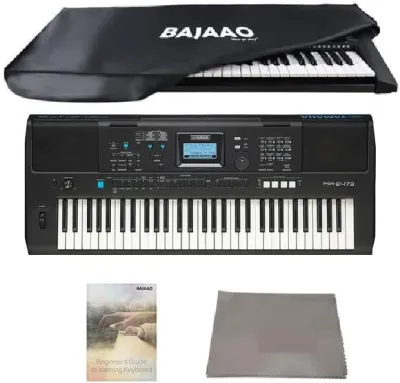
![Yamaha PSR-E473 61-key [With Keyboard Adapter Keyboard Stand and Keyboard Sustain Pedal]](https://img.lazcdn.com/g/p/0775fb7dd3e7c0109cea1aa874d9a613.jpg_400x400q80.jpg_.webp)
![Yamaha PSR-E473 61-key [With Keyboard Adapter]](https://img.lazcdn.com/g/p/259e70c609cfb678481a45d2fa3de44e.jpg_400x400q80.jpg_.webp)
Prices are valid at publication and may change. Please refer to the product page for the latest price.
However, a 61-key keyboard does have physical limitations. If you plan to study classical piano repertoire, you will eventually encounter pieces that require the extreme high and low registers of a standard 88-key piano. For early-stage learning and modern music styles, 61 keys provide more than enough room to grow without feeling restricted.
Beyond the number of keys, “Touch Response” is the most critical specification for any beginner keyboard. This feature, also known as velocity sensitivity, means the keyboard detects how hard or soft you strike the keys. If you press a key firmly, the sound is loud; if you press it gently, the sound is quiet.
Practicing on a keyboard with touch response is essential for developing finger strength and learning dynamic expression. Without it, your playing will sound flat and mechanical, resembling a toy rather than a musical instrument. We recommend verifying the touch sensitivity settings in the user manual, as most players prefer to adjust the sensitivity level to match their natural finger strength.
Voices and Polyphony: Separating Gimmicks from Useful Tools
The specification sheet for the PSR-E473 boasts hundreds of built-in “Voices,” which are the different instrument sounds available on the keyboard. While experimenting with synthesizers, drums, and brass sounds can make practice sessions highly entertaining, beginners should prioritize the quality of the primary acoustic and electric piano tones.

A realistic, high-quality piano sound is vital because it helps train your ear to recognize correct pitch and tonal character. When evaluating a keyboard, focus on how natural the main grand piano voice sounds when sustained. High-quality core sounds will keep you engaged and motivated to practice far longer than a massive library of novelty sound effects.
Another critical technical term is “Polyphony,” which refers to the maximum number of individual notes the keyboard can produce at the exact same time. The PSR-E473 offers 64-note polyphony. While this might sound like more notes than you have fingers, polyphony is consumed rapidly when you use a sustain pedal or layer two voices together.
When polyphony is too low, older notes are abruptly cut off to make room for new ones, resulting in a choppy sound. A specification of 64-note polyphony is generally sufficient for beginners, ensuring that your sustained chords and layered sounds remain smooth and continuous without noticeable dropouts.
Built-in Lessons and Connectivity: Supporting Your Practice Routine
Modern learning often relies on a mix of traditional practice and digital assistance. The PSR-E473 includes built-in lesson functions designed to help you break down songs step-by-step. These tools allow you to practice the left-hand and right-hand parts separately, adjust the tempo to a comfortable speed, and gradually build up to the original performance tempo.
In addition to onboard tools, connectivity ports expand how you can interact with the instrument. The “USB to Host” port is a highly valuable specification, allowing you to connect the keyboard directly to a computer, tablet, or smartphone. This connection enables you to use interactive learning applications, music notation software, or basic digital audio workstations.
The keyboard also features an “Audio In” port, which lets you connect an external music player or smartphone. This allows you to play backing tracks or tutorial audio directly through the keyboard’s built-in speakers, creating an integrated practice environment.
Before purchasing accessories, always consult the manufacturer’s official documentation to confirm the exact cable types and adapter requirements. Ensuring compatibility with your specific tablet or computer model beforehand will save you time and prevent setup frustration.
Who Should Choose the PSR-E473 (and Who Should Look Further)?
The Yamaha PSR-E473 is an ideal choice for beginners, casual hobbyists, and aspiring songwriters who need a portable, versatile instrument. Its combination of touch-sensitive keys, diverse sounds, and modern connectivity provides an excellent platform for exploring different musical genres and learning the basics of keyboard playing.
However, your long-term goals should dictate your choice. If your primary ambition is to study classical piano and progress through formal graded examinations, you will eventually outgrow this keyboard. Classical students require a full 88-key layout with fully weighted hammer-action keys that accurately replicate the physical resistance of an acoustic piano.
For those living in Singapore, purchasing from an authorized local dealer is highly recommended. This ensures you receive a valid local warranty, access to genuine accessories, and reliable after-sales technical support should you encounter any issues with your instrument.
Frequently Asked Questions (FAQ)
Is the Yamaha PSR-E473 good for learning piano?
The Yamaha PSR-E473 is a highly suitable instrument for early-stage learning, music theory, and casual playing. Its touch-sensitive keys allow you to practice basic dynamics, and its built-in lesson features support independent study. However, because it lacks fully weighted keys, it is not a direct substitute for a digital or acoustic piano if your goal is to master advanced classical piano techniques.
Does the PSR-E473 have weighted keys?
No, the PSR-E473 does not have weighted keys. It features touch-sensitive (velocity-sensitive) keys, which respond to the force of your touch but do not provide the physical resistance or hammer-action feel of an acoustic piano. If you are concerned about key resistance, we recommend visiting a local showroom to test the key feel in person or watching official demonstration videos to observe the action.

Community discussion
Share your experience or ask a question. Comments are reviewed before publication.