
Choosing the right drumstick is one of the most direct ways to influence your sound, playing comfort, and physical longevity behind the kit. The three primary wood species used in drumstick manufacturing—hickory, maple, and oak—each possess distinct physical properties that dictate how they feel in your hands and how they interact with your drums and cymbals. By understanding the differences in density, weight, durability, and shock absorption, you can select a stick that complements your genre, technique, and physical comfort.
A drummer’s relationship with their sticks is highly tactile. Every stroke sends vibrations back through the fingers, wrists, and arms, while the physical weight of the stick determines how much effort is required to execute fast fills or heavy backbeats. While factors like tip shape and taper play significant roles, the underlying wood species forms the foundation of the stick’s performance.
There is no single superior wood for every drummer. A jazz player seeking delicate cymbal articulation and rapid-fire speed will have vastly different requirements than a heavy metal drummer who needs maximum durability and high-volume projection. Consequently, selecting the right material involves balancing trade-offs between weight, durability, and shock absorption to find the perfect match for your playing style.
Products mentioned in this guide
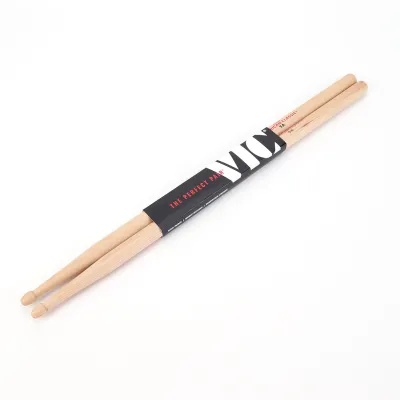
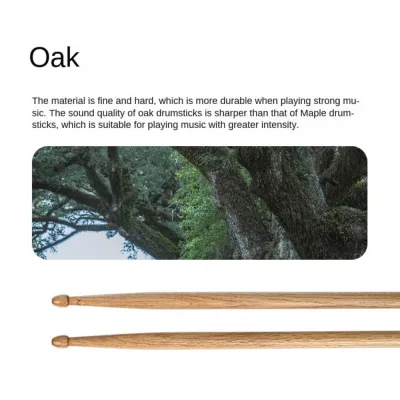
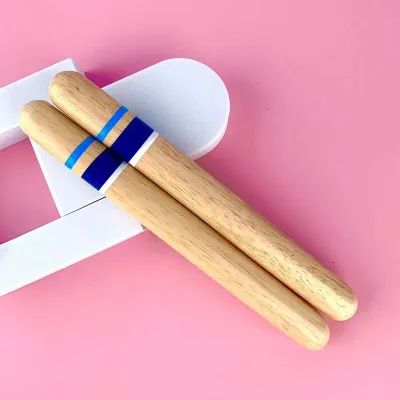
Prices are valid at publication and may change. Please refer to the product page for the latest price.
Understanding the Core Differences in Wood Density and Weight
Density is the primary physical characteristic that distinguishes these three wood types. Maple is the least dense of the three, followed by hickory as the industry standard, and oak as the densest and heaviest. This density hierarchy directly impacts the physical weight of the drumstick, even when comparing sticks of the exact same model and dimensions, such as a standard 5A.
Because maple is a lightweight, low-density hardwood, a maple stick feels agile and effortless in the hand. This lower density allows manufacturers to produce thicker sticks, such as a 2B or 5B profile, that remain remarkably light. Drummers who use maple can achieve a thicker grip for comfort without the wrist-straining weight that usually accompanies larger stick diameters. This makes maple highly suitable for fast, intricate playing styles where rapid movement is prioritized over sheer volume.
Hickory represents the golden mean of drumstick materials. It possesses a medium-to-high density that provides a satisfying, balanced weight in the hand. This balance is why hickory has become the global standard for drumstick manufacturing. It offers enough heft to produce a solid, powerful stroke without causing premature arm fatigue during long practice sessions. Most players find that hickory provides a natural, intuitive weight distribution that adapts easily to almost any musical genre.
Oak sits at the top of the density scale. It is a highly dense, heavy hardwood that packs significant mass into a standard stick profile. An oak stick of the same dimensions as a maple or hickory stick will feel noticeably heavier and more front-weighted. This extra mass translates directly into greater momentum during the swing, allowing the player to produce high volume and powerful projection with less physical effort. However, this added weight can also lead to faster arm fatigue if the player is not accustomed to managing the increased inertia.
Because natural wood is subject to environmental variations, two pieces of the exact same wood species can differ slightly in weight. Furthermore, different manufacturers employ unique drying and treatment processes that can alter the final density. Players should always consult the manufacturer’s detailed specifications for exact weight ranges and diameter measurements, keeping in mind that even minor dimensional adjustments can significantly alter how a specific wood species feels in the hand.
Durability and Lifespan: What to Expect from Each Wood Type
The durability of a drumstick is closely tied to its wood grain structure and how that structure responds to repeated high-velocity impacts. When a drumstick strikes a metal cymbal edge or a hard rim, the wood fibers compress and shear. Over time, this mechanical stress leads to structural fatigue, which manifests as chipping, splintering, or eventual snapping at the shoulder or tip.

Maple, being the softest and least dense of the three woods, has the shortest lifespan under heavy impact. Its loose grain structure is prone to rapid wear, especially when subjected to aggressive rimshots or consistent shoulder-striking on cymbal edges. For light, fast players who focus on jazz, acoustic sets, or orchestral percussion, maple can last a reasonable amount of time. However, heavy hitters will find that maple sticks chip and split quickly, making them an expensive choice for high-volume genres.
Hickory offers excellent durability due to its fibrous, resilient grain structure. The wood fibers in hickory are highly interlocking, which allows the stick to absorb repeated impacts without immediately shearing. When hickory sticks begin to wear, they tend to compress and gradually shave off in small fibers rather than snapping cleanly. This gradual wear pattern gives the drummer ample warning before the stick fails completely, making it a highly reliable option for both practice and live performances.
Oak is renowned for its exceptional hardness and resistance to wear. The tight, dense grain of oak makes it highly resistant to chipping and denting, even when subjected to punishing rimshots and heavy cymbal work. For heavy hitters in rock, metal, or marching band contexts, oak sticks offer the longest lifespan of the three materials. Instead of splintering gradually like hickory, oak tends to maintain its structural integrity for a long time, though when it does finally fail, it may snap suddenly along the grain line due to its rigid nature.
To ensure safety and maintain consistent playability, drummers must regularly perform visual and tactile checks on their sticks. Run your fingers along the shoulder and neck of the stick to feel for deep grooves, cracks, or soft spots caused by cymbal impacts. Inspect the wood tip for chipping or flattening, as a damaged tip can easily tear drumheads. If a stick exhibits deep splintering, a hollow sound when tapped, or significant structural warping, it should be retired immediately to prevent sudden breakage during a performance.
Feel, Rebound, and Cymbal Response
Beyond weight and durability, the choice of wood profoundly affects the tactile feedback—or feel—of the stick, as well as the acoustic tone produced by the instruments. When a stick strikes a surface, a shockwave travels back up the shaft into the player’s hands. The wood’s natural elasticity determines how much of this energy is absorbed by the stick and how much is transferred directly to the drummer’s joints.
Hickory is highly celebrated for its natural shock-absorbing properties. It possesses a unique elasticity that dampens the harsh vibrations of high-impact strikes before they reach the hands and wrists. This shock absorption is crucial for maintaining joint comfort and reducing the risk of repetitive strain injuries, such as tendonitis, during extended practice sessions. The rebound of a hickory stick is predictable and lively, offering a balanced response off both drumheads and practice pads.
Maple, due to its lightweight and flexible nature, also provides excellent shock absorption and a very soft, forgiving feel. The rebound of a maple stick is exceptionally fast and springy, allowing for effortless double-stroke rolls and intricate ghost notes. Acoustically, maple produces a warm, soft, and dark tone on cymbals. The delicate tip response of a maple stick is highly prized by jazz drummers who want to draw out the complex, smoky overtones of thin ride cymbals without overpowering the ensemble.
Oak, by contrast, is a rigid and unyielding material. Because of its extreme density, oak transfers significantly more shock directly to the player’s hands and wrists. Drummers who use oak must employ proper technique and a relaxed grip to avoid discomfort or joint fatigue over time. However, this rigidity results in an incredibly bright, clear, and articulate cymbal response. An oak stick produces a sharp, defined ping on ride cymbals and a cutting, high-pitched crack on snare drums, making it ideal for cutting through dense walls of amplified guitars.
Because feel and acoustic response are highly subjective, players should avoid purchasing sticks in bulk based solely on theoretical descriptions. The unique interaction between your grip, your striking technique, and the wood’s natural resonance can only be verified through hands-on testing. It is highly recommended to test a pair of each wood type on an actual drum kit or a high-quality practice pad to evaluate how the rebound, weight distribution, and shock transfer align with your personal comfort and musical preferences.
Decision Framework: Which Drum Stick Wood Matches Your Needs?
To help you navigate these material differences, consider the following decision framework based on your primary playing style, physical needs, and performance environment.
- Choose Hickory if: You need a versatile, balanced stick that offers a middle ground in weight, durability, and shock absorption for general-purpose playing. Hickory is the ideal starting point for beginners and a reliable default for multi-genre session drummers who require a stick that can transition seamlessly from delicate acoustic passages to heavy rock backbeats.
- Choose Maple if: You prioritize a lightweight feel, faster swing speeds, reduced arm fatigue, and a brighter, warmer cymbal response, accepting a potentially shorter lifespan under heavy use. Maple is excellent for jazz, orchestral work, low-volume acoustic gigs, or for players who prefer a thicker stick diameter without the added weight.
- Choose Oak if: You play with high impact, require maximum durability and volume, and prefer a dense, heavy stick that minimizes breakage, while accepting higher shock transfer to the hands. Oak is the premier choice for heavy rock, metal, marching percussion, and any scenario where projection and stick longevity are paramount.
- Verify first if: The sticks feature specialized coatings, non-standard tapers, or synthetic tips. For example, a nylon tip will produce a much brighter, more consistent cymbal sound regardless of the wood type, while heavy lacquer or grip coatings can alter the stick's weight, slip resistance, and vibration transfer.
| Wood Type | Relative Weight | Durability | Shock Absorption | Ideal Playing Style |
|---|---|---|---|---|
| Maple | Light | Low to Medium | High (Soft Feel) | Jazz, Acoustic, Orchestral, Fast Technical Playing |
| Hickory | Medium | High | High (Balanced Feel) | General Purpose, Rock, Pop, Fusion, All-Rounders |
| Oak | Heavy | Very High | Low (Rigid Feel) | Heavy Rock, Metal, Marching, High-Volume Genres |
Frequently Asked Questions (FAQ)
Do synthetic or carbon fiber drumsticks outperform wood?
Synthetic and carbon fiber drumsticks offer extreme durability and near-perfect weight consistency from pair to pair, but they do not universally outperform natural wood. While they resist breaking and do not warp, synthetic sticks lack the natural feel, organic rebound, and complex acoustic resonance of wood. Furthermore, synthetic materials are highly rigid and transfer significantly more shock directly to the hands and wrists, which can lead to joint strain if proper technique is not maintained. Additionally, some music schools, instructors, or venues restrict the use of hard synthetic sticks because they can cause accelerated wear on drum rims, cymbals, and practice pads.
How can I extend the lifespan of my wooden drumsticks?
To maximize the lifespan of your wooden drumsticks, start by rotating between multiple pairs during practice sessions; this allows the compressed wood fibers to rest and recover from moisture and impact. Next, evaluate your setup and technique: ensure your cymbals are mounted at a slight angle rather than flat, and strike them with a glancing blow rather than hitting directly against the sharp edge, which causes premature shoulder snapping. Finally, store your sticks in a stable environment, such as a dedicated stick bag kept away from extreme humidity, direct sunlight, or rapid temperature changes. In tropical climates like Singapore, high humidity can cause wood to absorb moisture and warp, so keeping your sticks in a dry, climate-controlled room is essential for maintaining their straightness and structural integrity.

Community discussion
Share your experience or ask a question. Comments are reviewed before publication.