
Starting your piano journey is an exciting milestone, but staring at a blank row of 88 identical black and white keys can feel incredibly daunting. Many beginners in Singapore, practicing on compact digital pianos in their apartments, turn to visual aids to bridge the gap between sheet music and the physical keyboard. The ideal choice of keyboard sticker keys depends heavily on your learning style, your instrument’s material, and how quickly you want to transition to playing without looking at your hands. While full-note adhesive labels offer immediate gratification, minimalist markers or non-adhesive silicone strips often provide a more sustainable path to true musical literacy.
Do You Actually Need Keyboard Sticker Keys?
Before purchasing any visual aids, it is essential to weigh their immediate benefits against their long-term impact on your playing habits. Keyboard stickers act like training wheels on a bicycle; they help you get moving quickly, but keeping them on too long can prevent you from developing balance. The primary trade-off is between rapid initial orientation and the development of spatial muscle memory. When every key is labeled, your eyes naturally look down at the keyboard rather than up at the sheet music, which can severely delay your sight-reading skills.
Certain learner profiles benefit from temporary visual aids. Young children developing spatial awareness, or adult hobbyists playing simple pop melodies by ear, find stickers highly encouraging. These markers reduce initial cognitive load, making early practice sessions feel rewarding.
Products mentioned in this guide
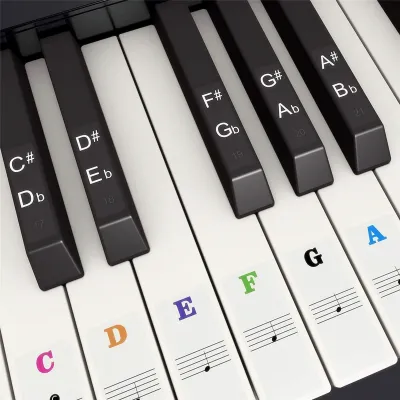
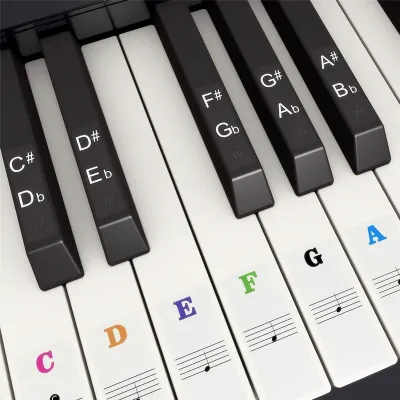
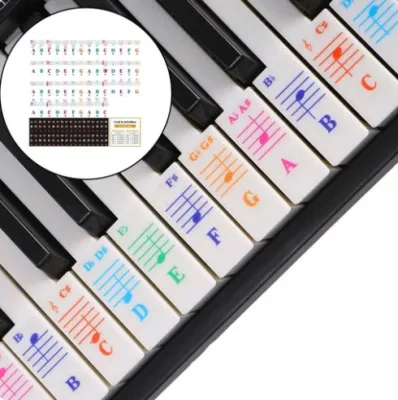
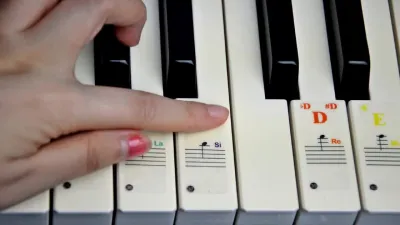
Prices are valid at publication and may change. Please refer to the product page for the latest price.
However, if your goal is to progress through classical grades or read sheet music fluently, relying heavily on visual key markers can quickly become a hindrance. A clear sign of the “dependency trap” is being unable to play a simple melody on an unlabeled piano, or seeing your reading speed drop to zero when looking away from the keys. True keyboard familiarity comes from feeling the patterns of the black keys (groups of twos and threes) to navigate the white keys blindly.
Comparing Types of Keyboard Stickers for Beginners
If you decide that a visual aid is the right choice for your current learning stage, you will find three primary categories available on the market. Each style aligns with a different cognitive approach, ranging from highly detailed alphabetical guides to minimalist reference dots. Before applying any adhesive product to your instrument, always consult your keyboard manufacturer’s care guidelines. Some high-end digital pianos feature textured keytops designed to mimic natural ivory and ebony, which can be easily discolored or stripped by strong adhesives.

Full Note Letter Labels
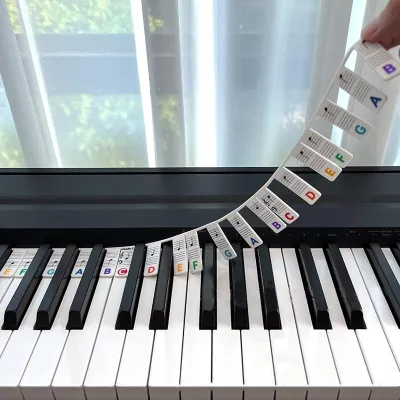
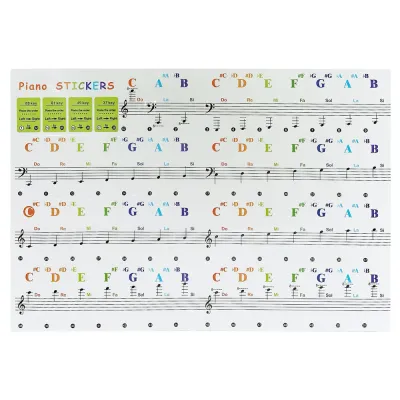
Full note letter labels are the most common type of keyboard sticker keys, typically displaying the note name along with its corresponding position on the musical staff. This style is highly effective for absolute beginners who need immediate key recognition to play their first tunes, or self-taught adults matching notes from basic chord charts. They eliminate guesswork, allowing you to focus on finger coordination and rhythm during your first few weeks.
However, the major drawback is the intense visual clutter they introduce. Having dozens of letters and staff lines constantly in your field of vision can be overwhelming. More importantly, they create a strong dependency; your brain begins to read the letters on the keys rather than recognizing the physical shape of the keyboard or the notes on the page, stalling your sight-reading development.
Color-Coded Stickers
Color-coded stickers assign a specific color to each note of the octave, grouping identical notes across different octaves into easily recognizable color families. This approach is exceptionally well-suited for young children or visual learners. Many beginner method books and educational apps use color-matched sheet music, allowing students to play complete songs simply by matching colors.
However, color-coded systems do not translate well to standard musical environments. Standard sheet music is strictly black and white, and acoustic pianos in music schools or exam halls will not have colorful markers. If a student becomes entirely dependent on color cues, they may experience severe disorientation and a loss of confidence when transitioning to a standard instrument.
Removable Key Markers and Dots
For learners who want to build sustainable habits from day one, minimalist removable key markers and dots are often the most recommended option. Instead of labeling every single key, these small, unobtrusive stickers are placed only on strategic reference points, such as Middle C or the boundaries of specific octaves. This style is perfect for beginners who want just enough guidance to orient their hands without cluttering the entire keybed.
By marking only a few anchor points, you are forced to use the natural geography of the keyboard—specifically the alternating groups of two and three black keys—to find the rest of the notes. Because these markers offer the lowest visual distraction, they actively encourage spatial awareness, helping you look up at your sheet music more often and rely on tactile feedback.
How to Transition Away from Keyboard Stickers
Using keyboard stickers should always be a temporary phase. To avoid frustration, plan a structured, gradual transition to a clean keyboard rather than removing all stickers at once. A highly effective phased removal strategy involves taking off the markers in stages. Start by removing the stickers from the black keys first, as their physical groupings of twos and threes make them easy to identify. Next, remove the stickers from the extreme high and low octaves where you rarely play. Finally, begin removing alternating white keys in the central octave, leaving only a few reference points like C and F, before eventually removing those as well.
During this weaning process, incorporate exercises to build physical memory. Practice playing simple five-finger scales with your eyes closed, focusing on how the keys feel beneath your fingertips. Work on interval recognition exercises, learning to identify the physical distance between a third (skipping one key) and a fifth (skipping three keys) purely by touch.
When removing adhesive stickers, protect your instrument’s keybed. Singapore’s humid climate can cause adhesives to degrade over time, leaving a gummy residue that attracts dust. Avoid harsh chemical solvents like acetone, which can permanently melt or discolor plastic keys. Instead, use a tiny amount of mild soapy water on a microfiber cloth, or a specialized, electronics-safe adhesive remover. Wipe the keys gently, ensuring no liquid drips down between the keys into the sensitive electronic contacts below.
Alternatives to Physical Keyboard Stickers
If you are hesitant to apply adhesives to your piano, several excellent non-destructive alternatives are available. One popular option is choosing an electronic keyboard with built-in lighted keys. These instruments feature keys that illuminate to guide your fingers, often syncing with built-in lesson suites or interactive learning apps. While engaging for casual practice, ensure you can turn this feature off easily so you do not become permanently dependent on the lights.
Another practical alternative is the use of removable silicone keyboard note strips. These flexible, one-piece overlays lay flat across the top of your keys without any adhesive. They can be placed on the keyboard during practice sessions and lifted off in a single second when you want to test your memory. Before purchasing, always verify compatibility with your specific instrument, checking both the key count (such as 61-key or 88-key layouts) and the exact width of the keys to ensure a snug fit.
Finally, a traditional paper keyboard map placed on your music stand right behind the keys provides a zero-risk visual guide. Because the map is not physically on the keys, it forces your eyes to look up and away from your fingers, naturally promoting better posture and faster transition to reading standard sheet music.
Frequently Asked Questions (FAQ)
Will keyboard stickers damage my piano keys?
The risk of damage depends heavily on your piano’s key material and the quality of the sticker’s adhesive. Standard plastic keys on entry-level electronic keyboards are relatively resilient but can still be scratched or dulled by low-quality adhesives. High-end digital pianos and acoustic pianos often feature synthetic ivory or wooden keys, which are highly porous and easily stained or warped by moisture and chemical adhesives. Always check your instrument manufacturer’s care instructions and test a single sticker on an inconspicuous key, such as the very highest key on the keyboard, before labeling the entire set.
Should I put stickers on all 88 keys?
For the vast majority of beginners, labeling all 88 keys is highly discouraged. Most beginner piano repertoire is concentrated in the middle of the keyboard, spanning only two or three octaves around Middle C. Labeling the extreme bass and treble keys creates unnecessary visual noise and clutter, making it harder to focus on the notes you actually need. It is far more effective to limit your markers to the central octaves, allowing your eyes to naturally adapt to the clean, unlabeled keys at the outer edges of the instrument as your playing range expands.

Community discussion
Share your experience or ask a question. Comments are reviewed before publication.