
Choosing the right Secondary 3 exam paper compilation is a pivotal decision that shapes your academic trajectory leading up to the Singapore-Cambridge GCE O-Level examinations. As you transition into upper secondary, the volume of content and the complexity of assessment objectives increase significantly. A well-chosen compilation does not merely offer a collection of questions; it serves as a diagnostic tool to pinpoint conceptual gaps, a training ground for exam stamina, and a roadmap for mastering the specific answering techniques required by examiners. By focusing on resources that match your academic standing and target your specific subject vulnerabilities, you can establish a highly resilient foundation before entering the high-stakes environment of Secondary 4.
To make an informed purchase, you must look beyond attractive cover designs or generic marketing promises. The most suitable compilation must align directly with the latest Ministry of Education (MOE) syllabus, offer comprehensive step-by-step solutions, and provide a structured progression in difficulty. Whether you are struggling with the abstract concepts of Additional Mathematics or trying to structure coherent essays for Humanities, the way you select and utilize these practice papers will directly influence your revision efficiency. This guide outlines a systematic approach to evaluating these books, aligning them with your learning needs, and integrating them into a highly productive study routine.
Understanding the Role of Sec 3 Exam Papers in O-Level Prep
Secondary 3 represents a major academic shift, characterized by a steep increase in cognitive demand and marking rigor compared to lower secondary levels. In lower secondary, assessments often focus on direct recall and straightforward application of basic concepts. In contrast, upper secondary subjects demand higher-order thinking skills, such as synthesis, critical evaluation, and the application of knowledge to unfamiliar real-world scenarios. This transition can be jarring for many students, as the grading criteria become far more stringent, requiring precise terminology and structured logical flows to secure full marks.
Products mentioned in this guide
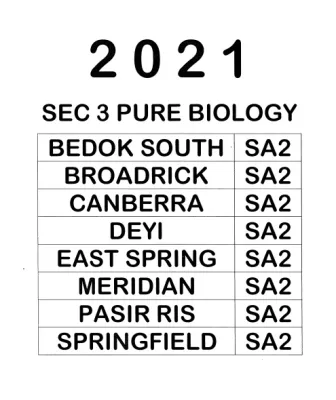
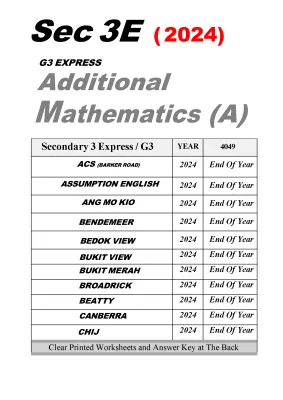
Prices are valid at publication and may change. Please refer to the product page for the latest price.
Using targeted Secondary 3 exam paper compilations helps bridge this academic gap by exposing you to the exact format and style of questions you will encounter in major assessments. Rather than waiting until the final year to practice under exam conditions, engaging with these papers early allows you to adapt to the increased depth of the curriculum. This early exposure is particularly crucial for subjects like Pure Sciences and Humanities, where the volume of content is vast, and the ability to link different topics within a single question is highly tested.
Furthermore, these compilations are invaluable for building exam stamina and time-management skills. A typical upper secondary paper requires sustained concentration over two to three hours, a significant jump from the shorter tests of lower secondary. By practicing with full-length papers, you train your mind to remain focused and analytical even under time pressure. You learn how to allocate your time strategically across different sections, ensuring that you do not spend too much time on low-weightage questions at the expense of high-value structured problems.
Finally, Secondary 3 practice papers serve as an early warning system for identifying foundational knowledge gaps. Because Secondary 4 is highly compressed and focused on intensive revision, you cannot afford to carry unaddressed misconceptions into your final year. Working through comprehensive compilations allows you to discover which topics require immediate remediation. Addressing these weaknesses during Secondary 3 ensures that your foundation is secure, allowing you to focus on advanced integration and exam strategies when you enter Secondary 4.
How to Evaluate the Quality of an Exam Paper Compilation
When browsing online marketplaces or physical bookstores, you will find a wide array of assessment books and exam compilations. To separate high-quality educational resources from poorly put-together materials, you must evaluate several critical components, starting with the depth and clarity of the worked solutions. A high-quality compilation must provide comprehensive, step-by-step breakdowns for every question, rather than just listing the final numerical answer or a brief one-sentence summary. For mathematical and scientific subjects, the solutions should clearly show the formulas used, the intermediate algebraic steps, and the units of measurement. For languages and humanities, the guide should offer model essays or structured outlines that demonstrate how to construct a coherent argument.

In addition to basic solutions, premium compilations often feature examiner insights, common student pitfalls, and marking scheme annotations. These additions are incredibly valuable because they teach you how examiners think and what they look for when grading. Understanding why a certain phrasing is rejected or why a specific step is mandatory helps you avoid careless mistakes that could cost you precious marks. Look for books that highlight typical misconceptions, as this direct feedback helps you self-correct during your independent study sessions.
The physical layout and usability of the book are also important factors that affect your learning experience. A good compilation should have a clean, readable layout with adequate space for working out problems directly on the page. Books with cramped text, tiny fonts, or insufficient writing space can make studying feel tedious and disorganized. Having enough room to write down your full logical steps allows you to review your thought process easily when comparing your work against the answer key.
Lastly, consider the reputation of the publisher and the editorial accuracy of the publication. Educational books that are rushed to print often contain frustrating misprints, typographical errors, or flawed solutions that can confuse you and waste your study time. Opt for established educational publishers known for rigorous editorial standards and accurate content. You can verify this by checking the preface, looking for endorsements from experienced educators, or reviewing the errata sheets if available. Investing in an accurate, well-edited book ensures that your practice remains productive and free from unnecessary confusion.
Aligning Your Choice with Specific Subject Weaknesses
Every student has a unique academic profile, with specific strengths in some areas and distinct weaknesses in others. Therefore, a one-size-fits-all approach to buying exam papers is rarely effective. You must first decide whether to purchase single-subject volumes or multi-subject bundles. Single-subject compilations are highly recommended if you have a severe weakness in a specific subject, such as Additional Mathematics or Chemistry. These dedicated books offer a deeper pool of questions and more varied problem types, allowing you to perform intensive, focused practice on the areas where you struggle the most. On the other hand, multi-subject bundles can be a cost-effective option if you want a general overview of all your subjects and need to maintain a consistent baseline of practice across the board.
Another crucial factor is the difficulty gradient of the questions within the compilation. A well-designed book should offer a balanced mix of basic recall questions, intermediate application problems, and challenging, higher-order thinking tasks. If a book is too easy, it will not prepare you for the rigors of the actual examinations; if it is consistently too difficult, it may damage your confidence and lead to frustration. Look for compilations that clearly label the difficulty level of each paper or section, enabling you to progress systematically from foundational exercises to highly complex, non-routine problems.
You must also choose between topical arrangements and full-paper formats based on your current stage of revision. Topical compilations group questions by specific chapters, making them ideal for targeted revision immediately after a topic is taught in school. This format helps consolidate your understanding of individual concepts before moving on to the next unit. Conversely, full-paper formats simulate the actual examination structure, combining multiple topics into a single paper. These are highly effective when used during the lead-up to mid-year or end-of-year examinations, as they test your ability to retrieve information from different areas of the syllabus and apply it fluidly under timed conditions.
By carefully matching the format of the compilation to your specific learning goals, you can maximize the return on your study efforts. If you find yourself struggling with algebraic manipulation, a topical Additional Mathematics book is your highly effective starting point. If your issue is exam anxiety and poor time management across an entire science paper, a full-paper compilation will provide the realistic simulation you need to build confidence and speed.
Verifying Syllabus Alignment and Exam Format Before Purchase
One of the most critical steps in selecting a Secondary 3 exam paper compilation is verifying its alignment with the current Ministry of Education (MOE) syllabus. The Singapore curriculum undergoes periodic reviews and updates to ensure the content remains relevant and aligned with global educational standards. Using an outdated compilation can be highly counterproductive, as you may waste valuable time studying topics that have been removed, or miss out on newly introduced concepts that are highly likely to be tested. Always check the publication year, edition number, and the specific syllabus code printed on the cover or copyright page to ensure it matches the syllabus currently taught in your school.
When a syllabus is updated, certain topics may be shifted between levels, completely removed, or introduced for the first time. For example, changes in the mathematics or science syllabi might introduce new practical assessment formats or alter the weightage of specific topics. An outdated book will not reflect these changes, leading to a mismatch in your preparation. By cross-referencing the table of contents of the compilation with your school textbooks or the official syllabus documents available on the MOE website, you can ensure that every hour of practice is directly relevant to your upcoming exams.
In addition to topic coverage, you must ensure that the question styles in the compilation match current examination trends. Modern O-Level papers place a strong emphasis on real-world applications, data analysis, and source-based evaluation. In science subjects, this translates to complex data-response items and structured practical questions that test your experimental design skills. In humanities, it means source-based questions that require sophisticated cross-referencing and reliability checks. A high-quality compilation will feature modern question formats that mirror these trends, rather than relying solely on old-fashioned, rote-memorization questions.
Before making a purchase, take a few minutes to flip through the pages or view the online preview of the book. Look closely at the style of the questions in the later sections of each paper. If the questions seem overly simplistic or do not match the style of the sample papers provided by your school teachers, it is best to look for a suitable alternative compilation that offers a more accurate representation of modern assessment standards.
Actionable Strategies for Using Sec 3 Exam Papers
Owning the right exam paper compilation is only half the battle; the way you use it determines its ultimate impact on your grades. To get the most out of your practice, you should simulate strict exam conditions whenever you attempt a full paper. Find a quiet, distraction-free study space, set a timer to match the official duration of the paper, and put away your textbooks, notes, and mobile devices. Simulating these conditions helps you build the mental stamina required for actual exams and teaches you how to manage your pacing. It forces you to make difficult decisions, such as skipping a challenging question to secure easier marks elsewhere, which is a vital skill for exam success.
Once you complete a paper, the real learning begins during the self-assessment phase. Do not simply check your final answers and move on. Use the provided marking schemes to conduct a rigorous, honest evaluation of your work. Pay close attention to how marks are allocated for intermediate steps and specific keywords. In scientific and mathematical subjects, you can often earn partial credit even if your final answer is incorrect, provided your method is sound. Conversely, you might lose marks for omitting units, failing to show working, or using imprecise language. Understanding these nuances helps you refine your answering technique and secure every possible mark.
To prevent making the same mistakes repeatedly, maintain a dedicated error log alongside your practice papers. Whenever you get a question wrong or struggle to find the correct approach, document the question, the correct solution, and a brief explanation of your mistake in your log. Categorize your errors into conceptual misunderstandings, careless mistakes, or poor time management. Reviewing this log regularly, especially in the days leading up to an exam, keeps your common pitfalls fresh in your mind, making you much less likely to repeat them when it matters most.
Finally, do not hesitate to seek help when you encounter a solution that you cannot understand even after reviewing the answer key. Bring the specific question to your school teachers, tutors, or study groups for clarification. Asking targeted questions about a specific step in a worked solution is far more productive than asking for a general explanation of an entire topic. This proactive approach ensures that every mistake becomes a valuable learning opportunity, systematically strengthening your foundation as you progress toward your O-Level year.
Frequently Asked Questions (FAQ)
Should I buy Sec 3 papers or go straight to the O-Level Ten Year Series?
It is highly recommended to start with Secondary 3 exam paper compilations before moving on to the O-Level Ten Year Series (TYS). Secondary 3 compilations are specifically designed to cover the curriculum taught during your first year of upper secondary, allowing you to focus on consolidating this foundational knowledge. The O-Level TYS, on the other hand, contains full papers that span the entire two-year syllabus, including advanced Secondary 4 topics that you have not yet learned. Attempting the TYS too early can lead to unnecessary frustration and confusion, as you will encounter many questions you are not equipped to answer. Save the TYS for your Secondary 4 year when you have covered the complete syllabus.
Are school-specific prelim papers better than commercial compilations?
Both resources have distinct advantages, and using them in combination often yields highly effective results. School-specific prelim papers, often sourced from various top schools, are excellent for exposing you to highly challenging, non-routine questions that push your critical thinking limits. However, these papers can sometimes vary wildly in difficulty and quality, and they may lack comprehensive, professionally edited worked solutions. Commercial compilations, conversely, offer standardized editing, consistent quality control, and highly detailed step-by-step answer keys. For structured foundation building, start with high-quality commercial compilations, and use school prelim papers later to challenge yourself once your core concepts are secure.
How many years of past papers should a Sec 3 compilation include?
When selecting a compilation, the relevance of the syllabus and the quality of the worked solutions are far more important than the sheer volume of past papers. A compilation that includes three to five years of high-quality, fully aligned papers is generally more than sufficient for Secondary 3 revision. Going too far back increases the risk of practicing outdated topics or encountering question formats that are no longer relevant to the current examination standards. Focus on thoroughly understanding and mastering the papers within a smaller, highly relevant range rather than rushing through a massive volume of outdated material.

Community discussion
Share your experience or ask a question. Comments are reviewed before publication.