
Selecting your first 88-key weighted piano in Singapore requires balancing touch authenticity, digital features, and the practical realities of local living spaces. While the sheer variety of options on the market can feel overwhelming, focusing on how the instrument mimics an acoustic piano’s mechanics will ensure you build a solid foundation. By evaluating key action, sound engine capabilities, and physical dimensions, you can confidently select an instrument that supports your musical journey for years to come.
Investing in a proper instrument from the very beginning prevents the development of poor playing habits. A keyboard that feels too light or lacks dynamic responsiveness can hinder your progress, making it difficult to transition to traditional acoustic pianos in exam halls or studios. By understanding the core specifications and matching them to your specific living environment, you can make an informed decision that offers excellent value for your investment.
Understanding 88-Key Weighted Actions for Beginners
The mechanism beneath the keys is the most critical factor in determining how a digital piano plays and feels. For beginners, understanding the distinction between different key actions is essential for selecting an instrument that promotes proper finger technique and hand posture.
Products mentioned in this guide
![Casio AP-470 Digital Piano [FREE BENCH] 88 Weighted Keys Upright Celviano for Beginners and Exam](https://img.lazcdn.com/g/p/a1f8c88e81d7687a7cfc1a2264a5e81b.jpg_400x400q80.jpg_.webp)
![Roland FP-E50 Digital Piano Portable Electronic 88 Weighted Keys PHA-4 Standard Keyboard Escapement FP E50 SuperNATURAL FPE50 Bluetooth [PREORDER]](https://img.lazcdn.com/g/p/5db2ada92dc8a33ee8382f610822149b.jpg_400x400q80.jpg_.webp)
![Yamaha P-143BT Portable Digital Piano 88 Weighted Keys Bluetooth Beginners Instrument P143 P-143 [LIMITED STOCK]](https://img.lazcdn.com/g/p/b40c0a5d1400f3afb2c14a886464b0ef.jpg_400x400q80.jpg_.webp)
Prices are valid at publication and may change. Please refer to the product page for the latest price.
Unweighted keys are typically found on entry-level electronic keyboards. These keys rely on simple plastic springs to return them to their resting position, offering minimal resistance. While they are lightweight, they do not simulate the feel of a real piano, making it nearly impossible to develop the finger strength and control required for expressive playing.
Semi-weighted actions offer a slight compromise, combining spring tension with small weights attached to the keys. While they provide a bit more resistance than unweighted models, they still lack the mechanical complexity of an acoustic action. They are generally designed for portable gigging keyboards rather than serious piano study.
Fully weighted hammer actions are the preferred standard for piano students. These mechanisms use actual mechanical hammers or counterweights to replicate the leverage, inertia, and resistance of an acoustic piano’s action. When you press a key, you are moving a physical hammer assembly rather than compressing a spring, which provides the authentic resistance needed to build finger strength and muscle memory.
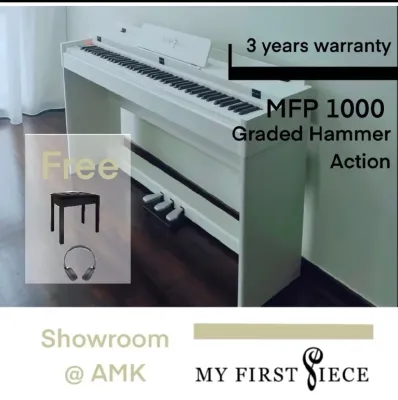
Within fully weighted actions, look for graded hammer action. On an acoustic piano, the bass keys feel heavier because they strike thicker strings, while the treble keys feel lighter. Graded digital keybeds replicate this natural variation, which is crucial for developing a balanced touch across the entire keyboard.
A full 88-key layout is also indispensable for standard piano repertoire. While smaller 61-key or 73-key instruments may seem appealing for their compact size, they will quickly limit your progress. Standard classical pieces, contemporary pop arrangements, and jazz standards frequently utilize the extreme upper and lower registers of the instrument, making a full-size keyboard a necessity from day one.
Essential Features to Evaluate for Your First Piano
Beyond the physical feel of the keys, several technical specifications directly influence how a digital piano sounds and interacts with other devices. Evaluating these features will help you choose an instrument that remains useful as your skills advance.

Polyphony is the maximum number of individual notes or voices that a digital piano can produce at the same time. When you play a chord with the sustain pedal depressed, each note continues to ring out, consuming polyphony. If you play a rapid, complex passage, a low polyphony limit will cause older notes to cut off abruptly. For beginners, a minimum of 64-note polyphony is acceptable, but 128-note or 192-note polyphony is highly recommended to ensure seamless, uninterrupted play.
Sound generation methods determine the quality and realism of the piano tones. Most digital pianos utilize acoustic sampling, which involves playing back high-resolution recordings of premium grand pianos. Look for instruments that offer multi-layered sampling, which triggers different recordings depending on how hard you strike the key, capturing the tonal changes from soft to loud. Some advanced models use physical modeling, which uses real-time mathematical algorithms to simulate the complex physical interactions of strings, soundboards, and cabinets, offering a highly organic and responsive sound.
Connectivity options are vital for modern learning methods. A USB-to-Host port allows you to connect your piano to a computer, tablet, or smartphone, enabling you to use interactive learning applications, sheet music readers, and music production software. Bluetooth MIDI provides a convenient wireless connection to these apps, while Bluetooth Audio allows you to stream backing tracks or lesson videos from your phone directly through the piano’s built-in speakers.
The built-in speaker system determines how effectively the instrument fills your practice space. Entry-level portable pianos typically feature built-in amplifiers ranging from 6 to 12 watts per channel, which is perfectly adequate for a small bedroom or study. If you plan to place the piano in a larger living area or want a deeper, more resonant bass response, look for models with higher wattage speakers or consider connecting the instrument to external active monitors.
Space and Climate Considerations for Singapore Homes
Living in Singapore introduces unique environmental and spatial factors that must be considered when purchasing a digital piano. High-density housing and a tropical climate require practical planning to ensure your instrument remains in optimal condition.
Spatial constraints in HDB flats and condominiums mean that every square centimeter counts. A standard 88-key digital piano measures approximately 130 to 140 centimeters in width. When planning your layout, you must account for the physical footprint of the keyboard, the depth of the stand, and the clearance required for a comfortable piano bench. Ensure there is enough room for you to sit with proper posture and that the pedal board can be accessed without your knees hitting the underside of the keyboard stand.
Singapore’s tropical climate, characterized by high humidity levels often exceeding 80%, can pose a threat to electronic instruments. High moisture levels can cause internal electronic components to corrode, sensor pads to degrade, and key mechanisms to become sticky or unresponsive. To protect your piano, avoid placing it near open windows, balconies, or areas exposed to direct sunlight. Using a room dehumidifier, running air conditioning periodically, or placing specialized silica gel packs inside the keyboard cover can help maintain a stable environment for your instrument.
Noise management is another crucial consideration in high-density residential areas. To practice comfortably without disturbing your neighbors, look for digital pianos with precise volume controls and dedicated headphone jacks. Having dual headphone outputs is particularly beneficial, as it allows you to practice silently alongside a teacher, parent, or duet partner without broadcasting the sound to the entire household.
Matching Piano Types to Your Learning Goals
To narrow down your choices, it is helpful to align the instrument’s form factor and feature set with your specific musical goals and lifestyle. Different styles of digital pianos cater to different types of players.
For classical students, the primary focus must be on touch realism and acoustic sound quality. If you are preparing for graded exams, prioritize instruments with highly responsive graded hammer actions, triple-sensor keybeds for rapid note repetition, and realistic pedal resonance. These features ensure that the techniques you practice at home will translate seamlessly to the acoustic grand pianos used in examination halls.
For music production and pop music enthusiasts, versatility and connectivity are more important than pure acoustic realism. Look for a slab-style digital piano that can function as a MIDI controller for your computer. These instruments often feature extensive sound libraries, including vintage electric pianos, organs, synthesizers, and string ensembles, along with dedicated pitch bend wheels and modulation controls for creative sound design.
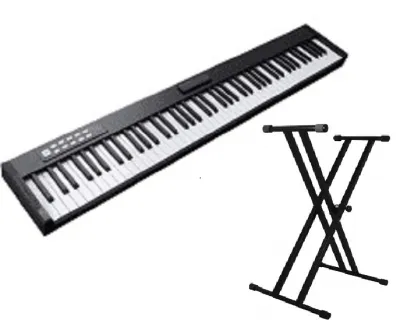
For tight spaces or multi-purpose rooms, a portable slab-style piano is often the most practical choice. These lightweight instruments can be set up on a sturdy, collapsible stand (such as a double-braced X-stand or a Z-stand) when you want to practice, and easily stored away in a closet or under a bed when you need to clear the room. This flexibility is ideal for smaller apartments where a permanent piano setup is not feasible.
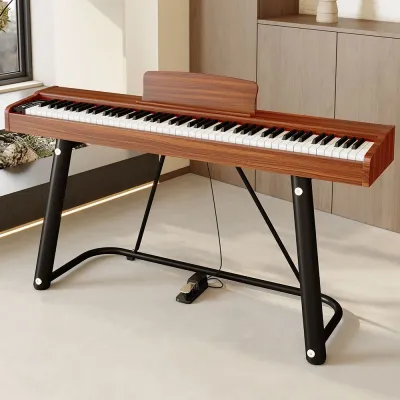
For living room aesthetics and a permanent setup, console-style cabinet pianos are the preferred option. These instruments are built into integrated wooden stands that resemble traditional upright pianos, complete with sliding key covers to protect against dust and a fixed three-pedal board. A console piano serves as an elegant piece of furniture while providing a stable, wobble-free playing experience that closely mimics an acoustic upright.
In-Store Testing and Pre-Purchase Checklist
Before committing to a purchase, visiting a local showroom in Singapore to test the instruments in person is highly recommended. This hands-on evaluation allows you to verify that the touch and sound meet your expectations.
When testing a piano, do not rely solely on the built-in demonstration songs. Sit at the instrument and play the keys yourself, even if you only know a few basic notes. Press the keys slowly to feel the initial resistance and the subtle let-off or escapement feel near the bottom of the key stroke. Play a single note repeatedly at varying strengths to ensure the volume and tone respond naturally to your touch, allowing for a wide dynamic range.
Pay close attention to the mechanical noise of the keybed. Turn the volume of the digital piano completely down or wear headphones, and play the keys firmly. A high-quality key action should operate relatively quietly; excessive clacking, thumping, or lateral key wobble indicates poor build quality or inadequate cushioning, which can become highly distracting during quiet practice sessions.
Finally, verify the purchase terms and after-sales support with the authorized local dealer. Confirm the duration of the local warranty, which typically ranges from one to three years in Singapore, and clarify what components are covered. Ask whether the purchase price includes delivery and professional home assembly, especially for heavy console-style models, and ensure that the dealer has a reliable local service center for future maintenance.
Frequently Asked Questions (FAQ)
Can I start learning on a 61-key keyboard before upgrading?
While you can learn basic music theory and simple single-hand melodies on a 61-key keyboard, it is not recommended for serious piano study. Non-weighted keys do not build the finger strength or control required for proper piano technique, and the limited range will quickly prevent you from playing standard two-handed repertoire. Starting with an 88-key weighted piano saves you from having to unlearn poor habits and avoids the extra cost of a premature upgrade.
Do I need a dedicated power conditioner for my digital piano?
For typical residential setups in Singapore, a dedicated power conditioner is generally not necessary, as the local electrical grid is highly stable. However, using a high-quality surge protector power strip is a sensible and inexpensive precaution to protect the sensitive microprocessors and internal electronics of your digital piano from occasional electrical surges or lightning strikes during storms.

Community discussion
Share your experience or ask a question. Comments are reviewed before publication.