
Deciding whether a Nioye keyboard piano is the right instrument for your musical journey depends on matching the specific model’s technical features with your personal learning goals. As an entry-level brand often found on online marketplaces, Nioye offers various models, making it essential to look past marketing buzzwords and inspect the physical specifications. A beginner needs an instrument that fosters correct finger strength and ear training, so verifying the key action, sound generation, and connectivity of your chosen model is the most reliable way to ensure a smart purchase.
Core Specifications to Verify on a Nioye Keyboard
Evaluating the key action is the most critical step when choosing any digital keyboard. For a beginner, the way the keys respond to your touch directly shapes your finger strength and playing technique. When looking at a Nioye keyboard, you will typically encounter three types of key action: non-weighted, semi-weighted, or fully weighted hammer action. Non-weighted keys offer very little resistance and are common on budget-friendly models, but they do not prepare your hands for the feel of a real piano. Semi-weighted keys provide a moderate level of spring-back resistance, which is a reasonable compromise for casual players. Fully weighted hammer action uses mechanical weights to replicate the physical hammer strike of an acoustic piano, making it the gold standard for serious learners.
Regardless of the weight, you must verify that the model features touch sensitivity, also known as velocity sensitivity. Without touch sensitivity, the keyboard will produce the same volume level whether you strike a key softly or firmly. This limitation prevents you from practicing dynamics—the soft and loud variations that give music its emotional depth. Always check the product specifications sheet or user manual to confirm that the keys are touch-sensitive before finalizing your purchase.
Products mentioned in this guide
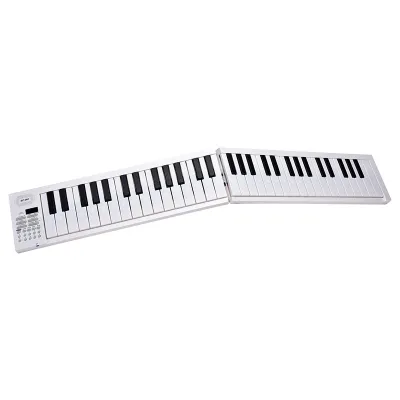

Prices are valid at publication and may change. Please refer to the product page for the latest price.
Another technical specification to verify is the polyphony count. Polyphony refers to the maximum number of individual notes or tones the keyboard can produce at the exact same time. When you play a chord while holding down the sustain pedal, the number of active notes multiplies rapidly. A low polyphony count, such as 32 notes, can cause older notes to cut off abruptly, ruining the flow of your music. For a beginner, a minimum of 64-note polyphony is highly recommended, while 128-note polyphony ensures you will not outgrow the instrument as your repertoire becomes more complex.
Finally, examine the sound engine and the variety of built-in voices. While having hundreds of novelty sounds like synth pads and sound effects can be entertaining, your primary focus should be the quality of the default acoustic piano sample. A high-quality, realistic piano sound is essential for developing your musical ear and pitch recognition. Look for models that utilize multi-layered stereo sampling, which captures the natural decay and resonance of a physical grand piano.
Learning Features and Device Connectivity
A digital keyboard should act as an active partner in your daily practice sessions. When evaluating a Nioye keyboard, look for built-in practice aids that simplify the learning process. A built-in metronome is an absolute necessity for any beginner, as it helps you develop a steady internal sense of rhythm and tempo. Dual-mode, which allows you to layer two different sounds together, and split-mode, which divides the keyboard into two distinct zones, are also highly useful. Split-mode is particularly valuable if you are taking lessons, as it allows a teacher and student to play the exact same pitch range side-by-side on a single instrument.

Modern piano learning relies heavily on interactive technology, making device connectivity a major decision factor. You should verify whether the keyboard features a USB-to-Host port or MIDI connectivity. This interface allows you to connect the keyboard to a tablet, smartphone, or computer. Once connected, you can use popular interactive learning applications, sheet music readers, or digital audio workstations to guide your practice. Some contemporary models also offer Bluetooth MIDI, which eliminates cable clutter, though you should check user feedback regarding connection stability and latency.
Do not overlook the importance of a dedicated headphone jack. One of the greatest advantages of a digital keyboard over an acoustic piano is the ability to practice silently. This feature is essential for those living in high-density housing or shared apartments, where late-night practice might otherwise disturb family members or neighbors. Ensure the keyboard has a standard headphone output, and check whether it requires a standard 3.5mm headphone plug or a larger 6.35mm professional audio adapter.
Build Quality, Setup, and Budget Alignment
The physical construction of the keyboard affects both its longevity and your overall playing comfort. Most entry-level keyboards feature a lightweight plastic chassis, which makes them highly portable but potentially susceptible to flexing under heavy use. When inspecting a Nioye model, look closely at the quality of the plastic casing and the stability of the control buttons. If you are purchasing a bundle that includes a stand, ensure it is a sturdy double-X stand or a dedicated wooden frame. A flimsy, unstable stand will cause the keyboard to wobble while you play, which can be highly distracting and may even lead to poor posture.
The sustain pedal is another critical component that requires close inspection. Many budget keyboard packages include a small, plastic foot-switch pedal. These lightweight pedals tend to slide around on smooth floors and do not offer the realistic resistance of an acoustic piano pedal. If the included pedal is basic, consider budgeting for a separate, heavy-duty, piano-style sustain pedal with a non-slip rubber base to improve your playing experience.
Before making a purchase, measure your available living space and compare it to the physical dimensions of the keyboard. An 88-key keyboard is quite long and requires a dedicated spot in your home. If you have limited space, you might need to consider whether a more compact 61-key or 76-key model is appropriate, keeping in mind that fewer keys will eventually limit the classical pieces you can play. Additionally, consider the weight of the unit; if you need to pack the keyboard away after every practice session, a lightweight model is far more practical than a heavy, semi-permanent setup.
Finally, protect your investment by verifying the warranty terms and return policies. Because budget brands are frequently sold through online marketplaces and third-party retailers, customer support experiences can vary. Ensure that the seller offers a clear return window of at least 14 to 30 days, allowing you to thoroughly test the keys, speakers, and connections for any manufacturing defects immediately upon arrival.
Decision Guide: Is This Brand Right for Your Practice?
To decide if a Nioye keyboard is the right choice for your home, you must weigh your budget against your long-term musical aspirations. A budget-friendly Nioye model is an excellent option if you are a casual hobbyist, a parent buying a first instrument for a young child, or someone working with a strict budget. If the model you are looking at includes touch-sensitive keys and basic MIDI connectivity, it provides all the essential tools needed to learn the basics of note reading, hand coordination, and simple melodies without a major financial commitment.
Conversely, you should look toward more established, higher-tier digital piano brands if you are committed to serious classical piano study or preparing for formal music examinations. Classical training demands the precise weight and tactile feedback of a graded hammer-action keybed, which budget models rarely replicate perfectly. Advanced players will also require more sophisticated sound engines, higher polyphony counts, and professional-grade audio outputs that are typically found on mid-range to premium instruments.
Before finalizing your decision, take a few practical steps to ensure satisfaction. Search for unedited, user-uploaded video demonstrations of the specific Nioye model you are considering, as these provide a more realistic representation of the sound quality than polished promotional videos. If possible, visit a local music showroom to feel the difference between non-weighted, semi-weighted, and fully weighted keys. Lastly, always purchase through an authorized storefront or a reputable online marketplace with a robust buyer protection policy to ensure a smooth transaction.
Frequently Asked Questions (FAQ)
Do I need a fully weighted keyboard to start learning piano?
While a fully weighted keyboard is highly recommended for developing proper finger strength and transitioning smoothly to an acoustic piano, it is not strictly mandatory for absolute beginners. If you are just starting to learn basic music theory, note locations, and simple melodies, a lighter semi-weighted or touch-sensitive keyboard is perfectly adequate. However, as you progress to intermediate pieces that require subtle dynamic control and expressive playing, you will eventually need to upgrade to a fully weighted hammer-action instrument to continue developing your technique.
Can I connect a Nioye keyboard to a tablet for learning apps?
Most modern digital keyboards, including many Nioye models, can be connected to a tablet or computer to work with interactive learning applications. To do this, you will need to verify that the keyboard has a USB-to-Host port, which transmits MIDI data. You will also need a compatible adapter, such as an Apple Camera Connection Kit for iOS devices or an OTG adapter for Android devices, to connect the keyboard’s USB cable to your tablet’s charging port. Always consult the specific model’s user manual to confirm plug-and-play compatibility before purchasing external adapters.

Community discussion
Share your experience or ask a question. Comments are reviewed before publication.