
Starting to learn the piano is an exciting journey, but choosing your first instrument can be challenging. Among the various options available, the roll-up piano often catches the eye of beginners. With its highly portable design, flexible silicone keys, and budget-friendly price point, it seems like an ideal, space-saving solution. However, if your goal is to learn traditional piano technique and progress to playing acoustic or standard digital pianos, a roll-up piano is generally not suitable as your primary practice instrument. While it serves as an excellent tool for casual music exploration, ear training, and basic note recognition, its physical limitations can hinder the development of essential playing habits.
Evaluating Key Feel and Playability on a Roll-Up Piano
Traditional pianos rely on weighted keys and complex hammer actions to create resistance. When you press a key on an acoustic piano, you throw a hammer toward a string; this physical weight allows for precise control over volume and tone. A roll-up piano, by contrast, features flat silicone keys laid over a flexible sensor mat. There is no mechanical key travel, pivot point, or physical resistance. When you press a key, your finger immediately hits the hard surface beneath the mat.
This lack of weighted action makes it difficult to develop finger independence and strength. Furthermore, touch sensitivity on these instruments is highly limited. While some premium roll-up models claim to offer basic velocity sensitivity, most budget options operate on a simple on-off switch mechanism. This means that regardless of whether you strike the key gently or forcefully, the instrument produces the same volume level.
Products mentioned in this guide
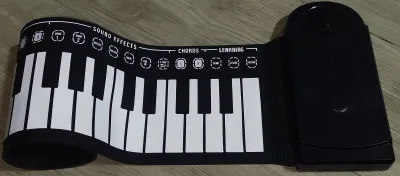
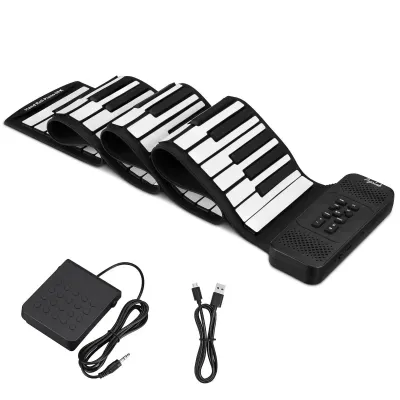
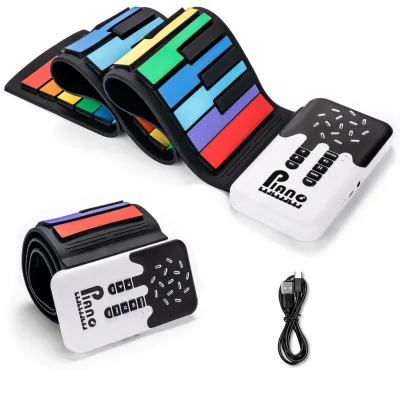


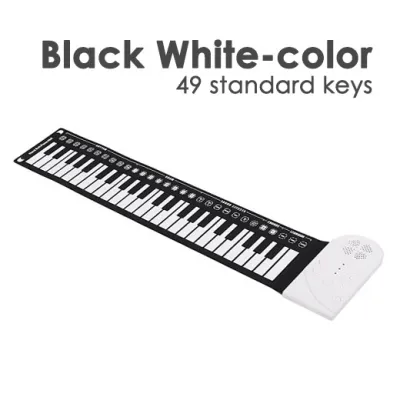

Prices are valid at publication and may change. Please refer to the product page for the latest price.
Another major playability hurdle is physical instability. Because the silicone mat is flexible, it must be placed on a completely flat, rigid surface like a dining table or a desk. Even on a flat surface, the lightweight material is prone to shifting, sliding, or bunching up during faster passages. This instability often leads to double-triggering—where a single press registers as multiple notes—or missed notes entirely, which can frustrate a beginner trying to establish a steady rhythm.
How Roll-Up Keyboards Impact Beginner Technique and Posture
Learning piano is as much about muscle memory and physical posture as it is about reading sheet music. When you practice on a standard keyboard, you are taught to maintain an arched hand shape, as if you are gently holding a small ball. This posture allows your fingers to strike the keys with maximum control, leverage, and joint safety. Because a roll-up piano has flat keys with no physical depth, maintaining this arched hand shape is nearly impossible. Beginners almost always resort to flattening their fingers to ensure the flat sensor pads register the touch, which can lead to weak finger joints and poor hand posture that is difficult to correct later.

Additionally, the flat sensor design alters how you strike the keys. On a real piano, you press down into the keybed. On a roll-up mat, because there is no downward travel, players often develop a “tapping” or “slapping” motion to guarantee the sensor registers the contact. This striking technique can cause tension in the wrists and forearms, potentially leading to fatigue or discomfort during longer practice sessions.
Coordination and pedaling present further challenges. Standard piano pieces quickly introduce two-handed coordination and the use of a sustain pedal to blend notes smoothly. Most roll-up pianos feature simplified control boards that struggle with complex polyphony—the ability to play multiple notes simultaneously without dropping any. If you attempt to play a dense chord while holding down a melody note, some notes may fail to sound. Furthermore, the lack of a stable, integrated sustain pedal system makes it difficult to practice proper pedaling coordination, which is essential for intermediate repertoire.
Signs a Roll-Up Piano Fits Your Current Learning Goals
Despite these limitations, a roll-up piano is not without its merits. It can be a highly effective tool if you align its use with specific, realistic learning goals. For instance, if you are introducing young children to the concept of a keyboard layout, a roll-up piano is a fantastic, low-risk toy. It allows them to explore basic note recognition, understand high and low pitches, and engage in simple ear training exercises without the financial commitment of a full-sized instrument.
It is also an invaluable companion for frequent travelers or those living in highly compact spaces, such as studio apartments or shared rooms in Singapore, where a traditional digital piano simply cannot fit. If you are a vocalist who needs a portable tool to find starting pitches, or a music theory student who wants to visualize chord structures while studying on the go, the roll-up format is incredibly convenient.
Ultimately, you can view a roll-up piano as a low-risk trial. If you are entirely unsure whether you or your child will stick with the piano, spending a small amount on a roll-up keyboard allows you to test the waters of musical interest. Once a consistent practice habit is established, you can confidently transition to a more robust instrument.
When to Upgrade: Signals You Have Outgrown the Roll-Up Format
As you progress through beginner method books, you will eventually reach a point where the roll-up piano actively holds back your development. One of the clearest signs that it is time to upgrade is the inability to execute expressive dynamics. If your lesson books instruct you to play a passage softly and transition to loudly, and your instrument cannot replicate these volume changes, you have outgrown its capabilities.
Physical discomfort is another critical signal. If you find your fingers, wrists, or forearms aching after a practice session, it is likely due to the tension caused by tapping on a flat, unyielding surface. Similarly, if you experience intense frustration because the keys are double-triggering or failing to register during faster scales and chord transitions, your finger speed has surpassed the tracking capability of the silicone sensors.
Finally, as your repertoire expands beyond simple five-finger patterns, you will require a wider key range and proper pedal integration. Standard beginner pieces soon require a sustain pedal to connect notes smoothly, and classical compositions will quickly exceed the limited octave ranges of smaller roll-up models. Moving to a standard 88-key weighted keyboard will unlock the full spectrum of piano literature.
Practical Alternatives for Small Spaces and Tight Budgets
If you have determined that a roll-up piano will not meet your long-term learning needs, but you are still constrained by space or budget, several practical alternatives exist. For those with limited space, entry-level portable keyboards with 61 or 73 semi-weighted or synth-action keys offer a much better compromise. While they do not fully replicate the weight of an acoustic piano, they feature physical keys that travel downward, allowing you to practice proper hand arching and finger pressing.
If you live in a compact apartment in Singapore and want the best possible training for your fingers, look for slim, compact digital pianos. Many manufacturers design space-saving console models with fully weighted, hammer-action keys that take up minimal floor space while delivering an authentic playing experience.
Before making a purchase, always verify the manufacturer specifications. Look closely at the key action type—aiming for “weighted” or “graded hammer action” rather than “unweighted.” Additionally, check the polyphony limit; a minimum of 64-note polyphony is recommended to ensure that notes do not cut off abruptly when playing chords with the sustain pedal.
Frequently Asked Questions (FAQ)
Can I use a standard sustain pedal with a roll-up piano?
Whether you can use a standard sustain pedal depends entirely on the specific model of your roll-up piano. Many basic roll-up keyboards do not support external pedals at all, relying instead on a built-in sustain button on the control panel. For models that do support a pedal, they often use a non-standard 3.5mm jack rather than the industry-standard 6.35mm (1/4-inch) jack found on traditional sustain pedals. Before purchasing an external pedal, check the manufacturer’s specifications to verify the input jack size and polarity compatibility, as using an incompatible pedal may result in reversed operation or no response at all.
How should I clean and store a silicone roll-up keyboard to prevent damage?
To keep your roll-up piano functioning properly, gentle maintenance is essential. To clean the silicone keys, wipe them down with a slightly damp microfiber cloth. Avoid using harsh chemical cleaners, alcohol, or excessive water, as moisture can seep into the control box and damage the internal circuitry, while chemicals can degrade the silicone material over time. When storing the keyboard, never fold or crease the mat. Folding can pinch and permanently break the delicate copper wiring and sensor traces running inside the silicone. Instead, roll the keyboard loosely, starting from the end opposite the control panel, and store it in its original box or a protective sleeve away from direct sunlight and extreme heat.

Community discussion
Share your experience or ask a question. Comments are reviewed before publication.