
When embarking on your musical journey, choosing your first instrument is a critical decision. The roland fp10 is frequently recommended as an entry-level digital piano, but determining whether it truly suits a complete beginner requires looking closely at how its features align with your learning needs. A beginner’s instrument should lay a solid foundation for proper habits, muscle memory, and musical expression.
To build proper technique, a beginner requires a keyboard with fully weighted, hammer-action keys and touch sensitivity. Without weighted keys, your fingers will not develop the strength or dexterity needed to play an acoustic piano. Touch sensitivity is equally vital because it ensures that the volume and tone of each note respond dynamically to how hard or soft you strike the key, teaching you how to control your musical expression from day one.
An authentic acoustic piano sound engine is another non-negotiable element. When you practice, your ears learn to associate specific physical movements with tonal colors and resonance. If a digital piano sounds artificial or repetitive, it can hinder your ability to develop a refined ear for dynamics and classical tone.
Products mentioned in this guide
![Roland FP10 Portable Digital Piano Keyboard 88 Keys PHA-4 FP-10 Wooden Stand Sustain Pedal FP 10 The Music Works [LIMITED STOCK]](https://img.lazcdn.com/g/p/0df154e46f8f59780663ee1b7ed17e13.jpg_400x400q80.jpg_.webp)
![Roland FP10 Digital Piano Portable Electronic 88 Keys PHA-4 Standard Keyboard SuperNATURAL Engine The Music Works FP-10 [LIMITED STOCK]](https://img.lazcdn.com/g/p/43dab64b8442873baf090a7394869fcc.jpg_400x400q80.jpg_.webp)
![Roland FP10 FP30X Portable Digital Piano 88 Keys Weighted Keyboard FP-10 FP-30X FP 10 30 [LIMITED STOCK]](https://img.lazcdn.com/g/p/42b9e7a7f49d113c2a0dc023dc6d5a14.jpg_400x400q80.jpg_.webp)
Prices are valid at publication and may change. Please refer to the product page for the latest price.
For many beginners, a simple, distraction-free interface is far more beneficial than an overwhelming array of buttons, flashing lights, and sound effects. When you are trying to read sheet music and coordinate both hands, you do not want to be distracted by complex menus or accidental rhythm changes. A clean, minimalist design keeps your focus entirely on your playing.
Finally, practical living conditions must be considered, especially in high-density urban environments like Singapore. In typical HDB flats or condominiums, space is highly optimized, and sound travels easily through shared walls. A beginner’s digital piano should have a compact physical footprint and offer high-quality headphone outputs to allow for silent practice at any hour without disrupting family members or neighbors.
How the Roland FP-10 Supports Core Piano Technique
The core strength of the roland fp10 lies in its ability to replicate the tactile experience of an acoustic piano, a feature that is paramount for any beginner. At the heart of this instrument is the PHA-4 Standard keyboard action. Unlike budget keyboards that use springs to return keys to their resting position, this hammer-action system uses physical counterweights to simulate the resistance of real wooden piano keys.
The PHA-4 action also incorporates an escapement mechanism, which mimics the subtle “let-off” or click felt when you gently press an acoustic piano key halfway down. This level of mechanical detail is rare in entry-level instruments and helps students transition seamlessly to acoustic grand pianos during lessons or examinations. Additionally, the keys are finished with a textured, moisture-absorbing material that replicates the feel of real ivory, preventing your fingers from slipping during longer practice sessions.
Complementing this physical action is Roland’s proprietary SuperNATURAL Piano sound engine. Instead of simply playing back flat, static recordings of notes, this technology uses advanced modeling to recreate the complex, organic behavior of an acoustic piano. As you play, the tone shifts smoothly across a wide dynamic spectrum, allowing you to practice delicate pianissimo passages and powerful fortissimos with realistic acoustic response.
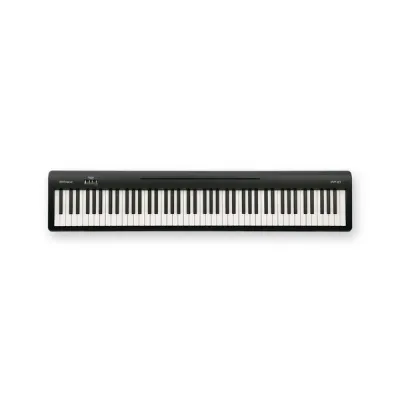
In terms of physical design, this model is exceptionally compact and lightweight. Measuring just under 128 centimeters in width and 26 centimeters in depth, it occupies a minimal footprint, making it easy to position against a bedroom wall or in a study nook. At approximately 12.3 kilograms, it is light enough to be moved easily by a single adult if you need to rearrange your living space.
For modern learners, connectivity is a major asset. The instrument features built-in Bluetooth MIDI, allowing you to connect wirelessly to mobile devices and tablets. Before purchasing, verify your mobile device’s compatibility with the app’s operating system requirements to ensure a seamless connection. By pairing the piano with Roland’s Piano Partner 2 app, you gain access to interactive sheet music, educational flashcard games to improve your sight-reading, and a convenient visual interface to adjust the piano’s internal settings without needing to memorize physical button combinations.
Feature Limitations to Consider Before You Buy
While the instrument excels in core areas, it is important to understand its built-in compromises before making a purchase. The first technical limitation to note is its 96-note polyphony. Polyphony refers to the maximum number of individual notes or voices that can sound simultaneously; while 96 notes are more than enough for beginner and intermediate classical or pop pieces, highly advanced classical repertoire involving rapid runs, heavy sustain pedal usage, and layered tones may occasionally result in older notes being cut off prematurely.

The onboard sound library is intentionally minimalist, offering only 15 distinct tones, including a few acoustic pianos, electric pianos, organs, and strings. It also lacks auto-accompaniment rhythms or arranger features. If your goal is to perform as a “one-man band” with backing tracks, or if you want to explore a vast library of synthesizer sounds, this instrument may feel overly restrictive.
The minimalist user interface can also present a learning curve. Because there is no built-in LCD screen, the top panel features only a few physical buttons. To change deep settings, select specific tones, or adjust the metronome’s time signature directly on the hardware, you must hold down the “Function” button while pressing designated keys on the keyboard itself. While this keeps the design clean, it can be frustrating to navigate without the companion app open on a nearby tablet.
Lastly, the physical connectivity options are geared strictly towards home use. The headphone output is a rear-facing 3.5mm jack, which can be slightly awkward to access if the piano is pushed flush against a wall. Furthermore, the instrument lacks dedicated left and right 1/4-inch audio line-out ports; if you plan to use this piano for live gigging, church performances, or direct analog recording into a mixing console, you will have to rely on the headphone jack, which can introduce noise and signal level challenges.
The Final Verdict: Is the FP-10 the Right Fit for Your Goals?
To decide if this digital piano is the right investment, you must weigh your specific musical goals against what the instrument is designed to deliver. If your primary objective is to learn traditional piano, prepare for graded classical examinations, and build authentic finger strength on a budget, this model is an outstanding choice. Its class-leading key action and realistic sound engine prioritize the physical fundamentals of playing over digital gimmicks, making it a highly focused learning tool.
Conversely, if you are more interested in music production, playing electronic keyboard styles with automatic backing rhythms, or having immediate, visual control over hundreds of onboard sounds, you should look elsewhere. In those scenarios, an arranger keyboard or a higher-tier stage piano with a dedicated screen and comprehensive audio routing options would better serve your creative workflow.
When you are ready to make a purchase, it is highly recommended to visit an authorized local music retailer in Singapore. Buying from an authorized dealer ensures you receive a genuine product backed by local warranty coverage, which is crucial for protecting your investment against any electronic or mechanical issues. Additionally, always verify that the included power adapter is fully compatible with Singapore’s electrical standards, which require a standard UK 3-pin plug operating at 230V and 50Hz.
If possible, take the time to test the keyboard action in person at a local showroom. Because touch sensitivity and key weight preferences are highly subjective, spending fifteen minutes sitting at the keys will give you immediate clarity on whether the physical resistance of the PHA-4 action feels comfortable to your hands before you arrange for delivery to your home.
Essential Accessories and Setup for Your First Practice Space
Creating an ergonomic and comfortable practice environment is just as important as choosing the right piano. To support the instrument properly, you will need to select a suitable stand. The dedicated Roland KSC-FP10 wooden stand is the ideal option for home setups, as it bolsters the piano securely, eliminates wobbling during energetic play, and gives the instrument a clean, integrated furniture-like appearance. If you require portability, a heavy-duty double-braced Z-stand or X-stand is a viable alternative, though these can sometimes introduce minor stability issues on carpeted floors.
The small, flat plastic footswitch included in the box is functional for absolute beginners but quickly becomes inadequate. It tends to slide around on tiled or wooden floors and only supports basic on/off switching. To develop proper pedaling habits, consider upgrading immediately to a dedicated damper pedal like the Roland DP-10, which features a slip-resistant rubber plate and supports half-pedaling techniques that allow for realistic control over note sustain.
For quiet practice, a pair of comfortable, closed-back over-ear headphones is an essential accessory. Closed-back headphones prevent sound from leaking out into your living room and block ambient household noises from distracting you. Look for a pair with a neutral sound profile to ensure that the rich dynamics of the piano’s sound engine are reproduced accurately.
Finally, do not overlook the importance of bench ergonomics. A sturdy, height-adjustable piano bench is crucial for maintaining correct posture. When seated, your forearms should be parallel to the floor, and your elbows should be slightly higher than the keys, which helps prevent wrist fatigue, tension, and repetitive strain injuries during long, productive practice sessions.
Frequently Asked Questions (FAQ)
Does the Roland FP-10 have weighted keys?
Yes, the instrument is equipped with Roland’s PHA-4 Standard keyboard, which features fully weighted, hammer-action keys. This system utilizes physical weights instead of springs to replicate the natural resistance and mechanical feel of an acoustic piano. It also includes an escapement mechanism and textured key surfaces to help beginners build proper finger strength and transition smoothly to acoustic instruments.
Can I connect the FP-10 to a computer for recording?
Yes, you can connect the instrument to a computer or mobile device using the USB Type-B port or via wireless Bluetooth MIDI. This allows the piano to act as a MIDI controller to trigger virtual instruments or record performance data within a Digital Audio Workstation (DAW). However, it does not support direct USB audio transmission; if you wish to record the piano’s internal sound engine directly, you must connect its headphone output to an external audio interface.
Is the Roland FP-10 good for small apartments?
Yes, its compact physical dimensions make it exceptionally well-suited for smaller living spaces, such as typical Singapore HDB flats or condominiums. With a depth of only 26 centimeters and a weight of 12.3 kilograms, it can easily fit into tight spaces or be stored away when not in use. Additionally, its headphone connectivity allows for completely silent practice sessions at any hour of the day or night.

Community discussion
Share your experience or ask a question. Comments are reviewed before publication.