
Choosing your first instrument is a pivotal step in your musical journey. The Yamaha CK61 is a compelling option if your goal is to play modern music, learn sound design, and perform in a band. It is a highly versatile, lightweight stage keyboard that offers a vast library of sounds and intuitive physical controls. However, whether it is the right choice for you depends entirely on your specific learning goals, budget, and the type of music you want to play.
For beginners focused on classical piano, the Yamaha CK61 may not be the ideal starting point due to its unweighted key action and 61-key limit. Conversely, for those interested in pop, electronic music, band performance, or music production, this instrument provides an engaging, hands-on platform. Understanding the core differences between a digital piano and a stage keyboard will help you determine if this model aligns with your musical aspirations.
Define Your Musical Goal: Acoustic Piano vs. Electronic Keyboard
Before evaluating any specific instrument, you must clarify what “learning to play” means to you. The musical keyboard family is broad, and choosing the wrong category of instrument can hinder your progress or lead to frustration.
Products mentioned in this guide
![Yamaha CK61 CK88 Portable Stage Keyboard Piano 61 88 Keys Synthesizer with Speaker [LIMITED STOCK]](https://img.lazcdn.com/g/p/7ff12ed20536890d809aba02c11ffcc7.jpg_400x400q80.jpg_.webp)
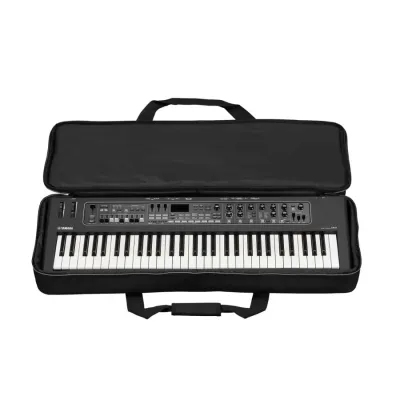
Prices are valid at publication and may change. Please refer to the product page for the latest price.
If your primary goal is to play classical music, pass formal graded piano examinations (such as the ABRSM syllabus widely followed in Singapore), or play traditional jazz, you require an instrument that replicates an acoustic piano. This means you need a full 88-key keyboard with weighted hammer-action keys. Weighted keys simulate the mechanical resistance of a real piano’s hammers, which is essential for developing the finger strength, hand posture, and dynamic control needed to play expressive classical pieces.
On the other hand, if your interests lie in pop, rock, contemporary worship music, synthesizer sounds, or songwriting, an electronic keyboard or stage keyboard is often a better fit. These instruments prioritize portability, sound variety, and real-time control over acoustic realism. They typically feature 61 or 73 keys, which are unweighted or semi-weighted. This design allows you to navigate diverse instrument voices—such as organs, brass, strings, and synthesizers—with ease.
Identifying your preferred genre and learning style dictates your hardware requirements. If you want to perform as a solo pianist, prioritize key action and acoustic piano sound quality. If you want to play in a band, layer multiple sounds, or experiment with effects, prioritize physical controls, connectivity, and portability.
Evaluating the Yamaha CK61 for Beginner Needs
The Yamaha CK61 is designed as a portable stage keyboard, bridging the gap between a digital piano, an organ, and a synthesizer. It is engineered for musicians who need quick access to high-quality sounds and immediate control over their mix. For a beginner, this layout offers an incredibly interactive experience, though it introduces specific trade-offs compared to traditional home digital pianos.

One of the main advantages of the CK61 is its lightweight, compact design. Weighing just 5.6 kilograms, it is highly portable and runs on either an AC adapter or eight AA batteries. This makes it an attractive option for Singaporean homes where space is at a premium, as it can be easily stored away in a closet or under a bed when not in use. However, the trade-off for this ultra-portable design is the absence of a heavy, wooden cabinet and a fully weighted keybed.
Before purchasing, you should verify the technical specifications to ensure they match your home setup. The CK61 features 128-note polyphony, which is ample for preventing dropped notes when layering sounds or using sustain. It also includes built-in 6-watt speakers, allowing you to practice without external amplification. For detailed compatibility with external hardware, always consult the manufacturer’s official documentation regarding supported USB drivers and MIDI configurations.
Key Action and Playability
The Yamaha CK61 utilizes Yamaha’s FSB (Future System Basic) keyboard action, which consists of 61 semi-weighted, synth-action keys. Unlike the weighted keys found on digital pianos, these keys offer light resistance with a springy feel. They are designed to accommodate a wide variety of sounds, making it easier to play fast synthesizer leads, rhythmic organ glissandos, and quick brass stabs.
For a beginner, learning on synth-action keys has both benefits and drawbacks. On the positive side, the lighter action is easier on untrained fingers, reducing initial hand fatigue and making early practice sessions more comfortable. On the negative side, it does not build the finger strength and forearm control required for acoustic pianos. If you eventually transition to an acoustic piano, you will experience a significant adjustment period as you adapt to the heavier key resistance.
If your goal is to build proper classical piano technique, starting on a semi-weighted keyboard can lead to poor habits, such as playing with flat fingers or struggling to control dynamics. However, if your focus is modern keyboard playing, the FSB action is highly responsive and comfortable for hours of practice.
Sounds, Rhythms, and Learning Tools
Unlike traditional entry-level “arranger” keyboards that feature built-in auto-accompaniment rhythms and interactive lesson modes, the Yamaha CK61 is a performance-focused instrument. It does not contain pre-programmed backing styles or chord dictionaries. Instead, it relies on a massive library of high-quality sounds derived from Yamaha’s premium stage pianos and synthesizers, organized into three independently controllable zones.
For beginners, this hands-on interface can be highly motivating. The top panel is covered with physical sliders, buttons, and knobs that let you adjust volume levels, change effects, and tweak filter sweeps in real time. This encourages active experimentation with sound design, a crucial skill for modern keyboardists. Rather than just playing notes, you learn how to shape the texture of your music.
To practice with backing tracks or follow online tutorials, you can utilize the CK61’s built-in Bluetooth audio receiver. This allows you to stream audio from your smartphone or tablet directly through the keyboard’s speakers or connected headphones, letting you play along with your favorite songs. For silent practice, the keyboard features standard headphone outputs, ensuring you can practice at any hour without disturbing your household.
Self-Check: Should You Choose the CK61 or Look Elsewhere?
To determine if the Yamaha CK61 is the right investment for your musical journey, evaluate your personal circumstances against this diagnostic checklist.
- Choose the CK61 if:
- Your space is limited: You live in a compact apartment or need an instrument that can be easily moved, packed away, or transported to rehearsals.
- Your musical focus is modern: You want to play pop, rock, electronic, or contemporary worship music, and you value having instant access to organs, vintage electric pianos, and synthesizers.
- You enjoy sound customization: You want to learn how to layer sounds (such as combining a grand piano with a warm string pad) and adjust effects like delay and reverb using physical knobs.
- You want a built-in audio interface: You plan to connect your keyboard to a computer or mobile device to record high-quality audio directly without needing an external audio interface.
- Look for alternatives if:
- You are studying classical piano: You plan to take formal piano exams or want to develop authentic acoustic piano technique, which requires 88 weighted keys.
- You want built-in guided lessons: You prefer a keyboard that has interactive learning software, light-up keys, or built-in chord guides to teach you how to play.
- You are on a tight budget: The CK61 sits in a mid-tier price band (typically around S$1,100 to S$1,300 in Singapore). If you are unsure of your long-term commitment, a more basic, budget-friendly starter keyboard may be a safer initial step.
Before making your final decision, visit an authorized local music retailer in Singapore to physically test the instrument. Feeling the physical resistance of the FSB keys and hearing the sound engine through quality headphones is the most reliable way to ensure the instrument inspires you to practice. When purchasing, verify what accessories are included in the box. The CK61 typically includes an AC adapter, but essential items like a keyboard stand, a comfortable bench, and a sustain pedal must often be purchased separately.
Alternative Paths for Different Beginner Profiles
If you realize the Yamaha CK61 does not perfectly match your goals, several alternative categories of instruments may serve you better.
For those committed to classical piano or formal lessons, an 88-key digital piano with weighted hammer action is the correct path. Models in Yamaha’s P-series, such as the P-145 or P-225, offer graded hammer action keys that mimic the heavier feel of low notes and lighter feel of high notes on an acoustic grand piano. These models focus heavily on acoustic piano realism and are designed to build proper finger technique from day one.
If your primary interest is electronic music production, beat-making, or composing within a Digital Audio Workstation (DAW) on your computer, a dedicated MIDI controller keyboard is a highly efficient alternative. MIDI controllers do not produce sound on their own; instead, they send data to your computer to trigger software instruments. This path is often much more cost-effective and integrates seamlessly into a home studio setup.
When comparing different paths, always calculate the total setup cost rather than just the price of the keyboard. A complete setup requires a sturdy, double-braced X-stand or Z-stand to prevent wobbling, an adjustable bench to maintain proper playing posture, a high-quality sustain pedal for expressive playing, and a reliable pair of closed-back headphones for focused practice sessions.
Frequently Asked Questions (FAQ)
Can I learn classical piano on a 61-key keyboard?
You can learn basic music theory, note reading, and simple melodies on a 61-key keyboard, but you cannot properly learn classical piano. Classical music frequently utilizes notes outside the five-octave range of a 61-key instrument. Furthermore, the lack of weighted keys prevents you from developing the finger strength and delicate dynamic control required to perform classical repertoire expressively.
Do I need a sustain pedal for the Yamaha CK61?
Yes, a sustain pedal is highly recommended for the Yamaha CK61, especially when playing acoustic and electric piano sounds. A sustain pedal allows notes to ring out after you release the keys, creating smooth transitions between chords and adding depth to your playing. You should verify whether a sustain pedal is included in your retail bundle, as you may need to purchase a compatible pedal, such as the Yamaha FC4A or FC5, separately.
Is the Yamaha CK61 good for music production?
The Yamaha CK61 is an excellent tool for music production because it features a built-in USB audio and MIDI interface. This allows you to connect the keyboard directly to your computer or iOS device with a single USB cable to record both MIDI data and high-quality audio into your recording software. However, if you only plan to control software instruments and do not need the CK61’s internal sounds or physical controls, a dedicated MIDI controller may be a more practical and budget-friendly choice.

Community discussion
Share your experience or ask a question. Comments are reviewed before publication.