
The Yamaha PSR-E373 is a highly popular entry-level instrument, but whether it is the right choice for you depends on your specific musical goals, space constraints, and budget. It offers a solid balance of touch-sensitive keys, diverse sounds, and educational tools, making it an excellent starting point for casual players, songwriters, and those exploring modern music. However, if your ultimate goal is classical piano mastery, you may need to evaluate its physical limitations compared to a fully weighted digital piano.
Assess Your Learning Goals and Musical Direction
Before choosing any instrument, clarify what you want to achieve. If your dream is to play classical repertoire or transition quickly to an acoustic piano, your needs will differ significantly from someone who wants to play pop songs, compose music, or enjoy casual home entertainment.
The Yamaha PSR-E373 is an arranger keyboard, meaning it is designed with a vast library of instrument voices and auto-accompaniment styles. This makes it highly suitable for players interested in modern genres, songwriting, and understanding how different instruments interact in a band setting. You can play a melody with your right hand while the keyboard automatically generates a full backing band based on the chords you play with your left hand.
Products mentioned in this guide
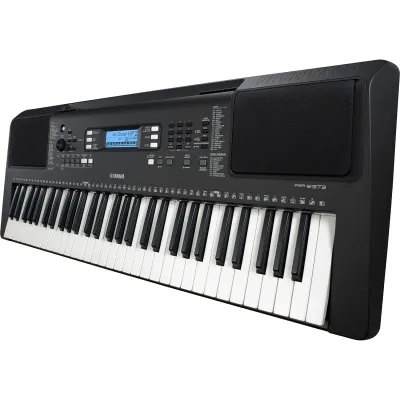
Prices are valid at publication and may change. Please refer to the product page for the latest price.
However, if your primary focus is strictly traditional piano technique, the extensive buttons, backing tracks, and synthesizer sounds might serve as a distraction rather than an aid. Determining your musical direction early helps ensure you do not pay for features you will rarely use, or conversely, miss out on tools that keep you motivated.
Evaluating the Key Action and Playability
The physical feel of the keys is one of the most critical factors in a beginner’s development. The PSR-E373 features 61 keys, which is the standard size for portable keyboards. You should verify that this range is sufficient for your initial practice pieces, as it allows you to learn basic two-handed coordination and play most introductory repertoire without running out of notes.

Crucially, this model includes touch-sensitive (velocity-sensitive) keys. This means the volume of the sound changes based on how hard or soft you strike the keys, which is essential for developing expressive playing and dynamic control. Avoid keyboards without touch sensitivity, as they can foster poor playing habits that are difficult to correct later.
Keep in mind that these are synth-action keys, which are lightweight and springy rather than weighted. They do not mimic the heavy resistance of an acoustic piano’s wooden keys. While synth-action is excellent for younger players or those with limited finger strength, adult learners aiming for classical piano exams will eventually need to transition to a fully weighted hammer-action keyboard to build proper finger strength and technique.
Reviewing Built-in Learning Tools and Connectivity
Self-study requires structured guidance, and the onboard tools can serve as a helpful supplement to formal lessons. You should check the keyboard’s built-in lesson suite, which typically offers step-by-step phrase training to help you learn songs at your own pace. These functions allow you to practice one hand at a time before combining them.
Rhythm and timing are foundational to music, making the built-in metronome and recording capabilities highly valuable. Recording your practice sessions allows you to listen back critically and identify areas where your timing or phrasing needs adjustment. Additionally, practicing alongside the built-in backing tracks helps build confidence in keeping time with an ensemble.
For modern learners, connectivity is vital. You should verify the rear panel ports to ensure compatibility with your external devices. The presence of a USB-to-Host port allows you to connect the keyboard to a computer, tablet, or smartphone. This connection enables you to use interactive learning applications, interactive sheet music, and basic music production software to expand your educational resources.
Space, Budget, and Setup Considerations
Bringing a keyboard into your home requires careful planning of your physical environment. Because space in modern apartments can be limited, you should measure your available desk or floor space before purchasing. A 61-key keyboard is relatively compact, but it still requires a stable surface or a dedicated stand to ensure a safe and ergonomic playing height.
When budgeting, do not look only at the keyboard itself. You must check the product packaging details to identify exactly what is included in the box. Many packages do not include essential accessories such as a keyboard stand, a comfortable bench, headphones for silent practice, or a sustain pedal. Factor these additional items into your total starting budget.
To protect your investment, check the current pricing in S$ and verify the warranty terms offered by authorized local retailers. Purchasing from an authorized dealer ensures you receive genuine local warranty coverage and access to reliable customer support, which is far safer than relying on parallel imports or unverified online marketplace listings that may leave you without recourse if a defect arises.
When to Consider Alternative Keyboards
While the PSR-E373 is highly versatile, certain goals make other instruments a better fit. If your primary ambition is to progress through classical piano grades or achieve the most authentic acoustic piano experience, you should look past 61-key models and invest in an 88-key digital piano with fully weighted, graded hammer-action keys.
If your interest lies primarily in electronic music production, sound design, or mixing beats on a computer, a dedicated MIDI controller keyboard or an entry-level synthesizer might serve you better. These devices prioritize integration with digital audio workstations and offer knobs, sliders, and pads for real-time sound manipulation rather than built-in speakers and traditional lesson suites.
Finally, if you are already familiar with basic keyboard layouts and require advanced accompaniment styles, deeper sound editing, or professional audio outputs for live performances, you may want to explore higher-tier arranger keyboards. These advanced models offer greater processing power and customization options that can grow with your performing needs.
Frequently Asked Questions (FAQ)
Do I need to buy a separate sustain pedal?
You should check the manufacturer’s box contents, as a basic plastic footswitch is sometimes included in bundle deals but is rarely standard in the standalone box. A basic footswitch operates as a simple on/off switch, which is sufficient for absolute beginners learning to hold notes. However, as your repertoire advances, you will want to upgrade to a dedicated, heavy-duty sustain pedal that mimics the physical resistance of an acoustic piano pedal and supports more nuanced expression.
Can I connect the keyboard to a computer for music software?
Yes, you can connect the keyboard to a computer using the USB-to-Host port located on the rear panel. You should check the manufacturer’s website to verify if your operating system requires specific driver installations or if the device is class-compliant for plug-and-play functionality. Keep in mind that while this port transmits MIDI data to control software instruments, you should verify whether the specific model supports two-way USB audio transfer or if you will need a separate audio interface to record the keyboard’s internal sounds directly into your computer.
Is a 61-key keyboard enough to learn piano?
For a complete beginner, a 61-key keyboard is entirely sufficient to learn the fundamentals of music theory, hand positioning, and basic two-handed coordination. This range comfortably covers the vast majority of beginner and early-intermediate pieces. You will only find the range limiting when you begin playing advanced classical music or complex jazz arrangements that utilize the extreme high and low registers. If a piece occasionally exceeds your physical keys, you can use the keyboard’s octave-shift function to temporarily transpose the pitch, allowing you to practice the notes within the available physical space.

Community discussion
Share your experience or ask a question. Comments are reviewed before publication.