
Choosing between the kalimba and the piano as a complete beginner depends entirely on your personal musical goals, available living space, and budget. While one instrument offers an almost immediate sense of accomplishment with minimal financial investment, the other provides a foundational gateway to classical music theory and limitless expressive range. By evaluating how each instrument fits into your daily routine, you can select the path that keeps you motivated to practice and play.
Learning Curve and Musical Outcomes
The initial learning curve of the thumb piano kalimba is remarkably gentle, making it highly accessible for absolute beginners. Most standard kalimbas are tuned to a diatonic scale, typically in C major, which means there are no discordant notes that sound inherently out of place when played together. This intuitive layout allows beginners to play simple melodies and basic chords almost immediately, often using simplified tab notation rather than standard sheet music. You do not need to master complex hand independence or read treble and bass clefs simultaneously to produce a pleasing sound.
In contrast, the piano presents a steeper initial hurdle that requires coordinated physical and mental effort. Learning the piano demands that you develop independent movement in both hands, read two clefs at once, and understand how to translate visual notes on a page into precise finger placements across a wide keyboard. While this makes the first few weeks or months more challenging, it builds a robust foundation of motor skills and cognitive coordination that serves as the bedrock of formal music education.
Products mentioned in this guide







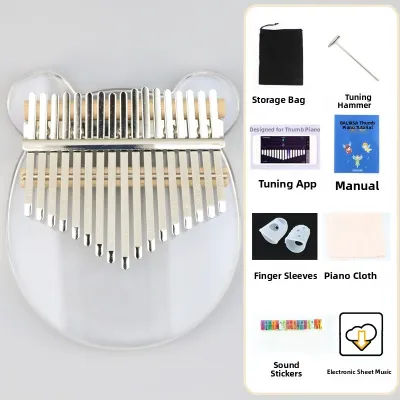
Prices are valid at publication and may change. Please refer to the product page for the latest price.
The musical range of these two instruments highlights their primary differences in versatility. A standard thumb piano kalimba usually features 17 tines, limiting your play to a single key unless you manually retune the tines or purchase a specialized chromatic model. This restricted range means you cannot easily play complex accidentals, sharp key transitions, or highly intricate polyphonic arrangements. The piano, with its standard 88 keys, offers a vast seven-octave range that accommodates everything from deep bass lines to sparkling high melodies, allowing for unlimited polyphony and complex harmonic structures.
For long-term musical development, the piano remains the ultimate vehicle for learning comprehensive music theory. The linear layout of the piano keyboard makes intervals, chords, and scale structures visually clear, which simplifies the comprehension of advanced musical concepts. Skills learned on the piano transfer seamlessly to almost any other instrument, including synthesizers, organs, and digital audio workstations. While the kalimba teaches basic rhythm and simple melodic construction, its unique alternating tine layout does not translate directly to other instruments, making it more of a self-contained hobby than a stepping stone to broader instrumental mastery.
Budget, Space, and Equipment Needs
Financial commitment is often the deciding factor for many beginners, and here the two instruments sit at opposite ends of the spectrum. An entry-level thumb piano kalimba is highly affordable, typically costing in the range of S$20 to S$60 for a solid wood or acrylic model that sounds excellent. This low barrier to entry makes it an ideal low-risk choice for anyone who wants to test their interest in making music without committing a significant portion of their savings.

A piano, even a digital alternative, requires a much larger financial investment. A basic, beginner-friendly digital piano with weighted keys generally starts in the mid-to-high triple digits, often ranging from S$500 to S$1,500, while acoustic upright pianos easily run into the thousands of dollars. For those living in compact apartments or HDB flats, the physical footprint of these instruments is a crucial consideration. A kalimba can be stored easily in a small drawer or on a bedside table, requiring absolutely no dedicated floor space.
Setting up a piano in a typical home requires careful spatial planning. An 88-key digital or acoustic piano occupies a significant portion of a room and requires a dedicated, stable stand and an adjustable bench to maintain proper playing posture. Additionally, acoustic pianos are highly sensitive to humid tropical climates, requiring regular professional tuning services and the continuous use of a heater rod or dehumidifier to prevent the wood and felt from warping.
The accessory requirements for a kalimba are minimal and usually included in the initial purchase. Most beginner packages come with a small tuning hammer, a protective carrying case, and key stickers to help you identify notes. There are no ongoing maintenance costs other than occasional tuning, which you can easily perform yourself using a free smartphone application. Pianos, on the other hand, may require additional purchases such as sustain pedals, music stands, metronomes, and high-quality headphones for silent practice.
Portability and Daily Practice Lifestyle
The lifestyle alignment of each instrument determines how easily you can integrate practice into your daily routine. The thumb piano kalimba is the epitome of portability, weighing less than a kilogram and fitting easily into a backpack or handbag. This allows you to practice during a daily commute, bring the instrument to a park, or play while traveling without any logistical hassle. It is an instrument designed to accompany you anywhere, turning idle moments into opportunities for creative expression.
A piano is entirely stationary, anchoring your practice to a single room in your home. This lack of mobility requires you to establish a dedicated practice space and set aside specific times of the day to sit down at the instrument. While this structure can help build a disciplined practice routine, it lacks the spontaneous, casual nature of the kalimba.
Sound management is another critical factor, particularly in high-density residential areas where thin walls can lead to noise concerns. The acoustic volume of a kalimba is naturally soft and delicate, producing a gentle, music-box-like tone that is unlikely to disturb anyone in the next room. This makes it perfect for late-night practice sessions. Digital pianos offer excellent volume control and headphone jacks, allowing for completely silent practice at any hour, but acoustic pianos offer no such luxury and require strict adherence to neighbor-friendly hours to avoid noise complaints.
Physical ergonomics also differ significantly between the two. Playing the kalimba relies heavily on the repetitive movement of your thumbs, which can cause mild fatigue or strain if practiced for hours without breaks. It also requires you to maintain a fingernail length that can cleanly pluck the metal tines. Piano practice engages the entire body, requiring proper spinal alignment, relaxed wrists, and coordinated arm movements, which can be physically demanding but ultimately promotes better long-term ergonomic habits for instrumentalists.
Decision Framework: Choosing Your First Instrument
To make the right choice, evaluate your personal circumstances against the unique characteristics of each instrument.
Choose the kalimba if:
- Your budget is modest, and you want to start playing immediately without a major financial commitment.
- You live in a compact apartment where floor space is highly limited.
- You want a highly portable instrument that you can play on the go, during travels, or in casual outdoor settings.
- Your primary goal is to play simple, relaxing melodies for personal enjoyment and stress relief without diving deep into complex music theory.
Choose the piano if:
- You are committed to learning comprehensive music theory, reading standard sheet music, and developing two-hand coordination.
- You have the physical space to accommodate a large keyboard instrument and a dedicated practice area.
- You want to explore a vast repertoire of musical genres, from classical masterpieces to modern jazz and pop arrangements.
- You view this purchase as a long-term investment in a foundational musical skill that can transition to other keyboard instruments.
Verify first if:
- Before making a final purchase, check the return and warranty policies of local music retailers to protect your investment.
- Visit a physical music store to test the tactile feel of the keys on a digital piano or the stiffness of the tines on a kalimba, ensuring they are comfortable for your hands.
- Review the manufacturer's specifications regarding key weight, dimensions, and power requirements to ensure the instrument fits your home setup.
Frequently Asked Questions (FAQ)
Can I learn music theory on a kalimba before switching to piano?
Yes, you can learn basic music theory concepts on a kalimba, such as understanding major scales, intervals, and simple chord progressions. These fundamentals will give you a head start when transitioning to the piano. However, the kalimba’s alternating tine layout and limited range mean you will still need to learn standard keyboard geography, two-hand independence, and how to read the bass clef once you make the switch.
Do I need to tune a thumb piano kalimba regularly?
Yes, a thumb piano kalimba requires periodic tuning to maintain its sweet, clear sound, especially after travel or changes in humidity. Tuning is a straightforward process that involves tapping the tines up or down with a small tuning hammer while checking the pitch on a digital tuner or smartphone app. Always consult the manufacturer’s specific tuning guide to ensure you adjust the tines safely without scratching the wood or damaging the metal.

Community discussion
Share your experience or ask a question. Comments are reviewed before publication.