
Choosing your first keyboard is a pivotal step that shapes your entire musical journey. While established brands like Yamaha and Casio have long dominated the beginner market with their structured educational ecosystems, Medeli has emerged as a compelling alternative by offering feature-rich instruments at highly competitive price points. The right choice does not depend on brand prestige alone, but rather on how well a specific model aligns with your learning goals, budget constraints, and space requirements.
For beginners, navigating the technical specifications of digital keyboards can feel overwhelming. A higher price tag does not automatically guarantee a better learning experience if the instrument lacks the specific features required for your curriculum. By focusing on verifiable specifications rather than marketing claims, you can make an objective decision that provides the best long-term value for your investment.
Brand Positioning for Beginners: Medeli vs. Yamaha and Casio
To make an informed choice, it is helpful to understand how each manufacturer positions its instruments in the global and local markets. Yamaha is widely recognized for its deep heritage in acoustic piano manufacturing, which heavily influences the design of its digital instruments. Their beginner keyboards often prioritize realistic acoustic piano samples and standardized educational pathways, making them a staple in traditional music schools. If your goal is to eventually transition to a traditional acoustic piano, Yamaha’s design philosophy offers a highly consistent stepping stone.
Products mentioned in this guide
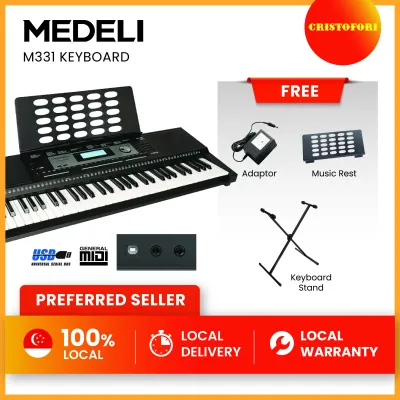
![Medeli M331 Keyboards [61 Keys] [Music Tutorial System]](https://img.lazcdn.com/g/p/ca70261348d9f2372a6d74125dbe3732.jpg_400x400q80.jpg_.webp)
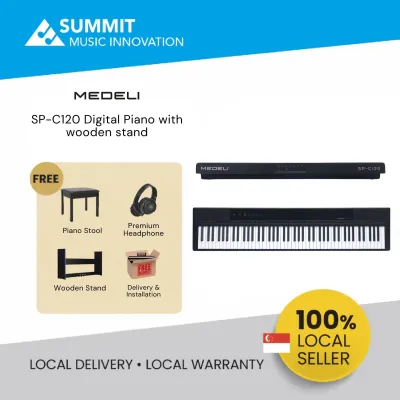
Prices are valid at publication and may change. Please refer to the product page for the latest price.
Casio, on the other hand, has built its reputation on accessibility, portability, and user-friendly digital interfaces. Their beginner-focused lines, such as the Casiotone series, are designed to be lightweight and highly intuitive, often featuring simplified control panels and built-in carrying handles. This makes Casio an excellent option for casual learners, younger students, or those living in space-constrained environments like typical high-rise apartments, where portability and easy storage are major advantages.
Medeli occupies a unique space by focusing on high feature-to-price ratios. As a major developer of digital music technology, Medeli often equips its entry-level keyboards with advanced features—such as extensive sound libraries, high polyphony counts, and versatile accompaniment styles—that are typically reserved for higher-priced models from other brands. For budget-conscious buyers who want to explore a wide variety of musical genres, experiment with music production, or access professional-grade features without a premium price tag, Medeli presents a highly competitive alternative.
Core Specifications to Evaluate for Your First Keyboard
Before comparing specific models, you must understand the core technical specifications that dictate how a keyboard plays and sounds. The first specification to verify is the key count. While a standard acoustic piano has 88 keys, beginner keyboards commonly come in 61-key or 76-key configurations. A 61-key instrument is highly portable and sufficient for learning basic music theory and simple melodies, whereas an 88-key instrument is essential if you plan to study classical repertoire or take formal graded examinations.

Another critical specification is maximum polyphony, which refers to the number of individual notes or voices the keyboard can sound simultaneously. When you play a chord while holding down a sustain pedal, the keyboard must process multiple notes at once; if the polyphony limit is too low, older notes will be cut off abruptly. For absolute beginners, a minimum of 32-note polyphony is acceptable, but 64-note or 128-note polyphony is highly recommended to ensure the instrument can handle more complex pieces as your skills progress.
Physical connectivity is equally important for modern learning. Ensure the keyboard features a USB-MIDI port, which allows you to connect the instrument to a computer, tablet, or smartphone to interact with educational software and interactive learning apps. Additionally, verify the presence of a dedicated headphone jack for silent practice, which is crucial for maintaining harmony with family members or neighbors in close living quarters.
Key Action and Touch Sensitivity
Key action refers to the physical mechanism beneath the keys, and it directly affects how the instrument responds to your touch. Touch sensitivity is a non-negotiable feature for any beginner; it ensures that the volume of the sound changes depending on how hard or soft you strike the keys. Without touch sensitivity, you cannot develop musical expression, dynamics, or the finger strength required to play with nuance.
When reviewing specifications, you will encounter three primary categories of key action: unweighted, semi-weighted, and hammer-action. Unweighted keys are light and springy, offering little resistance, which is common in entry-level 61-key models. Semi-weighted keys add a small amount of resistance using springs or weights, offering a compromise between portability and playability. Hammer-action keys use actual mechanical weights to replicate the physical resistance of an acoustic piano’s hammers, providing the most realistic playing experience for serious students.
Because touch response is highly tactile, it is always advisable to test the physical feel of the keys in a local showroom if possible. If you are purchasing online through an ecommerce platform, carefully verify the retailer’s return and exchange policies so you can exchange the instrument if the key action does not suit your physical playing style.
Sound Quality and Built-in Learning Tools
The audio experience of a keyboard is determined by its internal sound engine and built-in speakers. When comparing models, check the specification sheet for the number of built-in voices (instrument sounds) and rhythms (accompaniment styles). While having hundreds of sounds can be highly entertaining and inspire creativity, prioritize the quality of the primary grand piano voice, as this is the sound you will use most frequently during practice sessions.
Many beginner keyboards include built-in learning tools designed to assist self-directed students. These features often include step-up lesson functions that break down songs into left- and right-hand parts, visual guides on the display screen, and built-in metronomes to help you develop a steady sense of rhythm. Some models also offer basic onboard recording capabilities, allowing you to record your practice sessions and listen back to identify areas that need improvement.
Because sound quality is highly subjective and cannot be fully captured by numbers on a spec sheet, do not rely solely on written descriptions. Take the time to listen to official manufacturer demonstration videos using a high-quality pair of headphones to get an accurate representation of the instrument’s tonal character and speaker performance.
Evaluating Price and Long-Term Value
When assessing the financial aspect of your purchase, look beyond the initial price tag of the keyboard itself to evaluate the total cost of ownership. Entry-level models across Medeli, Yamaha, and Casio often compete within similar price tiers, such as under S$300 or S$500. To find the best value, compare the specific features offered within your budget, paying close attention to polyphony, key action, and connectivity options rather than assuming a higher price automatically equates to better quality.
Additionally, verify what essential accessories are included in the box. A complete setup typically requires a sturdy keyboard stand, a comfortable bench, a sustain pedal, and a compatible power adapter. Some budget-friendly models are sold as bare instruments, meaning you will need to purchase these accessories separately, which can quickly add to your overall expenses. Bundled packages often provide better value, provided the included accessories are of decent quality.
Finally, long-term value is heavily dependent on local support and reliability. Before making your final decision, verify the local warranty terms and ensure there is an authorized service center available in Singapore. Having access to official technical support and replacement parts ensures that your instrument remains a reliable learning tool for years to come, protecting your investment as you progress in your musical education.
Decision Framework: Matching the Keyboard to Your Goals
To finalize your choice, match the unique strengths of each brand to your specific beginner profile and long-term musical aspirations. If your primary goal is to follow a traditional classical piano curriculum, prepare for graded music examinations, and eventually transition to an acoustic piano, Yamaha is often the most logical choice. Their focus on realistic hammer-action keys and standardized piano tones aligns perfectly with the demands of formal music education.
If you have limited space at home, require an instrument that can be easily packed away, or want a highly portable keyboard for casual, self-paced learning, Casio is an excellent fit. Their compact designs and intuitive digital interfaces make them incredibly user-friendly for hobbyists who want to start playing immediately without navigating complex menus.
If you are working with a strict budget but want to maximize your creative options, Medeli is a highly compelling choice. By offering advanced features like higher polyphony, extensive sound libraries, and robust connectivity at a lower price point, Medeli allows budget-conscious beginners to explore music production, songwriting, and diverse genres without compromise.
Regardless of the brand you choose, always verify that the specific model you select is fully compatible with any external software, learning apps, or hardware accessories you plan to use. Checking these compatibility requirements on the manufacturer’s specification sheet before purchasing will ensure a seamless and frustrating-free start to your musical journey.
Frequently Asked Questions (FAQ)
Do I need an 88-key keyboard to start learning?
For absolute beginners, a 61-key keyboard is often entirely sufficient for the first year of learning. It provides enough range to play basic melodies, practice scales, and understand fundamental music theory concepts while remaining highly portable and affordable. However, as you progress to classical repertoire, advanced two-handed pieces, or formal graded examinations, you will eventually need to upgrade to a full 88-key keyboard to accommodate the wider range of notes required by advanced music.
Can I connect these keyboards to my tablet for learning apps?
Yes, most modern beginner keyboards from Medeli, Yamaha, and Casio can be connected to a tablet or computer, but you must verify the specific connectivity options on the model’s specification sheet. Look for a USB-MIDI port (often labeled USB to Host) or built-in Bluetooth MIDI capabilities. You will also need to check the compatibility requirements of your preferred learning app to ensure it supports the operating system of your device and the MIDI output of your chosen keyboard.
Are Medeli keyboards suitable for formal music exams?
For early-grade practical exams, the focus is primarily on basic musicality, rhythm, and finger technique, meaning the brand of the keyboard is less important than its core features. However, for higher-grade exams, exam boards typically require an instrument with 88 fully weighted, hammer-action keys and a progressive damper pedal to accurately assess your dynamics and touch control. If you plan to take formal exams, consult your music teacher to ensure your chosen keyboard meets the specific technical requirements of the exam board.

Community discussion
Share your experience or ask a question. Comments are reviewed before publication.