
Switching to low G strings as a beginner depends entirely on your musical goals and the style of music you want to play. If you are drawn to fingerstyle arrangements, classical pieces, or a warmer, guitar-like tone, a low G string is an excellent upgrade. However, if you want to learn traditional Hawaiian strumming, play campfire sing-alongs, or follow standard beginner video tutorials, sticking with the standard high G string is highly recommended.
The ukulele is famous for its bright, cheerful voice, which is largely a product of its traditional re-entrant tuning. In this setup, the strings do not progress sequentially from lowest to highest pitch. Instead, the top string (the G string closest to your face) is tuned to a high pitch, higher than the C and E strings below it. Swapping this out for a low G string changes the fundamental character of the instrument, turning it into a linear-tuned instrument. Before making this adjustment, it is helpful to understand how this change affects your learning curve, your playing experience, and your instrument itself.
High G vs. Low G: What Changes for a Beginner?
To make an informed decision, you must first understand the physical and acoustic differences between these two setups. Standard ukulele tuning is written as g-C-E-A, where the lowercase “g” represents a high pitch. When you play a standard ukulele, the pitch jumps down when you pluck the C string, then goes back up for the E and A strings. This is known as re-entrant tuning, and it gives the instrument its signature bouncy and rhythmic sound.
Products mentioned in this guide
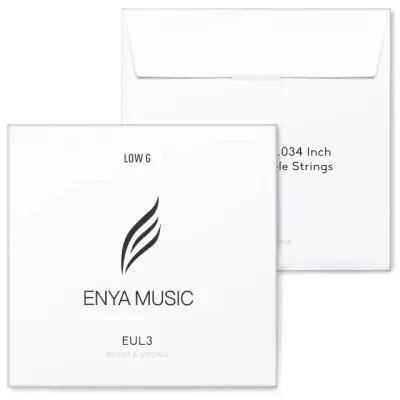


Prices are valid at publication and may change. Please refer to the product page for the latest price.
In contrast, low G tuning is written as G-C-E-A, where the uppercase “G” represents a note tuned a full octave lower. This creates a linear tuning system, meaning the pitches progress sequentially from lowest to highest as you move across the strings. Acoustically, this simple change dramatically alters the instrument’s voice. The bright, chime-like quality of the high G is replaced by a deeper, warmer, and more resonant bass tone.
For a beginner, the most reassuring fact is that your physical chord shapes and finger placements remain exactly the same. A C major chord, an F major chord, or a G7 chord are all fretted in the identical way regardless of whether you use a high G or a low G string. The physical layout of the fretboard does not change, meaning you do not have to relearn how to play the instrument. However, the sonic texture of those chords will change, as the lowest note of the chord will now be a deep G rather than a high G.
Signs You Should Switch to Low G Strings
As you progress past the very basic chords, you may find that your musical preferences lean toward styles that benefit from a wider range. One of the clearest signs that you should switch to low G strings is a strong desire to play fingerstyle arrangements or classical music. In fingerstyle playing, you pluck individual strings to play melodies and harmonies simultaneously. A low G string provides a logical, descending bass line that allows you to play lower notes that are physically impossible to reach on a standard high G ukulele.

Another sign is a preference for a fuller, warmer tone that blends smoothly with other instruments. If you plan to play your ukulele alongside acoustic guitars, keyboards, or in a casual band setting, a standard high G ukulele can sometimes sound thin or get lost in the mix. A low G string adds mid-range warmth and depth, helping the instrument sit more comfortably in an ensemble soundscape.
You might also feel frustrated by the jumping sound of the high G string when practicing scales or linear melodic runs. When playing a scale on a standard ukulele, the notes do not always flow in a straight upward or downward line because of the re-entrant tuning. If you find this counterintuitive or if you have a background in playing the guitar or piano, switching to a linear low G setup will make music theory and scale practice feel much more logical and familiar.
Finally, if you enjoy playing solo instrumental covers of popular pop, rock, or jazz songs, a low G string is incredibly useful. It allows you to replicate the bass lines of the original songs, giving your solo arrangements a more complete, self-contained, and professional sound.
Reasons to Stick with Standard High G Tuning
Despite the benefits of a low G, there are several compelling reasons why a beginner should stick with standard high G tuning, at least initially. The most practical reason is your learning material. The vast majority of beginner ukulele books, chord charts, and online video tutorials are designed specifically for standard re-entrant tuning. When an instructor plays a chord or a fingerpicking pattern in a video, it will sound exactly like your instrument if you use a high G. If you use a low G, the pitch balance will be different, which can be highly confusing for a novice trying to match their sound to the teacher’s.
Additionally, if your primary goal is to play traditional Hawaiian music, campfire songs, or simple rhythmic strumming, the high G string is the ideal choice. The classic, upbeat, and cheerful island sound of the ukulele relies heavily on the high G string. When you strum a chord with re-entrant tuning, the high notes on both ends of the strum create a unique, percussive chime that cannot be replicated with a low G string.
There is also the matter of simplicity. Standard high G strings are widely available, cheap, and easy to install. They do not require any modifications to your instrument. For a beginner who is still getting used to holding the instrument, pressing down on the frets, and keeping the strings in tune, keeping the factory-standard setup minimizes technical hurdles and lets you focus purely on building your basic playing skills.
How to Transition to Low G Strings
If you decide that a low G matches your musical goals, transitioning requires a few practical steps to ensure your instrument plays well and sounds correct. First, you must choose between wound and unwound low G strings. Wound strings feature a thin metal wire wrapped around a nylon or synthetic core. They produce a very bright, resonant, and powerful bass tone, but they can create a squeaking sound when your fingers slide along them, and they tend to wear down frets faster. Unwound strings are made of a single, thick strand of fluorocarbon or nylon. They offer a warmer, mellower tone and feel consistent with your other strings, but they can sometimes sound slightly quiet or dull on smaller soprano or concert ukuleles.
Second, you need to check the nut slots on your ukulele. The nut is the slotted piece of plastic or bone near the tuning pegs that holds the strings in place. Because a low G string is significantly thicker than a high G string, it may not fit into the existing slot. If the string sits on top of the slot rather than inside it, the action (the height of the string above the fretboard) will be too high, making it difficult to play and causing intonation issues. You may need to gently widen the slot using a small file, a task that should be done with extreme care or left to a professional at a local music shop.
Third, properly installing and stretching the new string is crucial for tuning stability. Synthetic ukulele strings are highly elastic and will stretch continuously for several days after installation. After putting the new low G string on, gently pull it away from the fretboard along its length to help stretch it out, then tune it back up to pitch. Repeat this process several times to help the string settle in quickly.
Lastly, be aware of your digital tuner settings. Some basic clip-on tuners are designed specifically for standard ukulele frequencies and may struggle to detect the lower octave of a low G string. If your tuner is confused or fails to register the note, switch it to chromatic mode (usually indicated by a “C” setting) or use a high-quality tuning app on your smartphone, which can easily pick up the lower frequency.
Frequently Asked Questions (FAQ)
Do chord shapes change when using low G strings?
No, all standard chord shapes remain completely identical. You will place your fingers on the exact same frets and strings as you would with a standard high G ukulele. The only difference is the voicing of the chord; because the G string is tuned an octave lower, the overall sound of the chord will be deeper, richer, and more resonant.
Can I use a standard high G string and just tune it down?
No, you cannot tune a standard high G string down to a low G. Standard high G strings are thin and designed to be under tension at a high pitch. If you attempt to tune one down a full octave, the string will become extremely loose, floppy, and completely unplayable. It will buzz loudly against the frets and will not hold a stable pitch. You must purchase a dedicated low G string, which is specifically manufactured with the thickness and mass required to maintain proper tension at the lower octave.
Will low G strings damage a cheap beginner ukulele?
In almost all cases, low G strings will not damage a beginner ukulele. High-quality low G strings are engineered to exert a total tension that is very similar to, or sometimes even slightly less than, standard high G strings. However, if your instrument is exceptionally cheap, poorly constructed, or already shows signs of structural damage—such as a lifting bridge, a cracked top, or a warped neck—the physical thickness of the string or any slight tension variance could exacerbate these issues. If you notice structural flaws, it is best to have the instrument inspected by a professional before making the switch.

Community discussion
Share your experience or ask a question. Comments are reviewed before publication.